Get in Touch with Tongren Tang Gulf

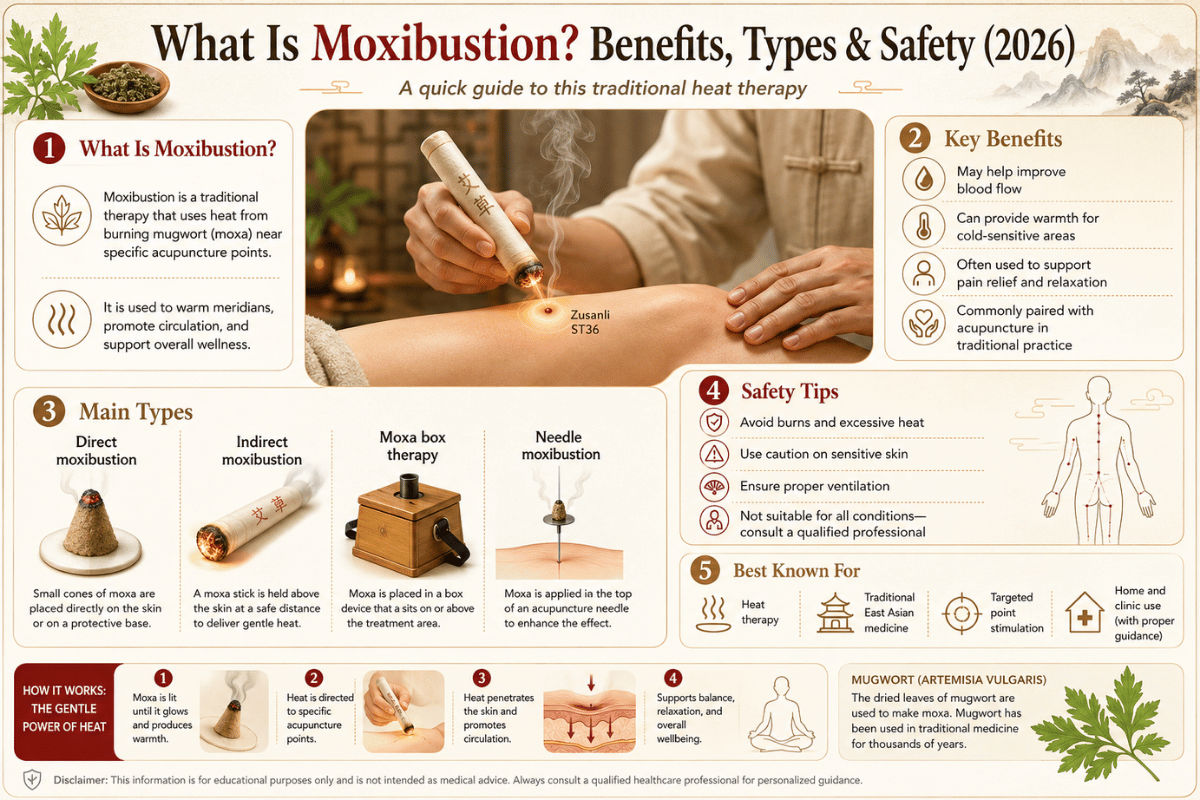
What is moxibustion? In one sentence, moxibustion is a 2,500-year-old branch of traditional chinese medicine that warms specific acupuncture points by burning dried mugwort — the dried leaves of Artemisia argyi. Practitioners use it alongside acupuncture to move qi, dispel cold, and support the body across conditions as varied as breech presentation, dysmenorrhea, and chronic pain.
At Tong Ren Tang we have practiced moxibustion since the clinic opened in 1669, and we still light a moxa stick every working day at our Dubai locations. This guide walks through what moxibustion really is, how it works, the five forms you may encounter, the conditions where the evidence is strongest, and what to expect in a session.
Quick Specs
| Origin | China, used since approximately 500 BCE |
| Material | Dried mugwort leaves (Artemisia argyi; Chinese: 艾叶 ài yè) |
| Application | Burned over or on acupuncture points to warm the body |
| Session length | 30–45 minutes total, 15–25 minutes active moxa |
| Strongest evidence | Breech presentation (Cochrane moderate-certainty) |
| Pairs with | Acupuncture, cupping, Chinese herbal medicine |
A 2,500-Year-Old Heat Therapy at a Glance
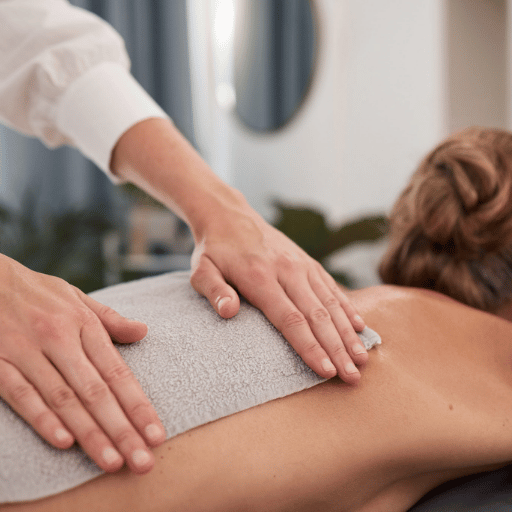
Moxibustion (Chinese: 灸 jiǔ) is a heat-based therapy from traditional chinese medicine. Your practitioner lights a stick, cone, or loose pile of dried mugwort — called moxa — and uses the slow, smoldering heat to warm specific points along the body’s meridians. Moxibustion is not incense, and it is not aromatherapy. Heat is the medicine.
Herb selection matters. Moxa is made from the aged, dried, finely-ground mugwort leaves of Artemisia argyi (or sometimes A. vulgaris), a member of the daisy family. Aged moxa burns at a lower, more even temperature than fresh material — which is why traditional clinics keep moxa for three to five years before using it for direct techniques.
The Herb Behind It All: Mugwort (Artemisia argyi)
Mugwort grows wild across Eurasia, including parts of the UAE and the wider Gulf. The plant contains essential oils — primarily 1,8-cineole and α-thujone — that give moxa its characteristic sweet, slightly bitter aroma. When the leaves burn slowly, those compounds vaporize alongside the visible smoke; modern mechanistic research points to moxa heat plus smoke pharmacology as the joint driver of the therapeutic effect of moxibustion. Mugwort is so central to the practice that the entire therapy is often simply called “moxa” in clinical shorthand.
How Does Moxibustion Work? TCM Theory Meets Modern Research
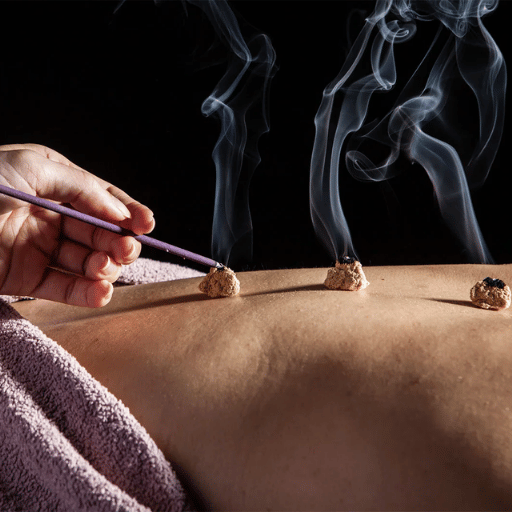
In traditional chinese medicine, health is maintained by the smooth flow of qi (the flow of energy) through 12 main meridians. When qi stagnates or yang energy becomes deficient — often expressed as cold sensation, sluggish digestion, or chronic pain — moxa is used to warm the meridian and restore the flow of qi. A classical phrase captures it: “jiǔ warms what acupuncture cannot reach.”
Modern research describes the same effect in different vocabulary. One widely-cited mechanism review in NIH PMC (Deng & Shen, 2013) identifies three layers:
- Thermal stimulation — burning moxa produces a surface temperature around 1,000 °C, with a skin-facing radiant temperature in the warm-but-tolerable band. This heat activates thermoreceptors, increases local blood flow, and relaxes superficial muscle.
- Infrared radiation — moxa heat emits visible light and a broad near-infrared spectrum that penetrates deeper than simple conduction. PMC mechanism researchers call this the “nonthermal radiation effect,” and it is one reason a moxa cone feels different from a hot pack at the same surface temperature.
- Smoke pharmacology — aromatic compounds in moxa smoke are absorbed transdermally and through inhalation; research published in PMC (2025) documents anti-inflammatory and antimicrobial activity from these compounds.
A fourth mechanism is emerging. A 2022 study cited by acupuncture researchers suggests moxibustion modulates the hypothalamic–pituitary–adrenal (HPA) axis and dampens stress responses through stimulation of specific acupoints. This bridges TCM’s “qi and blood” language with measurable neuroendocrine activity.
💡 Pro Tip — Why heat, not just any heat
Mugwort essential oils burn at a slow, sustained temperature that releases a near-infrared spectrum capable of penetrating roughly several millimetres into tissue — deeper than a hot stone or hot-water bottle. This is why a moxa stick feels qualitatively different from a heating pad, even when the surface temperatures are similar.
How is moxibustion different from acupuncture in our Dubai clinic?
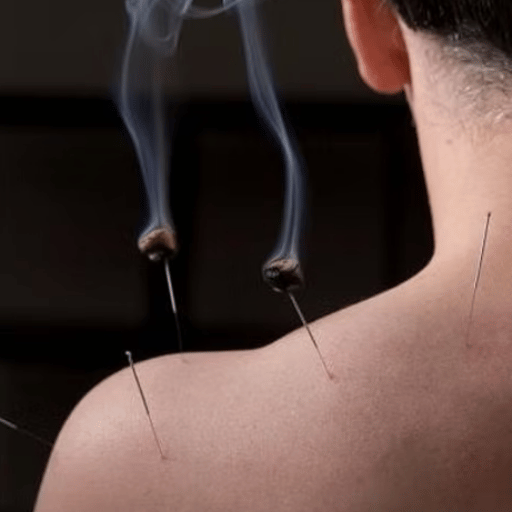
Acupuncture uses a fine acupuncture needle to stimulate a treatment point mechanically. Moxibustion uses heat from burning moxa to stimulate the same points without piercing the skin (in indirect moxibustion) or with only a small, controlled surface burn (in the rare direct moxibustion form). In practice the two are almost always used together — the classical phrase is “acupuncture and moxibustion” (针灸 zhēn jiǔ), one compound word in Chinese. A common pattern is to insert acupuncture needles first and then place a small moxa cone on the needle handle, allowing moxa heat to conduct down through the needle into the deeper acupuncture point. This combined approach is what most practitioners mean when they say “I do moxa.”
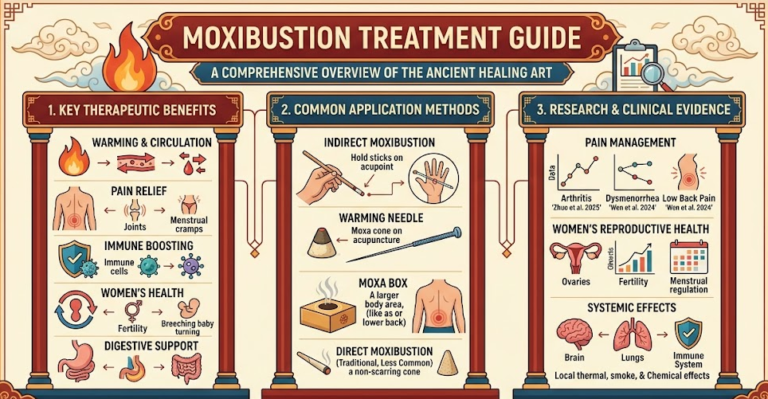
Types of Moxibustion: Direct, Indirect, Stick, Box, and Needle-Warming
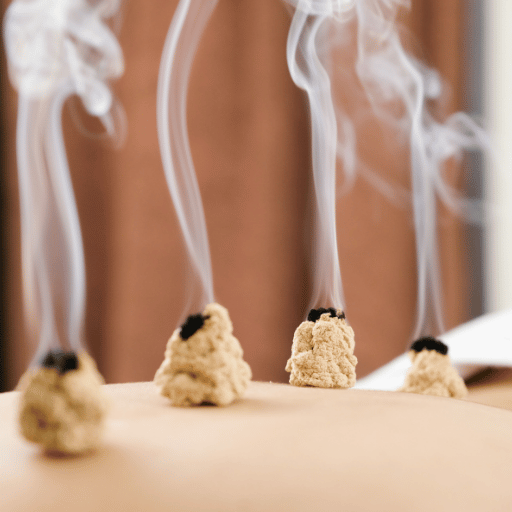
“Moxibustion” is an umbrella term that covers five techniques that look quite different on the treatment table. Variant choice depends on the condition being treated, the acupuncture point being warmed, and the patient’s tolerance for sensation and smell.
| Method | Technique | Sensation | Typical Use |
|---|---|---|---|
| Direct (non-scarring) | Small moxa cone burned on skin, removed before blister forms | Sharp warmth, brief sting | Deep cold patterns, joint pain |
| Direct (scarring) | Cone allowed to burn fully — produces a deliberate small scar | Painful; rarely used in modern Western practice | Severe chronic conditions in classical East Asian practice |
| Indirect with insulating layer | Moxa cone burned on a layer of salt or garlic or ginger over the acupuncture point | Steady, deep warmth — no contact with the skin | Most common form; warming the abdominal area (salt at CV8), digestive complaints (ginger), skin issues (garlic) |
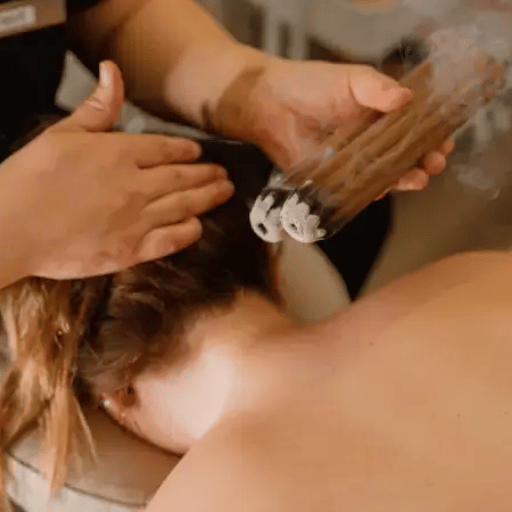
| Moxa stick (pole) | A moxa stick the diameter of a cigar is held about an inch above the point | Even radiant warmth | General wellness sessions, larger body regions |
| Needle-warming | Moxa placed on the acupuncture needle handle while needle is inserted | Deep, focused heat travelling down the needle shaft | When you want needle stimulation + deep heat at the same point |
In our Dubai clinic the indirect-with-ginger method is the most common for first-time patients — the ginger slice spreads the heat evenly, eliminates any chance of skin contact, and helps people who associate the word “burning” with something more dramatic than what actually happens.
Smokeless Moxibustion: When Smoke Isn’t an Option
A growing share of clinics — especially those embedded in hospitals — now use smokeless moxa rolls or sticks compressed from carbonized mugwort. A 2025 randomized controlled trial in the Springer BMC Complementary Medicine feasibility study from Hong Kong compared traditional and smokeless moxibustion for knee osteoarthritis and found no statistically significant difference in clinical outcomes — meaning the safety and effectiveness profile of smokeless variants matches the original. Bottom line: where indoor air quality is a constraint, smokeless options preserve effect.
Five Acupuncture Points Every Moxibustion Patient Encounters
Moxibustion is a point-specific treatment. Five acupoints are named again and again in clinical research protocols—learning their names will help you interpret what your practitioner is doing:
- ST36 — Zusanli (足三里). Four fingerbreadths below the kneecap, one fingerbreadth lateral to the shin. Single most-used moxibustion point in clinical research, including a recent NIH PMC review on moxibustion in cancer care. Used for digestive complaints, immune support, and general vitality.
- BL67 — Zhiyin (至阴). The outer corner of the small toenail. Known as the “breech baby” point — used in roughly 30-week breech presentation protocols and the subject of multiple Cochrane breech presentation reviews.
- CV4 — Guanyuan (关元). Three fingerbreadths below the navel on the midline. Used for low-energy patterns, kidney yang deficiency, and women’s-health applications.
- CV8 — Shenque (神阙). Navel itself. Always treated with the insulating-salt indirect method — never direct. Classical use for cold-pattern digestive issues.
- SP6 — Sanyinjiao (三阴交). Three fingerbreadths above the inner ankle bone behind the shin. Used for menstrual irregularity, dysmenorrhea, and sleep complaints. Avoided during pregnancy.
💡 Pro Tip — Why ST36 keeps showing up
Even when ST36 is not the “main” complaint, almost every moxibustion treatment plan ends with a few minutes of warming at ST36. It is the body’s general-tonification point, traditionally said to support the digestive system, immunity, and the smooth flow of qi between the upper and lower body.
Conditions Moxibustion Is Used For: An Evidence-Graded Look
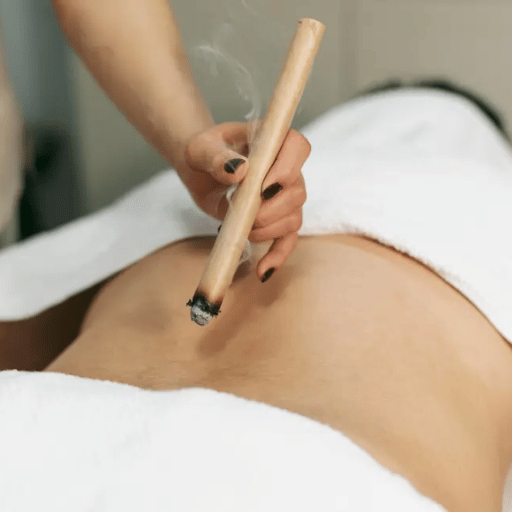
Moxibustion has been studied for an unusually wide range of conditions, and the quality of evidence varies. We use three honest buckets — Strong, Moderate, and Preliminary — so you can match expectations to the actual data.
| Condition | Evidence Strength | Key Citation |
|---|---|---|
| Breech presentation (around 34 weeks) | Strong (moderate-certainty in Cochrane) | Cochrane CD003928 |
| Chronic non-specific low back pain | Moderate (positive 2025 meta-analysis) | Frontiers in Medicine 2025 |
| Knee osteoarthritis | Moderate (2025 RCT, smokeless = traditional) | BMC Complementary Med 2025 |
| Dysmenorrhea (menstrual pain) | Moderate | Multiple systematic reviews |
| Cancer-related fatigue + chemotherapy side effects | Moderate | NIH PMC 2023 review |
| Diarrhea-predominant IBS | Preliminary | 2022 systematic review |
| Fertility support (often adjunct to fertility acupuncture) | Preliminary | Small trials only |
| Allergic rhinitis, post-stroke urinary incontinence, hyperlipidemia | Preliminary / emerging | Single trials, more research needed |
Honest summary: moxibustion is best understood as an adjunct with one strong indication(breech), several moderate ones(musculoskeletal pain syndromes, dysmenorrhea, cancer-supportive care) and a long tail of preliminary uses where it may help but should not replace standard care
Can moxibustion help turn a breech baby?
This is the most-asked clinical question and the one with the strongest answer. Standard protocol begins around 34 weeks with daily 15–20 minute sessions of indirect moxibustion at BL67 (Zhiyin), the outer corner of the small toenail, for one to two weeks. A 2023 Cochrane review found moderate-certainty evidence that moxibustion plus usual care probably reduces the number of breech babies at birth — though the reviewers note the evidence base is not yet ideal and adverse events were underreported in many trials. Fertility acupuncture and pregnancy-supportive TCM frequently incorporate this protocol; always coordinate with your obstetrician.
When Moxibustion Is Right for You — A Decision Guide
- Breech presentation at 28-37 weeks pregnant:Strong evidence, consult with your obstetrician as an adjunct.
- Chronic knee osteoarthritis or non-specific low back pain:Moderate evidence, expect to use about 6-10 treatments and revisit at four weeks. See acupuncture protocols for back pain for the bigger picture.
- Dysmenorrhea or digestive concerns similar to IBS:Moderate evidence, use along with dietary scrutiny.
- Fertility, allergic rhinitis, or general health enhancement:Preliminary evidence, it should be used asa complement, use conservative estimates.
- Guideline-contraindicated, pregnant non-breech abdomen, recent history of broken skin, severe heat-pattern based constitution, recent history of drinking: Do NOT use! Let your acupuncturist know why not.
What to Expect in a Moxibustion Session: Smell, Sensation, Timing
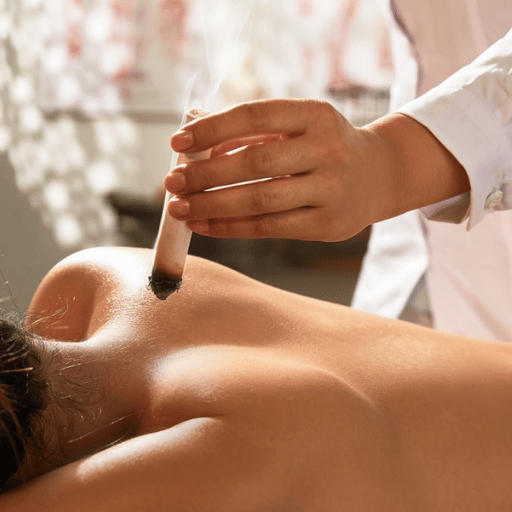
A typical first moxibustion session at our clinic runs 30 to 45 minutes start to finish, with 15 to 25 minutes of active moxa. Flow looks roughly like this:
- Brief intake — pulse and tongue diagnosis, plus conversation about your goal and any cold/heat signs.
- Point selection — your acupuncturist picks three to five points based on what they found.
- Setup — if acupuncture comes first, needles go in; if moxa is solo, you lie on the table while the practitioner prepares the moxa cone or moxa stick.
- Active moxa — 15–25 minutes, with the practitioner staying in the room and adjusting moxa distance every 30–60 seconds based on your feedback.
- Wind-down — a short rest, water, and a note on what to watch for over the next 24 hours.
📐 Engineering Note — The distance feedback loop
During indirect moxibustion the practitioner holds the moxa stick roughly 2–3 cm above the skin and moves it closer or further every few seconds. This is not improvisation — it is a continuous feedback loop adjusted to the warm-but-not-burning threshold reported by the patient. The moment you feel the heat sharpen, the moxa is already moving away. If you are mid-session and your practitioner is not making these micro-adjustments, ask them to.
Most first-time visitors at our Dubai clinic are surprised by two things: the smell is sweet and earthy (one patient described it as “honey and dry grass”), not acrid; and the heat sensation is closer to a hot stone than to a flame. You can also use our treatment timeline estimator before booking to get a rough idea of how many sessions a condition typically needs.
Does moxibustion hurt?
No— with one exception. Indirect moxibustion cannot ever be painful as it involves no actual contact with the skin. During direct non-scarring moxibustion, your practitioner will immediately take the cone away when you first feel heat, always well before a burn occurs.
Painful, scarring direct moxibustion is the only type to ever cause pain, and is rarely found in the world of modern Western acupuncture. If during your moxibustion experience you find the heat crossing into discomfort and your practitioner not stopping, you can and should request that they pause for a moment.
Is Moxibustion Safe? Side Effects, Risks, and Who Should Avoid It
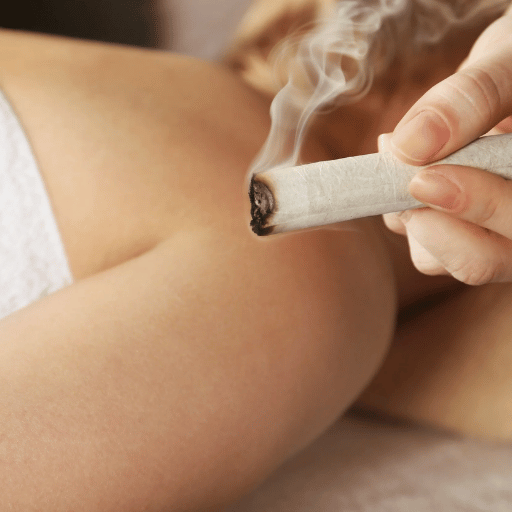
⚠️ Avoid moxibustion if you have
- Pregnancy with a non-breech presentation (avoid abdominal points entirely)
- Broken, inflamed or anesthetic skin at the intended acupuncture point:
- Known mugwort or Asteraceae-family allergy
- Severe asthma or smoke sensitivity (consider smokeless variant)
- Acute fever or recent alcohol use
The overall picture for safety of practitioner-treated moxibustion is good, when practiced by a properly trained and licensed professional. A summary of safety case reports drawn from a large Wiley systematic review (Xu et al., 2014) presents the realistic adverse events: allergic reaction to moxa, sore throat or cough from smoke, nausea and vomiting, dark patches of skin from repeated heat, and occasional fetal distress following inappropriate application in the abdominal region during pregnancy. Most effects are benign and temporary.
It is most common that risks from real world use arise from three root causes: poor practitioner technique (not holding the heat far enough away from the skin or for not long enough), poor ventilation (smoke accumulating in a small room), and self treatment without instruction. Direct scarring moxibustion is another, well known, practiced tradition that is unlikely to be practiced outside classical East Asian clinical settings.
💡 Three questions to ask before your first session
- How do you adjust moxa distance based on my feedback?
- What is your policy on room ventilation and smokeless alternatives?
- If I am pregnant or have a mugwort allergy, how do you adapt?
Can I do moxibustion at home?
Yes, within limits. Smokeless moxa sticks are sold for at-home use and can be applied to general-wellness points like ST36 or SP6 for 5–10 minutes once or twice a week. Three rules: (1) use only smokeless variants indoors and still ventilate; (2) never use direct moxa at home; (3) do not self-treat serious or pregnancy-related conditions, and especially not breech presentation, without practitioner guidance — the point location and timing of BL67 moxa really do matter and self-treatment is where adverse events cluster. If you live in the UAE’s hot climate, do not stack at-home moxa onto an already-overheated day; moxa is a warming therapy and ambient heat compounds the effect.
How to Find a Qualified Moxibustion Practitioner
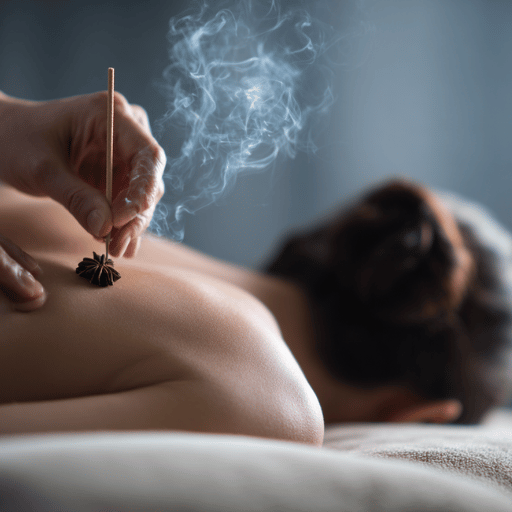
A qualified moxibustion practitioner is almost always a licensed acupuncturist with additional moxa training — the two are clinically inseparable. Use this five-point checklist anywhere in the world:
- ✔
Has an all-round decent acupuncture/TCM licence in the practitioner’s local jurisdiction (most practitioners in the US hold NCCAOM board certification; the major Emirates territories cater to practitioners holding TCM licensure in the UAE; throughout the UK, this is the BAcC). - ✔
Has completed a multi-year TCM degree, rather than the “weekend certification”. - ✔
Working in a well-ventilated room using a well-thought-out smoke management system (fan or smokeless variants). - ✔
Just before lighting, asks questions about pregnancy, medication use and allergies. - ✔
Can name the points used and justify their selection (vague “correcting energy” replies alert us that one should be wary).
Tong Ren Tang’s lineage runs back to Beijing in 1669, and our Dubai-based acupuncturist team holds TCM degrees from established Chinese universities along with UAE regulatory licensure. If you would like to compare moxa-trained practitioners locally, our Tong Ren Tang acupuncture and moxibustion clinic in Dubai is one option — but the checklist above will help you evaluate any clinic.
Where Moxibustion Is Headed: 2026 Outlook and Modern Adoption
For a therapy this old, moxibustion is having an unusually active year. Three trend signals matter for anyone considering it in 2026:
1. Research momentum
2025 produced at least four peer-reviewed papers on moxibustion mechanism and clinical outcomes — including the PMC 2025 study on chronic low back pain and a moxa-smoke mechanism paper (PMC 2025). After two flat decades, the citation curve is bending up.
2025 produced at least four peer-reviewed papers on moxibustion mechanism and clinical outcomes — including the PMC 2025 study on chronic low back pain and a moxa-smoke mechanism paper (PMC 2025). After two flat decades, the citation curve is bending up.
2. Smokeless adoption
Hospital indoor-air rules are nudging clinics toward smokeless moxa formulations. The 2025 Hong Kong RCT (above) shows that for knee OA, smokeless and traditional moxa produced equivalent outcomes — so the shift is largely free of efficacy cost.
Hospital indoor-air rules are nudging clinics toward smokeless moxa formulations. The 2025 Hong Kong RCT (above) shows that for knee OA, smokeless and traditional moxa produced equivalent outcomes — so the shift is largely free of efficacy cost.
3. Market growth
Global moxibustion instruments market was valued at roughly USD 1.8 billion in 2025 and is projected to grow to about USD 3.4 billion by 2034 (CAGR ~7.3%), according to industry research firm Dataintelo — driven by Asia-Pacific demand and smokeless device innovation.
Global moxibustion instruments market was valued at roughly USD 1.8 billion in 2025 and is projected to grow to about USD 3.4 billion by 2034 (CAGR ~7.3%), according to industry research firm Dataintelo — driven by Asia-Pacific demand and smokeless device innovation.
For a reader in 2026, the practical implication is simple: if you have been curious about moxibustion but worried about smoke, smell, or evidence gaps, the field is moving in your favour. Newer smokeless devices, fresh clinical data on chronic pain, and integration into fertility and oncology supportive care mean the next decade is likely to make moxibustion easier to access and easier to defend on the evidence.
Frequently Asked Questions
Q: What does moxibustion do to the body?
View Answer
Moxibustion delivers slow, deep heat plus near-infrared radiation and aromatic mugwort compounds to specific acupuncture points. The combined effect of moxibustion increases local blood circulation, relaxes muscle, modulates inflammatory cytokines, and — according to recent neuroendocrine research — may also dampen the body’s stress response via the HPA axis. In TCM language, this is described as warming yang, dispelling cold, and restoring the flow of qi.
Q: Is moxibustion still used today?
View Answer
Yes — and increasingly so. The World Health Organization recognises acupuncture-and-moxibustion as a traditional medicine system, dozens of 2024–2025 peer-reviewed papers have been published, and the global moxibustion instruments market is projected to grow from about USD 1.8 billion to USD 3.4 billion by 2034.
Q: How often should I receive moxibustion treatments?
View Answer
A typical chronic-condition course is six to ten sessions, scheduled twice weekly for the first two to three weeks and then tapering to weekly. Acute issues may resolve in two or three sessions. Breech protocols are typically daily for 7–14 days starting around 34 weeks.
Q: Can moxibustion be combined with acupuncture?
View Answer
Yes — they are clinically inseparable in TCM. A classical Chinese term for the combined practice is 针灸 (zhēn jiǔ, “needle-moxa”). Many sessions begin with needling and finish with a few minutes of moxa at a tonification point such as ST36.
Q: What is the difference between moxibustion, moxa, and acupuncture?
View Answer
Three different things often discussed together. Moxa is the material — processed mugwort leaves. Moxibustion is the therapy of burning moxa at specific acupuncture points. Acupuncture is the separate practice of inserting fine needles at the same points. In practice the words “moxa” and “moxibustion” are used interchangeably, and acupuncture and moxibustion are usually done together.
Q: What does moxibustion smell like?
View Answer
Sweet, earthy, and slightly herbal — closer to dried sage or hay than to incense. Smokeless variants have minimal smell.
Our Perspective on Writing This Guide
This guide focuses on what a UAE reader can verify or feel for themselves — the botanical reality of mugwort and Artemisia argyi, an evidence-graded condition matrix with real citations, and a practitioner-vetting checklist you can actually use. Where the data is strong (breech presentation), we have said so. Where it is preliminary (fertility, allergic rhinitis), we have said that too. Moxibustion has been part of routine practice at Tong Ren Tang since 1669 — and routine practice has taught us that honest evidence grading helps patients more than enthusiasm ever does.
About the Reviewers
Reviewed by the Tong Ren Tang Dubai Traditional Chinese Medicine team. Beijing Tong Ren Tang has practiced authentic TCM since 1669 and served the Qing imperial court as exclusive Chinese medicine supplier for 188 years (1723–1911). Our Dubai Healthcare City and Jumeirah clinics offer acupuncture, moxibustion, cupping, and Chinese herbal medicine seven days a week.
References & Sources
- Cochrane Review CD003928: Moxibustion for turning a baby in breech position — Cochrane Collaboration
- Deng & Shen (2013). The Mechanism of Moxibustion: Ancient Theory and Modern Research — NIH PMC
- The Case for Moxibustion for Painful Syndromes: History, Principles and Rationale — NIH PMC
- Lu et al. (2023). Moxibustion for the Treatment of Cancer and its Complications — NIH PMC
- 2025 study: Effectiveness and mechanism of moxibustion in treating chronic non-specific low back pain — NIH PMC
- 2025: Effectiveness and mechanism of moxibustion in treating chronic non-specific low back pain — Frontiers in Medicine
- 2025: Feasibility and barriers of utilizing moxibustion therapy in Hong Kong — Springer BMC Complementary Medicine and Therapies
- 2025: Investigation of the effect and mechanisms of moxa smoke — NIH PMC
- Xu et al. (2014). Safety of Moxibustion: A Systematic Review of Case Reports — Wiley / Evidence-Based Complementary and Alternative Medicine
- Moxibustion: What Is It and Does It Work? — Cleveland Clinic Health Essentials
- Moxibustion overview — University of Minnesota Earl E. Bakken Center for Spirituality & Healing
Related Articles
- Complete Moxibustion Treatment Guide — Benefits, Techniques & Clinical Evidence
- Fertility Acupuncture: What the Evidence Says
- How Acupuncture Helps Back Pain: 2025 Evidence-Based Guide
- Acupuncture vs Dry Needling: 2026 Comparison Guide
- Acupuncture and IVF Success Rates: 2026 Evidence
- Hijama vs Cupping: What’s the Difference (2026 Guide)