Get in Touch with Tongren Tang Gulf

Chinese Herbal Medicine: How It Works, What Science Says, and How to Start
History: Years (most ancient text: Shennan Bencao Jing, ca. 200 C.E.) (no. of years)
Active Formulas: 13,000+ in Chinese Pharmacopoeia
Core Principle: Individualized formulas based on patient constitution
Delivery Forms: Decoctions, granules, pills, teas, patent medicines
Evidence: Taking shape but still limited—most RCTs at high risk of bias; 94 reviews addressed; mostly grey literature
Cost: $15–$50/week (formulas) + $80–$200 (initial consultation)
Chinese herbal medicine is one of the world’s oldest continuous health systems with a history of more than two thousand years. Today millions of people in Asia, Europe and North America use Chinese herbal remedies – part of a treatment at the GP or hospital, or on their own initiative. Despite its longevity, the evidence base is patchy and there are genuine safety concerns.
This guide discusses the traditional theory behind Chinese medicine herbs, the way Chinese herbal formulas are created and prescribed, the research findings, the safety aspects and how to find a trained Chinese herbal practitioner if you want to try Chinese herbal tablets or Chinese herbal tea for yourself.
What Is Chinese Herbal Medicine? A 2,000-Year Healing System

Chinese herbal medicine is one aspect of TCM that utilises food ingredients of plant, mineral and animal origin – brought together in multi-herb formulas – to re-establish balance and treat illness according to individual diagnosis.
That definition is significant as it emphasizes the major distinction between Chinese herbal medicine and Western herbalism. In the West, a standardized single herb extract such as echinacea for colds or valerian for insomnia is usually chosen, while in TCM the herbalist does not often write a prescription for an individual herb. Instead, the prescription may have a formula consisting of between 4 and 20 herbs, each with its own role, which is then refined to the individual patient’s constitution and presentation pattern.
Two different patients with the same problem may have entirely different prescriptions.
Written Records. Our earliest extant Chinese materia medica is the Shennong Bencao Jing (Divine Farmer’s Materia Medica), which was written circa 200CE and which contains 365 herbal medicines ranked according to their toxicity and therapeutic action. Meanwhile, the Huangdi Neijing (Yellow Emperor’s Inner Canon) established the theoretical foundations of pre-modern Chinese Medicine – qi, yin-yang, the organ systems and disease mechanisms.
By the time of the Tang dynasty (618-907CE) the imperial pharmacopoeia contained thousands of proven prescriptions. Over this time the formulas were refined by generations of practitioners using them directly in the course of the practitioner’s practice, creating the knowledge base from which modern TM came.
Chinese herbal medicine is only one aspect of a broader system of healing, which also includes acupuncture, qigong, diet therapy and tui na massage. Usually practitioners in TCM combine different techniques – such as prescribing formulas of herbal medicine together with acupuncture – according to the ways in which they believe they will benefit the individual.
Based on such long-standing tradition as this, Tong Ren Tang is just an example shows us there what Chinese herbal medicine had impacted. As early as in 1669, Tong Ren Tang was established in Beijing, which has provided herbal treatments to the Chinese imperial family for 188years. Its good ingredient quality has made it been known as one of the most famous TCMs in the world even more than three centuries.
View Tong Ren Tang’s chinese herbal medicine service to find out how there its tradition.
Important Point, Chinese herbal medicine is different from Western herbalism, as the former gives individual multi-herb formulas, as the latter gives single extracted standardized herbs, based on the individual imbalance pattern.
Core Principles: Qi, Yin-Yang, and Five Elements
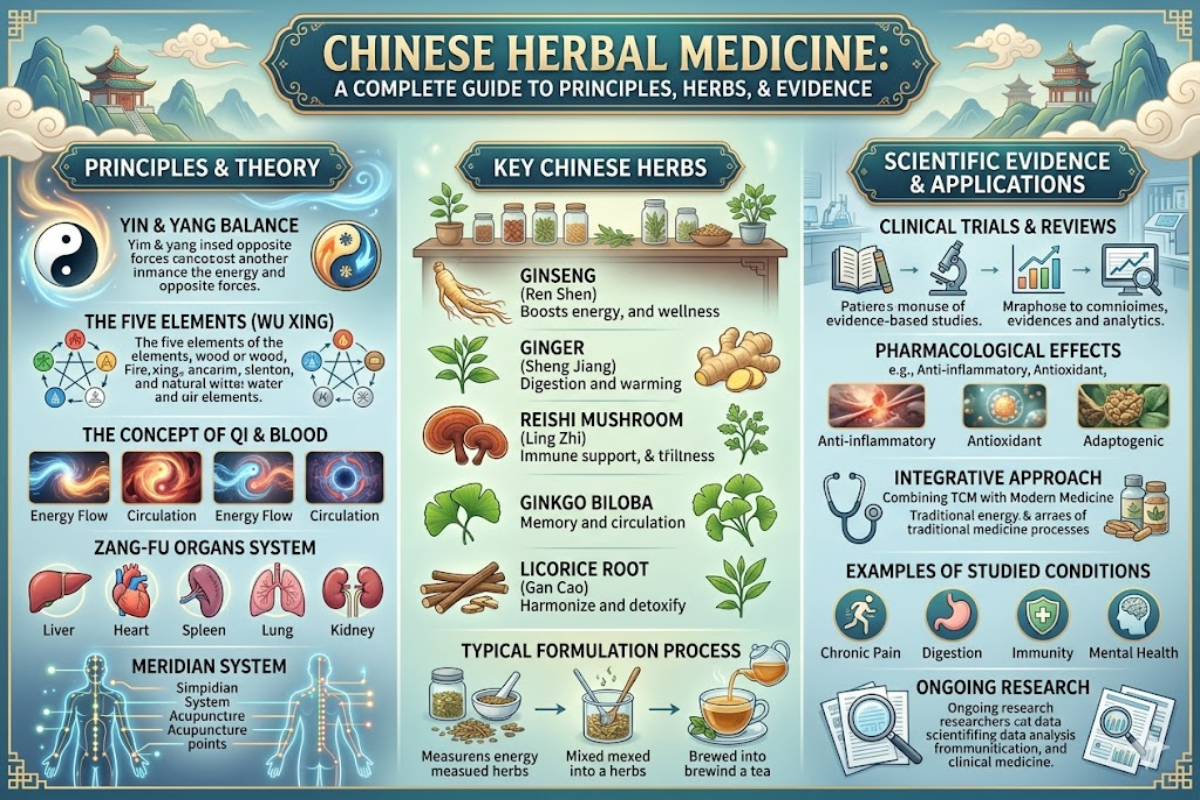
Absorbing the way TCM works can be tricky if you try and think in terms of the Western molecular model. TCM means thinking in patterns, relationships and maintaining balance. (4) There are three core TCM concepts that underpin every TCM diagnosis and herbal prescription.
Qi () – Life Energy. In TCM the life energy is the qi flowing within the body along well-defined channels known as meridians. Free, plentiful Qi is healthy Qi, any problem is an interruption, deficiency or counter-flow of qi. A chronically exhausted patient might be diagnosed as having a deficiency of qi; a patient with intolerable, cutting pain might have stagnation of qi. Herbal formulas will all target that single problem: tonification of debilitated qi, moving stagnation, removing excess.
Yın and Yang () -Antagonist Complement. Yin is moist, passive and cool. Yang is hot, dry and active. Balance is constantly achieved through the play of two opposing, yet complementary forces. Four diagnostic pairs used in TCM to classify conditions, cold/hot, interior/exterior, deficiency/excess, yin/yang are respectively: – a patient with nocturnal sweating and shiny, dry skin is diagnosed as yin deficiency – excess yin. A therapeutic formula will tonify yin, so metaphorically it clears out the deficit.
Five Elements (Wu Xing ) – correlating to organs, the network of organs. While the organs are given specific names in TCM; Liver, Heart, Spleen, Lung and Kidney they are related broadly to 5 elements Wood, Fire, Earth, Water and Metal respectively. These elements are placed within generating and controlling cycles: For example the Fire helps, nourishes the Earth it sits upon and creates the product (ash), Metal – controls water etc. Disruptions in a system as complex as this have a knock on impact through the entire network. A TCM doctor could trace the cause of chronic cough (Metal/lung) through to supposed digestive weakness (Earth/spleen) and treat both issues with the one formula.
Four diagnostic methods are all used in TCM diagnosis. Observation (including tongue color and coating- a swollen, pale tongue indicates Qı deficiency), auscultation and olfaction (listening to breathing and noting body odor), interviews (a thorough record of sleep, bowel movements, sweating, feelings etc.), and pulse diagnosis (by careful palpation at either wrist identifying 28 different types of pulse, for example floating, sinking, rapid, slow, slippery, choppy, wiry etc.). A diagnosis called for by these four methods determines the herbal prescription
Key Point: TCM works on patterns not on diseases. Two patients presenting with the same Western made diagnosis in a consultation room wearing the same white coat may both walk away with very different formulas.
How Chinese Herbs Are Prescribed: Formulas, Not Single Pills
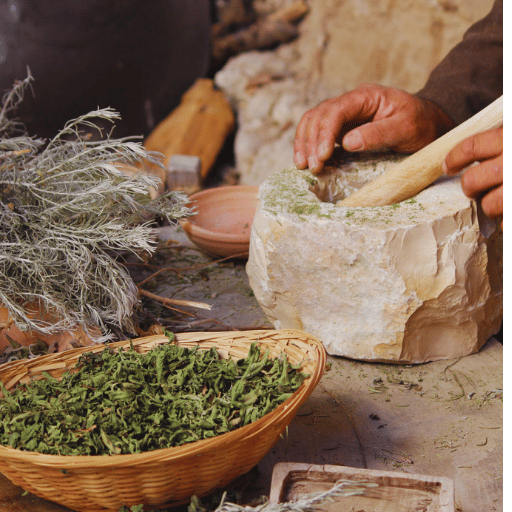
If you walk into a TCM shop expecting to take something home immediately, you will be very surprised what you find. Herbs are given as complex combinations of ingredients- even the strongest Chinese hospitals are reluctant to use single herbs on their own. Every Chinese herbal formula’s structure is based upon principles established by Chinese healthcare givers 2000 years ago.
| Role | Chinese | Function | % of Formula | Example (Si Jun Zi Tang) |
|---|---|---|---|---|
| Monarch (Jun) | 君 | Targets primary condition | 30–50% | Ren Shen (Ginseng) 9g |
| Minister (Chen) | 臣 | Reinforces monarch effect | 20–30% | Bai Zhu (Atractylodes) 9g |
| Assistant (Zuo) | 佐 | Treats secondary symptoms, reduces toxicity | 15–25% | Fu Ling (Poria) 9g |
| Envoy (Shi) | 使 | Guides formula to target area, harmonizes | 5–15% | Zhi Gan Cao (Licorice) 6g |
This matrix means no herbs are ever combined by chance. Each monarch herb validates the primary symptom. Its minister encourages it. An assistant heals secondary symptoms, moderates the other herbs’ toxicity, and guides the remedy to the correct body region. Finally, the envoy aims the remedy at the right place and harmonizes the herbs. Remove one herb and suddenly the remedy does something different in your body.
Chinese herbal formulas are available in many forms. Raw herbs are the strongest, most adaptable: Patients purchase pre-weighed herbs and decoct them in water at home. Granules are the easiest: a pre-processed powder that dissolves easily. Pills and tablets are baked formulas available over the counter for common disorders. Teas are a mild diurnal healthy benefit: chrysanthemum to alleviate eye strain, goji berry to promote longevity.
Tailoring begins when the TCM practitionr determines your constitution through the four methods of diagnosis described above. They select a native TCM formula to match your presentation – e.g. Si Jun Zi Tang for qi deficiency – then add and subtract herbs as needed, like loading it with warming herbs to become Li Zhong Tang, or improving digestion with Shen Ling Bai Zhu San. Want to see a real doctor’s approach? Visit Tong Ren Tang to see herbal formulas being customized for clients.
Engineering Point: Si Jun Zi Tang (Four Gentlemen Decoction) is one of the keystone formulas of traditional Chinese medicine. Add spices and you get Li Zhong Tang, add digestion herbs and you get Shen Ling Bai Zhu San, the foundation of hundreds of derivatives. Learning this one formula illuminates the vast universe of TCM prescribing styles.
Key point: Chinese herbal remedies are designed systems – nothing is arbitrary, and everything exists to make the remedy more potent and safer than the herbs alone.
10 Common Chinese Herbs and What Research Shows
China’s Pharmacopoeia lists thousands of chinese herbs used in clinical practice. Here are 10 common chinese herbs, descriptions, clinical uses, and modern research findings. Evidence levels represent the current literature, not the herbal medicine as it is traditionally practiced.
| Herb | Chinese Name | Primary TCM Use | Key Active Compound | Research Finding | Evidence Grade |
|---|---|---|---|---|---|
| Ginseng | Ren Shen (人参) | Qi tonifier, fatigue | Ginsenosides | Anti-inflammatory, immune modulation; limited RCTs | Moderate |
| Astragalus | Huang Qi (黄芪) | Immune support, energy | Astragalosides, polysaccharides | 2025 meta-analysis: reduced cancer-related fatigue | Moderate |
| Goji Berry | Gou Qi Zi (枸杞子) | Liver/kidney tonic, vision | Zeaxanthin, polysaccharides | Antioxidant activity in lab studies; few human trials | Low |
| Licorice Root | Gan Cao (甘草) | Harmonizer, throat/cough | Glycyrrhizin | Anti-inflammatory, antiviral; excess causes hypertension | Moderate |
| Ginger | Sheng Jiang (生姜) | Digestive, cold conditions | Gingerols, shogaols | Anti-nausea (Cochrane-reviewed); anti-inflammatory | Strong |
| Angelica | Dang Gui (当归) | Blood tonic, women’s health | Ferulic acid, ligustilide | Blood circulation, anemia support; limited RCTs | Low |
| Reishi | Ling Zhi (灵芝) | Immune modulation, calm | Triterpenes, polysaccharides | Immune support in cancer patients; quality varies | Low-Moderate |
| Turmeric | Jiang Huang (姜黄) | Blood circulation, pain | Curcumin | Anti-inflammatory (well-studied); bioavailability issues | Strong |
| Chrysanthemum | Ju Hua (菊花) | Eye health, cooling | Flavonoids, essential oils | Antioxidant, anti-inflammatory; mostly preclinical | Low |
| Schisandra | Wu Wei Zi (五味子) | Liver protection, adaptogen | Schisandrins | Hepatoprotective in animal studies; limited human data | Low |
A word of caution: “natural” does not imply “safe.” All herbs contain active chemical ingredients. This is why they have medicinal value. But it also means they have real risks. Licorice can raise blood pressure if taken too long. Ginger does thin the blood. Licorice can cause pre-term labor. Ginseng can interfere with warfarin, warfarin inhibits breakdown of herbal drugs. Herbs in traditional Chinese medicine are drugs and should be treated with the same respect as any pharmaceutical. Use of infrequently used herbs or unregulated herbal products risks unanticipated contamination or adulteration.
A few of these chinese herbs for health if you are interested – ginger and turmeric have excellent anti-inflammatory data from well-conducted studies, while goji berry and chrysanthemum only have preclinical data to draw upon. What grade the research is plays a role in what you ultimately decide to treat (common colds with herbal tea or a respiratory illness).
Take Home Message: Chinese herbs contain active ingredients that really work – which also means they have side effects. Evidence grades vary significantly from herb to herb – always reference the grade when relying on any individual herb for your health concern.
Does Chinese Herbal Medicine Work? What the Evidence Says

Honestly, it depends on the condition, the formula, and the quality of the study. Regarding Chinese medicine, it is not possible to say a simple yes or no: the research base is uneven, oscillating between areas of promising data and huge gaps in rigorous evidence.
Systematic reviews and meta-analyses from 2024-2025 suggest a somewhat mixed but cautiously optimistic outlook. There seems to be potential in research on metabolic conditions, although certainty remains limited. A 2025 meta-analysis reviewed six trials involving astragalus formulas and cancer-related fatigue scores, reporting positive results. Separately, a 2025 meta-analysis of 18 clinical trials with 2,202 patients suffering both coronary heart disease and stroke revealed the combined Chinese-Western therapy to be more efficacious than Western medicine alone. In a meta-analysis of 14 trials with 1,831 patients suffering hepatocellular carcinoma, those in the group using CHM in addition to conventional therapy had better survival outcomes and fewer adverse events. And the Cochrane Database of Systematic Reviews tackled the Chinese herbal medicine for conditions like Irritable Bowel Syndrome, noting symptom improvement versus placebo in several randomized controlled trials.
| Condition | Evidence Type | Sample Size | Finding | Quality |
|---|---|---|---|---|
| IBS | Cochrane review | Multiple RCTs | Symptom improvement vs placebo | Moderate |
| Cancer fatigue (Astragalus) | 2025 meta-analysis | Multiple RCTs | Reduced fatigue scores | Moderate |
| Coronary + stroke | 2025 meta-analysis | 2,202 patients | Improved efficacy rate | Low |
| Hepatocellular carcinoma | 14 meta-analyses | 1,831 patients | Better survival + fewer adverse events | Low |
| Allergic rhinitis | Systematic review | Multiple RCTs | Symptom reduction | Low-Moderate |
Key limitations are considerable and important to understand. Most published clinical trials involve a high risk of bias – lack of proper blinding, inadequate randomization, small samples. A vast majority of clinical trials involving Chinese herbal medicine are published in Chinese journals, making independent verification more difficult. Obviously, it is very difficult to blind a herbal decoction (the taste and smell are fairly unique). Formulations are highly variable – two published Chinese Medicine trials on “Astragalus for fatigue” could involve different doses, medicines and methods. Finally, the National Center for Complementary and Integrative Health maintains the evidence does not clearly show Traditional Chinese Medicine is effective for specific conditions.
Myth Busted: “Three thousand years of practice, therefore scientifically proven.” Longevity of practice does not constitute clinical evidence. Bloodletting was in widespread practice for 2,000 years prior to it being proved detrimental for most conditions. Scientific investigation of traditional Chinese medicine can be viewed positively – it provides the evidence necessary to guide the improvement of future practices – but it does not replace traditional use with evidence. There remains a lot to be discovered, but at present, the evidence base is weaker than many might hope.
None of that means Chinese herbal medicine has no place in health care. It does mean the evidence is still emerging. For specific conditions – especially as an adjunctive therapy along Western medicine – the data look encouraging enough that a body of evidence certainly exists to warrant further investigation. But using Chinese herbal medicines as equivalent replacement for evidence-based medicine has no equivalent in scientific literature at this time.
Main Point: Current best evidence for CHM in CAM effectively point a ‘synergism’ – to integrate a safe and effective traditional medicine with standard Western procedures, rather than substituting it. One obstacle is the quality of the studies – looks-good only on small and not exactly reputed studies should always be taken with a pinch of salt until substantiated by larger, more rigorous work.
Safety: Side Effects, Drug Interactions, and Quality Control

Then there is safety. This is where Chinese medicine most ironically requires our vigilance-the area of practice where there’s the greatest difference between strict regulation and self-prescribing. Potential hazards of herbal medicines are confirmed, serious, and real.
| Concern | Examples | Severity | Prevention |
|---|---|---|---|
| Hepatotoxicity | Polygonum multiflorum, Dioscorea bulbifera | Serious — acute liver failure reported | Buy from regulated sources, monitor liver function |
| Herb-drug interactions | Ginseng + warfarin, licorice + diuretics, St. John’s Wort + SSRIs | Moderate to Serious | Disclose all meds to TCM practitioner and Western doctor |
| Contamination | Heavy metals (lead, mercury), pesticides, undeclared pharmaceuticals | Variable — depends on contaminant and dose | Purchase GMP-certified products only |
| Allergic reactions | Individual sensitivity to specific herbs | Mild to Moderate | Start with small doses, monitor for 24–48 hours |
| Adulteration | 2018 study: 487 products, 1,234 hidden ingredients found | Serious — undeclared drugs pose unpredictable risks | Buy from established brands with third-party testing |
| Dosage errors | Self-prescribed excessive doses leading to toxicity | Variable — depends on herb and amount | Consult qualified TCM practitioner |
Certain herbs are known to be toxic. A recent analysis of the NIH Drug-Induced Liver Injury (DILI) Network showed a near three fold increase of herbal induced liver injury in the United States from 2004-2017. Some of the most common drugs of herbal induced liver injury include Polygonum multiflorum (He Shou Wu) that is sold openly online as a “hair growth” supplement.
Acute liver failure reports from multiple countries have been reported and are a well established documenting in pharmacovigilance databases.
Herb-drug interactions are also of great concern. Numerous individuals who are on standard medications will have added herbal supplements without informing their healthcare practitioners and being aware of the fact that some herbs interfere with the metabolism of drugs. Ginseng renders warfarin less effective and there is a known antagonistic effect between licorice roots and hypertension drugs that are suited for a diuretic.
Quality is the dividing line between safe and unsafe. Tong Ren Tang’s founding cry -“No compromise on quality and standard despite the scarcity of medicine ingredients” is a principle more relevant now than ever. With the huge influx of hundreds of herbal products sold online, from sources with no warranties for genuineness, contamination and adulteration are practical prospectives.
GMP certification, third-party testing and buying from proven companies with traceable production chains is a first step.
Main Point: The highest safety concerns derive from self-prescription, ‘shopping around’ for cheaper herbs and not informing herb use to physicians. These concerns are mitigated by finding an experienced practitioner, who uses quality controls.
How to Find a Qualified TCM Practitioner

Your TCM experience is heavily dependent on who is it that prescribes your herbal formula. In the US, the NCCAOM (National Certification Commission for Acupuncture and Oriental Medicine) conducts three board certification examinations for Acupuncture and Chinese Herbology. Completion of a master’s level program (generally 3-4 years) at an accredited program, plus supervised clinic hours, is required to take the exam.
State licensure requirements differing. Most US states regulating TCM require NCCAOM certification and a Masters Degree. In a few US states practitioners are able to prescribe herbal medicines however in many it is limited to acupuncture.
In the United Arab Emirates and other international markets legislation is different—ensure local licensing requirements are met prior to practicing therapy.
When choosing a TCM practitioner inquire straightforwardly: where were you trained? How many hours of clinical practice prescribing herbal medicine do you have? How do you acquire your herbs – are they GMPapproved? Do you screen for drug interactions before recommending? Do you work with Western doctors when necessary? An appropriate practitioner should answer questions freely and without defensiveness.
It’s the integrative approach that counts. Complementary and integrative health care means your TCM practitioner and your Western medicine doctor are both aware of your full program of care. Always inform your doctor of any herbal medicines taken, and always inform your TCM practitioner of any medications so that both practitioners can communicate and watch out for dangerous interactions – together with Western medical support herbal therapy is far safer.
Tong Ren Tang’s practitioner standards show 350+ years of clinic experience: licensed TCM practitioners, traceable sourcing of quality herbs, formulas prepared according to classical texts. Book a consultation with Tong Ren Tang’s TCM practitioners to experience this level of care yourself.
Key Point: Seek NCCAOM certification (US) or the relevant local standards, GMP herb sourcing, readiness to test for drug interactions, and an integrative protocol that includes a line of communication with your Western doctor.
Frequently Asked Questions
What is chinese herbal medicine used for?
Chinese herbal medicine is used for many ailments including chronic pain, digestive problems, resp diseases, skin problems, emotional health issues, fertility problems, and energy support. TCM creates a unique pattern diagnosis rather than fixing individual symptoms which means herbs for one pattern will often treat multiple syndromes if they all share the same root diagnosis in TCM. For instance, a formula used for the pattern ‘Spleen qi deficiency’ might have multiple effects including better digestion, more energy and firmer stool, because TCM views these complaints as one pattern.
Is chinese herbal medicine safe?
Relatively safe when practiced by skilled practitioners who use quality herbs. Risks occur when herbs interact with medication (blood thinners, antihypertensive drugs, anti-depressants), or when unregulated products become contaminated by pesticides, or heavy metals or pharmaceuticals, or when specific herbs contain hepatotoxins (Polygonum multiflorum). Purchase only through established sources or certified Chinese extract manufacturers and always tell your MD about your herbal use.
Does chinese herbal medicine actually work?
Research on the evidence base is mixed, with encouraging Cochrane reports of benefit for IBS and allergic rhinitis. A 2025meta analysis showed benefits for cancer related fatigue (Astragalus-based formulas) and coronary heart disease (18 trials, 2,202 patients). However study quality is inconsistent, with many small unblinded studies published in Chinese journals. The NCCIH states that evidence is currently insufficient for most conditions. Bottom line: CHM complements standard medical care but does not replace it. Early high-quality research gives hope that more and better evidence will follow.
How much does chinese herbal medicine cost?
Prices differ between the various formula types and practitioners. Raw herb decoctions cost about $15-$40 a week, concentrated granules are approximately $20-$50 a week, patent medicines (all pre-made pills and tablets) are $10-$30 a bottle. Initial consultations are around $80-$200, and follow up visits $50-$100. Prices depend on the practitioner experience, formula composition, geographical region. Some health insurance policies that include coverage for acupuncture treatment, also provide coverage for herbal consultations, which can help reduce the out of pocket expenses considerably. Package deals for multiple visits are common with established practices.
Can I take chinese herbs with Western medication?
Some herbs that have a significant interaction with pharmaceutical medications are: ginseng which can reduce the effects of blood thinners like warfarin, licorice root which counteracts the effects of diuretics taken for high blood pressure and other herbs that interfere with the way the liver processes drugs. Always inform both your TCM doctor and Western doctor of all medications and supplements that you are taking.
How long before chinese herbal medicine works?
Acute issues (colds, digestive upset): days to 2 weeks. Chronic conditions: 4-12 weeks. Formulas get adjusted every 2-4 weeks.
Experience Traditional Chinese Herbal Medicine
Tong Ren Tang – 350+ years of tradition, regulated TCM doctors, herbal formulas checked for consistency and quality, prepared according to classical principles.
Visit Tong Ren Tang
Referencing peer-reviewed meta-analyses, institutional medical references, and simple clinical databases – Chinese herbal medicine research continues to develop, study quality differs widely, and many traditional claims have yet to be proven via large scale clinical studies. We aim to mention both the strength and weakness of our findings transparently. Always see your physician before commencing herbal therapy for a medical problem.
References
- NCCIH – “Traditional Chinese Medicine: What You Need to Know” – nccih.nih.gov
- PMC – “Understanding Traditional Chinese Medicine Therapeutics” – PMC8000828
- PMC – “Traditional Chinese Medicine and Clinical Pharmacology” (Jun-Chen-Zuo-Shi) – PMC7356495
- PMC – “Efficacy of Astragalus for Cancer-Related Fatigue: Systematic Review” – PMC12041688
- PMC – “Chinese Herbal Medicine-induced Liver Injury” – PMC4521244
- PMC – “A review of herb-induced liver injury in mainland China” – PMC9592926
- Cleveland Clinic – “What You Should Know About Chinese Herbs” – cleveland clinic.org
Related Articles
- Top 10 Chinese Herbs for Immunity and Energy
- Chinese Herbal Tea Guide: Which Teas Support Your Health Goals?
- TCM for Digestive Health: Herbs That Support Your Gut
- Acupuncture and Herbal Medicine: How They Work Together
- Chinese Medicine for Stress and Sleep: A Natural Approach