Get in Touch with Tongren Tang Gulf
Eczema Chinese Medicine
Chinese Medicine for Eczema — Break the Steroid Cycle With 350 Years of Proven TCM
If your eczema keeps returning no matter what cream you try, you’re not alone, and it’s not your fault. Topical steroids suppress the surface symptoms, but they rarely address what’s going on underneath. At Tong Ren Tang, our practitioners look at the whole picture: your digestion, your sleep, your stress levels, even the coating on your tongue. That deeper assessment is what makes Chinese medicine different. We build a herbal protocol around your specific pattern — not a one-size-fits-all prescription, so your body can actually heal from the inside out.
- 350+ Years Heritage
- 4-Step TCM Protocol
- 8 RCTs Evidence Base
- Personalized Herbal Formulas
- Steroid-Free Approach
- Whole-Body Root-Cause Treatment

Why Eczema Keeps Coming Back — And How TCM Eczema Treatment Breaks the Cycle
You were steroid-free for a month. Then your eczema flared out of control. Itching returned in the same areas, the same frustration. Such relapse patterns indicate your body’s internal system still lacks balance due to limitations of Western care.
Topical steroids block the skin’s inflammatory response. They temporarily subdue redness, oozing and itchy areas. But they don’t correct the internal balance that allows eczema to develop. When you discontinue the topical corticosteroid, dermatitis reappears – in some cases, more severely. Some patients encounter a reaction called topical steroid withdrawal (TSW), where doctors notice the skin depends upon continued corticosteroid application and erupts upon withdrawal.

Chinese medicine fundamentally approaches eczema differently. The classic Chinese view implicates internal organ function – spleen, liver, lung balance – and thermal/dampness accumulation as the cause of diseases like atopic eczema. Inadequate spleen Qi function causes dampness, which breeds in the tissues. Liver hyperactivity due to emotional pressure spills excessive heat into the skin. Weak “defensive” lung qi allows invasion by pathogens. These internal imbalances express themselves on the skin as lesions, inflamed itchy areas and dryness — reducing quality of life significantly.

Each individual with eczema has a unique TCM composition reflecting underlying patterns. For one, a solid red eruption suggests damp-heat. For another, dry patches with intense itch confirm blood deficiency combined with wind. Some patients experience two pattern combinations simultaneously. Your specific diagnosis directs treatment.
Here is what matters: treatment of these imbalances leads to the internal resolution of skin problems. When the balance shifts, the symptoms disappear. No other eczema therapy has achieved such therapeutic long-term results as Chinese medicine, where patients notice improvements in their entire sense of wellbeing – digestion, sleep, mood – because the underlying system, not merely the skin, is healed.

Tong Ren Tang 4-Step Traditional Chinese Medicine For Eczema Protocol
Our four-phase protocol accomplishes this regularized return to health. Each course is custom-designed to treat the identified internal system imbalance. Herbal formulae are never the same.
01
TCM Diagnostic Assessment
Your practitioner performs a classical Chinese medicine diagnosis comprised of four tests: sight examination (wang); listen, smell, accept, and reject Chinese medicine diagnosis (wen); thorough interview according to TCM priorities (wen); pulse diagnosis after taking the wrist arteries(Phou); examination of the tongue (she). We look at the sites and appearance of the lesions, tongues, and pulse condition across three positions. Your history provides clues to whether your eczema derives from wind-dampness, heat-dampness, blood deficiency, or another combination pattern. This 30-45 minute consultation informs every decision for the subsequent treatment plan.
02
Personalized Herbal Formula
According to your diagnosed pattern, we prescribe a series of personalized Chinese herbal formula. In general, the course of prescription begins with Xiao Feng San (Wind-Dispersing Powder). Each custom prescription modifies individual herbal medicine according to the unique pattern result. Ku Shen (Sophora root) dispel dampness and alleviate it. Huang Qin (Scutellaria) drains overheating. Zi Cao (Lithospermum) topically and internally cools and heals the skin. Qing Dai (Natural Indigo) topically treats.
03
Complementary Therapies
These points supplement the herbal formula to activate immune modulation and lower the itch. SP10 (Sea of Blood) stimulates blood flow and clear heat from blood. LI11 (Pool at the Bend) Clears heat from the upper body, and dissipates heat in the skin. These treatments will work synergistically with the formula to help the body heal itself more rapidly. Heavy or widespread atopic dermatitis can be treated with herbal bath therapy – topical application of the herbal decoction will calm dryness and dampness, while the internal formula targets the problem at the source.
04
Lifestyle & Diet Adjustment
Diet is tailor-made by your practitioner for your particular pattern and type. Patients with dampness patterns avoid dairy, sugar, and greasy foods that create internal dampness. Patients with heat patterns avoid spicy dishes, alcohol, and shellfish that aggravate inflammatory skin reactions. We suggest that you eat cooling foods – mung bean, cucumber, pear, lotus root – to help support the herbal formula’s action. Aggravating environmental factors such as stress, sleep, and foods are discussed in the context of your complete protocol. This is not a generic recommendation – it’s specific to your pattern diagnosis.
TCM vs Steroid-Based Treatment — Why Patients Are Switching
When patients want eczema treatment they usually have 2 options: the usual Western treatment (topical steroids and antihistamines), or traditional Chinese medicine (herbal medicine and acupuncture). Both options improve the symptoms. Then the real question is what happens afterwards.
Metric
Topical Steroids
TCM Treatment
Initial Relief
1–2 weeks
2–4 weeks
12-Month Relapse Rate
60–70% (widely reported in dermatology literature)
Significantly lower recurrence observed in RCT data
Side Effect Risk
Skin thinning, TSW syndrome, adrenal suppression
Minimal reported adverse effects when prescribed by qualified practitioner
Root Cause Treatment
No — suppresses surface symptoms only
Yes — addresses internal imbalance driving the condition
Long-Term Management
Ongoing dependency with diminishing returns
Progressive reduction as body rebalances
Concurrent Benefits
Limited to skin symptom control
Improved digestion, sleep, stress response
Corticosteroid ointments provide more rapid relief at the beginning—that’s the point. However, it is at the expense of losing control to steroid dependency, since every relapse tends to be followed by a prescription of an even more potent preparation. Patients with AD who have been on mid-to-high potency steroids long-term face real risks: skin atrophy, striae, and perioral dermatitis. Li et al. documented that a small percentage develop topical steroid withdrawal, characterized by a burning and stinging sensation and unpredictable rebound exacerbations that may last months.
One thing to know upfront: TCM takes longer to deliver visible results. During weeks 2-4, your body starts restoring its internal balance — and once those internal patterns shift, remission periods get longer. TCM’s anti-inflammatory aim is not symptom suppression but actual resolution.
TCM Clinical Evidence — Research Summary
— A systematic review of 8 randomized controlled trials found that Chinese herbal medicine combined with conventional therapy showed superior outcomes for atopic dermatitis compared to conventional therapy alone. EASI scores and quality of life measurements both improved significantly in the TCM groups. (PMC9551201)
— A meta-analysis of acupuncture for eczema demonstrated that acupuncture reduced itching scores and decreased lesion area in patients with atopic eczema. The anti-inflammatory mechanism involves modulation of IgE levels and Th1/Th2 immune balance. (PMC7041622)
— A review in the Journal of Dermatological Treatment evaluated multiple clinical studies on Chinese medicinal herbs for eczema and concluded that certain herb combinations showed statistically significant improvements in erythema, surface damage, and sleep quality compared to placebo groups. (PMC3110124)
Eczema Recovery: Best Chinese Medicine For Eczema Results
These anonymized cases are typical of results seen in the clinic in our experience. Clinical presentation can vary depending on severity, individual compliance, constitution. All cases reported following our 4-step protocol.
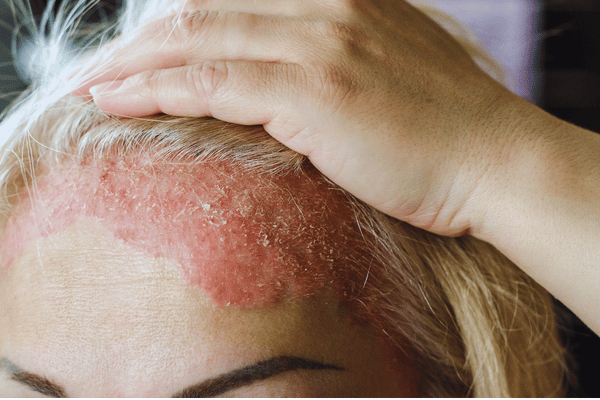
Case A — Adult Chronic Eczema
5+ Years of Recurring Atopic Dermatitis
An adult came in with five years of chronic atopic eczema, on both arms, both sides of the neck and the back of the knees. She had been on topical corticosteroids the entire time, her remission periods growing shorter and shorter each cycle. Itching was so severe she would wake from sleep four or five nights a week. She had been avoiding social activities, and just working out zapped her.
On examination we found a dampness-heat pattern sitting on blood deficiency. Tongue red with a thick yellow coating. Pulse: slippery and rapid. Spleen qi was weak, allowing the dampness to collect internally.
Xiao Feng San was prescribed with Ku Shen, Bai Xian Pi, and Di Fu Zi added to draw the dampness out. Needled twice a week at SP10, LI11 and ST36. Dairy and refined sugar eliminated.
Patients like this typically notice the itch dying down after about three weeks. Skin should look visibly different after six. Complete clearing may take anything from ten to twelve weeks. Sleep and energy can improve concurrently, as the internal system rebalances.

Case B — Childhood Eczema
Pediatric Atopic Dermatitis — Age 6
A six-year-old with eczema since infancy. Worst patches on the face, inner elbows and wrists. His parents had concerns about long-term steroid use on a child. Seasonal changes and specific foods aggravated his flares. Itching caused enough disruption at school to be a real problem.
TCM diagnosis was spleen deficiency with wind-dampness. His constitution was weak and the internal dampness built up with external wind to erupt through the skin. Tongue was pale with a thin white covering — classic qi deficiency.
Treatment relied on gentle spleen-strengthening herbs — Bai Zhu and Fu Ling — combined with slightly stronger clearing herbs. We added herbal soak baths three times weekly and systematic reintroduction of warming, digestible foods. No acupuncture. Pediatric tuina massage on the spleen and lung meridians instead.
Most children with this pattern are through the rough patch by four to six weeks. Flares normally diminish, appetite picks up, sleep gets calmer. Many children are able to reduce topical corticosteroids gradually as the herbal treatment takes effect — always with practitioner supervision.
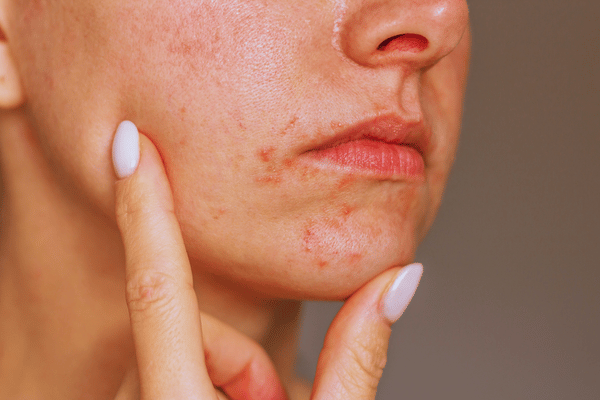
Case C — Perioral Dermatitis
Steroid-Induced Perioral Dermatitis
This patient began with a mid-potency steroid cream prescribed for mild but persistent facial eczema. Despite months of use the patient eventually developed perioral dermatitis — inflammatory bumps and redness around the mouth and chin. When the steroid was discontinued the rash worsened dramatically, showing a typical steroid rebound reaction.
Diagnosis pointed to stomach heat and damp-toxin accumulating. In Chinese medicine the facial area around the mouth maps to the stomach and spleen meridians. Liver qi stagnation from emotional stress was compounding the inflammatory response.
Internally the prescription focused on clearing stomach heat — Huang Lian and Zhi Mu — and resolving damp-toxin with Pu Gong Ying and Jin Yin Hua. External applications to the affected skin incorporated Qing Dai ointment. Acupuncture at ST44, LI4 and LR3 to regulate digestive heat and liver qi flow.
Perioral issues from steroid withdrawal take time in most cases — about 8 to 12 weeks before everything settles. Patients on the combined internal plus topical herbal treatment usually improve regularly over that period. Not the full rebound you see when stopping steroids cold-turkey.
Treatment Outcomes — Typical Improvement Metrics
3–6 wk
Typical Time to Noticeable Improvement
60%+
Patients Report Reduced Itching by Week 4
8–12 wk
Standard Full Treatment Course
350 Years of Royal Chinese Medicine — The Tong Ren Tang Heritage
Tong Ren Tang was founded in 1669, during the 8th year of Emperor Kangxi’s reign. By 1723 the pharmacy had been appointed official supplier to the imperial court — a position it held continuously for 188 years across 8 successive emperors, right through to the fall of the Qing Dynasty in 1911. No other traditional Chinese medicine institution holds this distinction.
The brand’s founding motto — “No labor shall be spared in the preparation of medicines; no material shall be less than the finest” — set the quality standard that has governed every herbal formula produced under the Tong Ren Tang name for over three centuries. This is not marketing language. It was a documented operational principle that determined which herbs entered the imperial pharmacy and which got rejected.
Today Tong Ren Tang operates in over 25 countries. The UAE clinic brings this 350-year therapeutic tradition directly to patients in the region, combining classical TCM diagnostic methods with modern clinical protocols. Every practitioner trained under the Tong Ren Tang system learns the same pattern differentiation methods that served China’s royal families — applied now to conditions like atopic dermatitis, chronic skin disease, and complex dermatological cases that have not responded to conventional treatment.
Your First Visit — What to Expect at Tong Ren Tang
No surprises about what will happen at your first visit—know what to expect. This is how the process will go for those seeking eczema care.
1
Book Online or WhatsApp
2
Arrive & Complete Intake
3
TCM Diagnosis (30–45 min)
4
Receive Your Prescription
5
Begin Treatment
What Happens During the Diagnosis
Your TCM practitioner takes a 30-45 minute diagnostic history. In contrast to a skin-centered dermatologic consultation, an evaluation of your whole constitution occurs. Three pulse positions are palpated to obtain an understanding of the function of various organ systems, while the tongue is examined for patterns of heat, cold, dampness or deficiency. Your practitioner inquires about your digestion, sleep, mood, energy, and the course of your dermatitis, prior to presentation, assessments that help inform treatment plans.
This point also calls to mind a pattern diagnosis within TCM. Your point prescription, treatment modality mix, and dietary recommendations all draw from this diagnosis.
Factors Affecting Your Treatment
There are many variables that factor into how long you need to be on a treatment course for managing your eczema and for what type of formulation: How chronic / severe your eczema is, what pattern was diagnosed, if you are using corticosteroid medication (and the tapering schedule for it) along with Chinese herbs, if you are using just an herbal formula or an herbal formula in conjunction with acupuncture / herbal baths as therapies, and if you are following the dietary recommendations and lifestyle modifications. Your practitioner will cover these points and give you a treatment plan you can understand on your first appointment.
Treatment Timeline Expectations
Acute eczema flares
Plausible response can usually be seen within about 2-4 weeks in patients with recent-onset or acutely inflamed atopic dermatitis. Improvement in pruritus is often the first sign of improvement, then reduction in erythema, resolution of lesions.
Chronic eczema
For old skin conditions with years or even decades of use of steroids an 8-12 week course may be necessary. During the first 2-3 weeks there may not be much visible change as the herbal formula re-balances the internal system. Visible changes generally start at 3-4 weeks with the clearing of the skin continuing throughout the course.
Maintenance phase
After the initial course of treatment, many patients will switch over to a milder herbal formula taken periodically (weekly or biweekly) with the purpose of maintaining overall body balance and preventing a future flare-up. Once the body has stabilized, the frequency of herbal dosing diminishes incrementally.
Eczema Chinese Medicine Interactive Tools
FAQ — Eczema & Chinese Medicine Treatment
Xiao Feng San (Wind-Dispelling Powder) is probably the most widely used Chinese herbal formula for eczema — a classical prescription that dispels wind, resolves dampness, and clears heat from the blood. No single remedy works for everyone, but based on the pattern diagnosed, your TCM practitioner will modify the formula to best suit your condition. Common ingredients include Ku Shen (Sophora) for dampness and itching; Huang Qin (Scutellaria) for heat resolution; Zi Cao (Lithospermum) for blood-cooling; and Qing Dai (Natural Indigo) for topical anti-inflammatory. Your herbal formula gets revised at follow-up appointments as your condition progresses.
Chinese medicine views eczema as originating internally, then showing up on the skin as an external symptom. Herbs and acupuncture work on correcting the internal imbalance driving the condition. A working diagnosis is made through TCM pattern assessment — typically dampness-heat, wind-dampness, or blood deficiency. From there your practitioner builds a personalized herbal formula matched to your specific pattern. Acupuncture at points like SP10 and LI11 helps regulate the immune response by controlling inflammatory mediators within the skin. Dietary changes cut out foods that generate dampness and heat internally. This multi-layered approach treats the condition at several levels: the internal organs, the blood, and the body’s defensive qi.
Rather than speaking of the Chinese medicine treatment as a “cure” to eczema (atopic dermatitis), practitioners limit their expectations to the creation of a long-lasting remission of the disease process. The condition is not thought to be “curable” because of its genetic basis and the external contributors in an individual’s environment. What Chinese medicine can provide is the limitation of relapses, healing of the systemic internal imbalance, and stabilization of the skin. Some patients have completed only two courses of acupuncture and Chinese herbs and remained eczema-free for ten years. Others, even with chronic disease, experience few or no further flare-ups after treatment ends. While individual results vary, most patients experience improvement, if not complete elimination, of their dermatitis condition over the course of treatment.
The traditional Chinese medicine framework for understanding eczema is centered in the organ systems of the spleen (SP), lung (LU), and liver (LV). The spleen holds the original essence of the body from conception; when spleen qi fails to transform and transport fluid as it should, dampness is generated internally and manifests outwardly in the form of weeping, itchy skin lesions. The lung plays a primary role in the defensiveness of the body, and when lung function is weakened, the natural barrier (wei qi) that guards against wind invasion is compromised. Wind contributes to dryness, itching, and leaking in eczema. The liver stores blood and according to Chinese medicine theory, a congested liver then generates excess heat, which rises to the skin and renders it inflamed. Most patients demonstrate disharmony in one or more of these three organ systems.
Stress and frustration stagnate liver qi, generating heat that rises to the skin. Anxiety weakens spleen function, producing dampness. Grief impairs the lung. Our protocols include liver-soothing herbs and stress-regulating acupuncture alongside the core eczema treatment.
When prescribed by a licensed TCM practitioner and using good quality herbs from a known source, generally there are very few side effects. Some people may notice slight changes in bowel movements (having slightly looser bowel movements or feeling slight warmth in the stomach) for the first few days, as the body adjusts to the herbal formula. Usually these effects last no more than a week. Tong Ren Tang sources herbs from a known source, through a controlled supply chain that has quality testing along the way to ensure the medicines are of a good standard, as has been the case over Tong Ren Tang’s 350+ years in operation. Your Chinese medicine practitioner will check how you respond to the treatment at the follow-ups, and may adjust the formula accordingly if you experience any discomfort. If you are taking Western medication, please make sure your Chinese medicine practitioner is aware of everything you are taking so we can see if there is any herb-drug interaction.
Most patients will notice a relief of the itching sensation within 2-3 weeks. Clinical improvements of the skin usually appear by the 3rd-4th week. 8-12 weeks may be needed to complete a course of treatment for chronic atopic eczema. Flares of acute eczema may respond to treatment in less than 2 weeks. The time scale varies according to duration of the condition, a weaning off topical corticosteroids (a higher commitment phase to recover the skin before weaning off corticosteroid maintenance) the severity of the skin lesions and adherence to the Chinese dietary protocol. Compared to corticosteroid creams which offer quick relief to the surface layer of the skin, Chinese medicine heals the skin from the inside out providing its over 2-4 week period to rebalance the internal organs before the skin changes show through.
Yes. TCM formulas for children use gentler herbs at lower doses, adjusted for age and body weight. For infants who cannot take herbal decoctions, we offer herbal baths and pediatric tuina massage instead.
There are indeed several straightforward natural options for eczema management: remove potential trigger foods (especially wheat, dairy and processed sugar), keep skin well hydrated with soap-free emollients, reduce stress with regular exercise or meditation, and apply cooling herbal formulas (like aloe vera or coconut oil) directly to affected areas. Nevertheless, few cases of moderate-to-severe atopic eczema can be improved with this approach alone. Chinese herbal medicine presents a structured framework of natural treatment that extends beyond superficial skin care – it actively treats the underlying dampness, heat or blood deficiency pattern (the “root”) behind the outward skin manifestation (the “branch”). Through use of the individualized herbal combinations, acupuncture, and TCM focus upon diet therapy we have a clinical reality for the natural treatment of eczema that removes the reliance upon topical steroids.
The cause of eczema in Chinese medicine is a disturbance within the internal organ systems of the body, not the skin. The skin condition is an external manifestation of a core imbalance. For example, eczema may develop due to: spleen deficiency with dampness (unable to extract water and transform it into chi so it lingers in tissues); liver heat or liver qi stagnation (producing inflammatory heat); lung deficiency (body unable to defend itself against external pathogenic factors); or blood deficiency (lacking substances to moisten and nourish the skin). Usually in chronic eczema there are several factors combined together into one pattern. Factors such as the environment, diet, emotions and constitution play a part in disturbing the systems. Treatment in Chinese medicine is individualized according to the unique pattern combinations in each patient which explains why two patients with seemingly identical eczema get prescribed completely different herbal formulas.