Get in Touch with Tongren Tang Gulf

Migraine Treatment in Dubai: Acupuncture, Herbs and Trigger Tracking

Dubai migraine guide
Migraine treatment in Dubai is a safety-first care pathway that can combine neurologist triage, prescribed acute or preventive care, acupuncture support, herb safety review, and trigger tracking when appropriate. Start by ruling out urgent neurological warning signs, then bring a useful trigger record instead of guessing from memory.
Migraine is not only a bad headache that happens on a busy day. For many people it is a neurological condition that can disrupt work, driving, sleep, family plans, prayer times, travel, and heat exposure. People may search for a migraine doctor, a migraine clinic, the best migraine doctors, a doctor for migraine treatment, medication options, acupuncture, herbs, or migraine relief because the same word covers very different situations.
This guide is written for readers comparing migraine treatment in Dubai and considering Traditional Chinese Medicine support. It does not replace a neurologist, emergency care, prescribed medicine, MRI or CT scan decisions, or a medical diagnosis. It helps you prepare better questions before a consultation, especially if you want acupuncture, Chinese herbal medicine, and trigger tracking to sit inside a safe treatment plan. Migraine headache can be part of a broader pattern of headaches and migraines, so personalized care starts by describing the whole pattern, not only the pain score.
Short answer: if the headache is sudden, unusually severe, linked with weakness, confusion, seizure, vision loss, high fever, neck stiffness, pregnancy, recent childbirth, a head injury, aura lasting more than 1 hour, or an attack lasting more than 72 hours, do not treat it as a routine TCM appointment. Seek urgent medical care first.
What Migraine Treatment in Dubai Should Clarify First
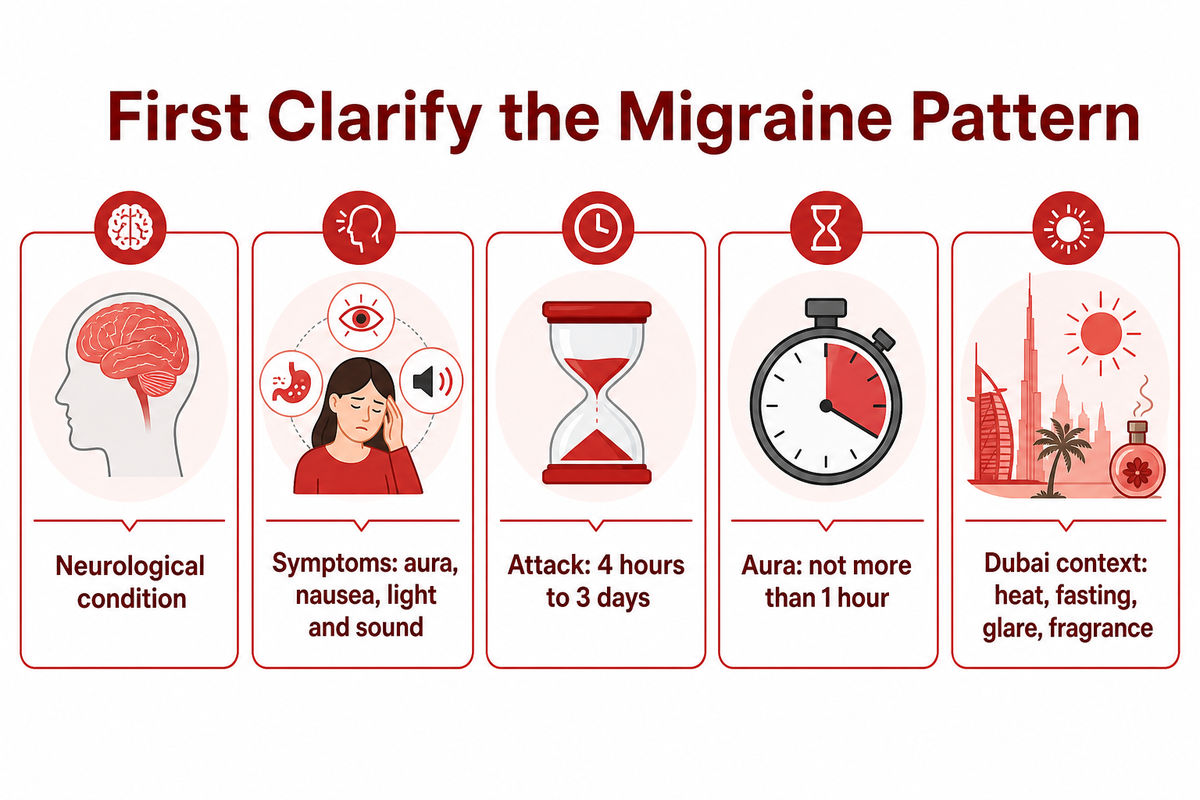
Migraine is a neurological condition, not just a bad headache, and it can include aura, nausea, vomiting, tingling, numbness, or sensitivity to light and sound. Some people have prodrome warning signs before the headache phase, such as fatigue, mood change, food craving, neck stiffness, or a sense that something is coming. Some see flashing lights, zigzags, blind spots, or other aura changes. Others feel a tingle, numbness, dizziness, or speech difficulty.
For clinical background on migraine classification, symptoms, and treatment boundaries, this guide uses a peer-reviewed migraine review alongside public patient guidance.
The migraine pain itself may throb, feel like intense pain, and usually affects one side, although it can move or involve both sides. A throbbing headache that typically affects one side of the head and worsens with movement is a common pattern, but it is not the only pattern. Some people have migraine with aura, some have migraine without aura, and some may use terms like silent migraine, vestibular migraine, or hemiplegic migraine after a clinician has helped them classify their symptoms. These types of migraines should not be self-diagnosed from a blog.
Migraine attacks can last from 4 hours to 3 days, and aura symptoms should not last more than 1 hour. That timing matters because a severe migraine that keeps extending, changes character, or adds new neurological symptoms needs a different response from a familiar migraine episode that follows your usual pattern.
Dubai adds practical variables. Heat, dehydration, skipped meals, fasting schedules, long commutes, screen glare, fragrance exposure, late nights, caffeine changes, air travel, and shift work can all blur the picture. These factors do not prove migraine causes in an individual sufferer, but they are worth tracking because they help a clinician see patterns across several times a month, not only during one bad day. Living with migraine is often easier when the record shows what changed before the attack.
When a Migraine Needs a Neurologist or Urgent Care
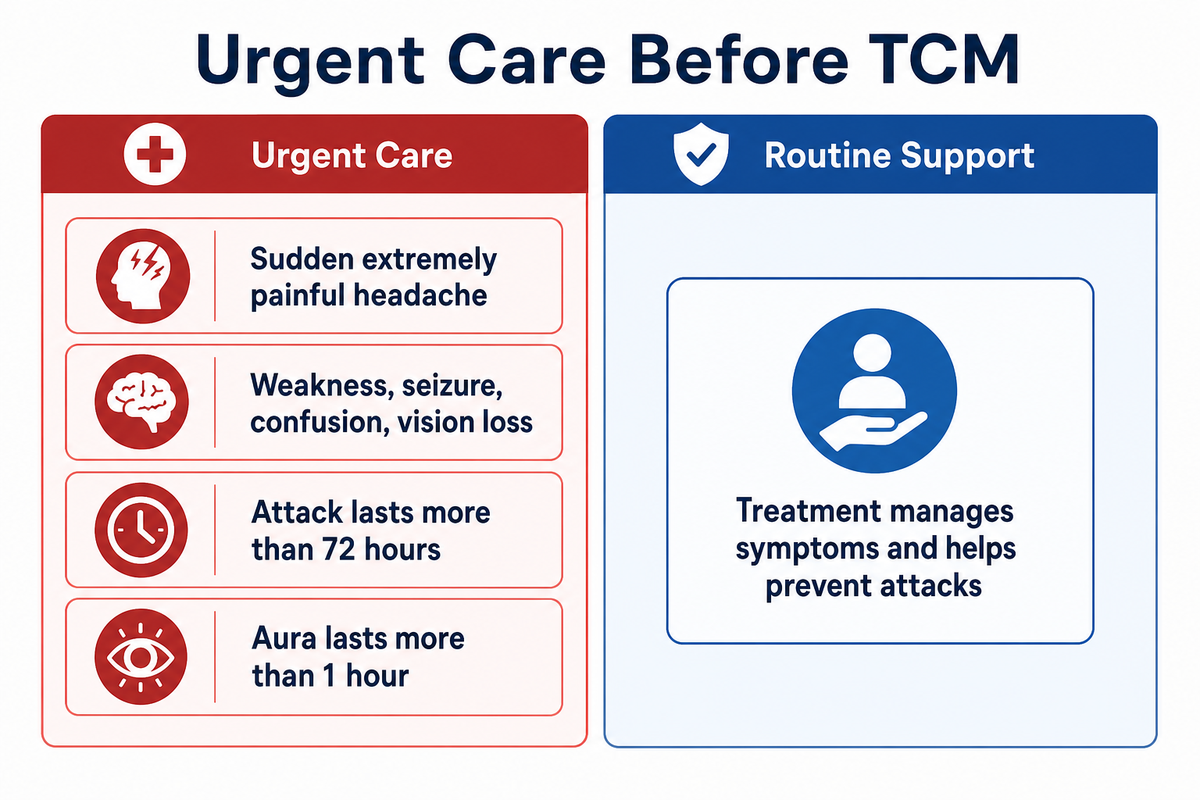
Before thinking about acupuncture or herbs, separate routine support from red-flag care. Seek emergency care for a sudden extremely painful headache, new weakness on one side, seizures, confusion, vision loss, fever with neck stiffness, or a headache after a head injury. Also seek urgent advice if a migraine attack lasts more than 72 hours, aura lasts more than 1 hour, or the person is pregnant or recently had a baby.
Neurologists in Dubai can help when migraine symptoms are severe, changing, difficult to control, more than weekly, linked with regular menstrual migraine, or mixed with other types of headaches such as tension headaches or cluster headaches. They can also decide whether MRI, MRI or CT, or MRI or CT scan is appropriate to rule out other conditions. Imaging is not needed for every migraine patient, but it may be important when the medical history or examination raises concern.
Migraine treatment cannot cure migraine, but it can manage symptoms and help prevent attacks. That sentence is important because many people search for an instant fix or a permanent cure when they are exhausted by recurring debilitating headaches. The safer goal is to reduce the frequency and severity, shorten attacks, protect quality of life, and use the right treatment options at the right time.
Complementary headache care should stay inside that boundary; NCCIH headache guidance is useful because it discusses headaches without replacing medical diagnosis or urgent care.
Acute treatment may include medicines such as pain relievers, anti-nausea medicine, gepants, or a triptan when prescribed and appropriate. Preventive medicine, lifestyle changes, trigger management, acupuncture support, and other approaches may fit differently depending on frequency and severity, existing conditions, pregnancy plans, work demands, and medicine response. Do not stop prescribed medicine because an acupuncture appointment is scheduled.
How Acupuncture Fits Into Migraine Prevention Support
Acupuncture may help some people with headaches or migraine, but it should be treated as supportive care rather than a replacement for urgent assessment, prescribed acute medicine, or preventive neurology care. The value is usually discussed around prevention support, nervous-system regulation, pain management, sleep, neck tension, stress load, and individualized pattern assessment, not emergency pain rescue.
The acupuncture discussion here follows the cautious framing in the NCCIH provider digest on headaches and complementary approaches.
Good acupuncture conversations should sound measured. The practitioner should ask about your diagnosis, migraine diary, medical history, medicines, pregnancy status, bleeding risk, recent surgery, fainting tendency, and whether your symptoms have changed. Needles should be sterile and single-use. If your current attack is unusual, severe, or linked with new neurological symptoms, the appointment should pause and medical care should come first.
Response varies. Some migraine sufferers report fewer headache days or better sleep after a course of treatment, while others need neurology-led preventive treatment, medication adjustment, or a different diagnosis. The International Headache Society diagnostic criteria and local medical assessment are still relevant because treatment for migraines depends on the type, pattern, and risk profile.
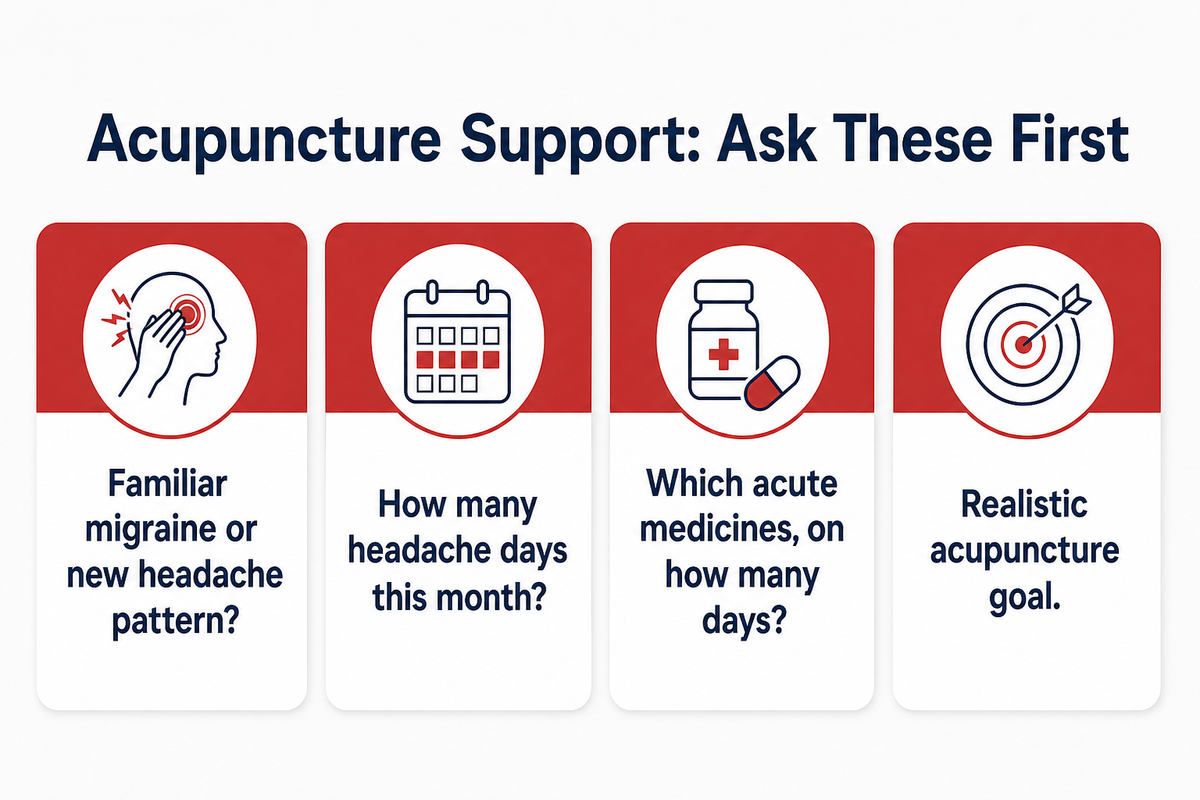
| Question | Why it matters |
|---|---|
| Is this familiar migraine, severe migraine, or a new headache pattern? | New or changing symptoms may need neurologist review before TCM support. |
| How many headache days occurred this month? | Frequency helps separate occasional attacks from chronic migraine risk. |
| Which acute medicines were used, and on how many days? | Medication overuse can worsen headache patterns and needs clinician guidance. |
| What is the realistic goal of acupuncture? | Supportive goals such as prevention, sleep, and tension control are safer than cure language. |
If you are comparing TCM services, review the clinic’s published treatments and ask how the practitioner coordinates with medical care when symptoms suggest a neurologist is needed.
Herbs and Supplement Safety: What to Discuss Before You Take Anything
Herbs are often discussed alongside acupuncture, but the safety bar is higher than many readers expect. Dietary supplements and herbs can interact with medicines, create risks during pregnancy, breastfeeding, childhood, surgery, liver disease, or anticoagulant use, and should be reviewed with a qualified clinician.
For supplement risk framing, this article follows NCCIH guidance on using dietary supplements wisely.
This includes products that sound natural. A supplement may still affect bleeding risk, blood pressure, blood sugar, liver metabolism, sedation, fertility planning, or prescribed migraine medication. People using anticoagulants, diabetes medicines, blood-pressure medicine, antidepressants, antiseizure medicine, regular painkillers, triptan therapy, or preventive neurology medication should bring a full list to the consultation.
Do not ask only, “Which herb works?” Ask safer questions:
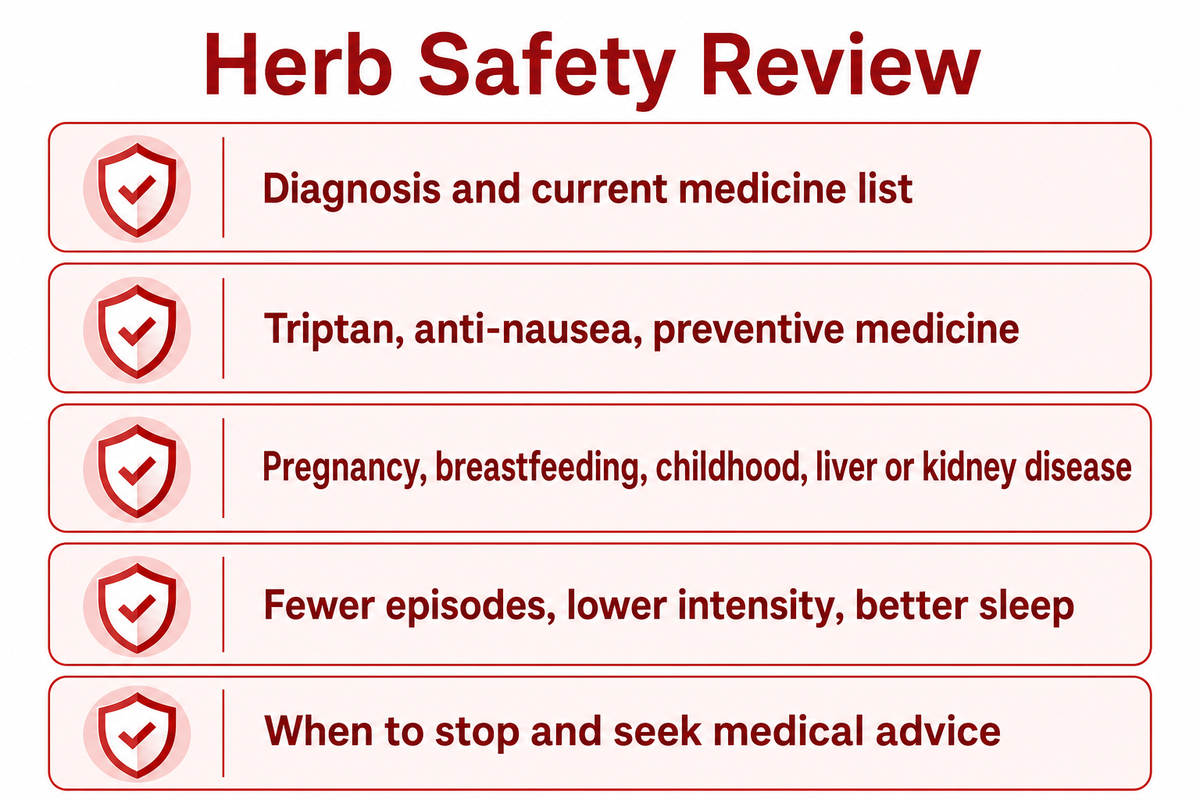
- Is this herb appropriate for my diagnosis, migraine symptoms, and current medicine list?
- Could it interact with a triptan, anti-nausea medicine, preventive medicine, anticoagulant, diabetes medicine, or planned surgery?
- Should I avoid it during pregnancy, breastfeeding, fertility treatment, childhood, liver disease, kidney disease, or before procedures?
- How will we judge whether it helps: fewer migraine episodes, lower intensity, better sleep, or less neck tension?
- When should the herb be stopped and medical advice sought?
A TCM herbal consultation should be individualized. It should not sound like a universal protocol for every migraine patient. It should also avoid claiming that one formula is an effective treatment for everyone, because headache patterns differ and the exact cause is not always obvious from symptoms alone.
Trigger Tracking: The 14-Day Dubai Migraine Pattern Map
A migraine diary can help a clinician diagnose migraine, recognize possible triggers and warning signs, assess acute or preventive medicines, and see attack patterns. Keeping a headache diary is also useful before a TCM appointment because it prevents the whole consultation from depending on memory.
The diary and trigger-tracking approach is aligned with clinical migraine review evidence, including the peer-reviewed migraine review used for this article’s evidence map.
Stress, sleep changes, hormonal shifts, caffeine or alcohol, weather and heat, diet, dehydration, light, smell, and medication overuse are common trigger patterns to track. In Dubai, the diary should also make room for summer heat, low fluid intake, fasting or delayed meals, strong perfume or oud, smoke, mall lighting, screen glare, late-night work, gym dehydration, air-conditioning changes, and long drives.
Use 14 days as a practical starting window. It is short enough to complete and long enough to catch weekday/weekend differences. If migraine episodes happen several times a month, continue longer and bring the record to both your neurologist and TCM practitioner.
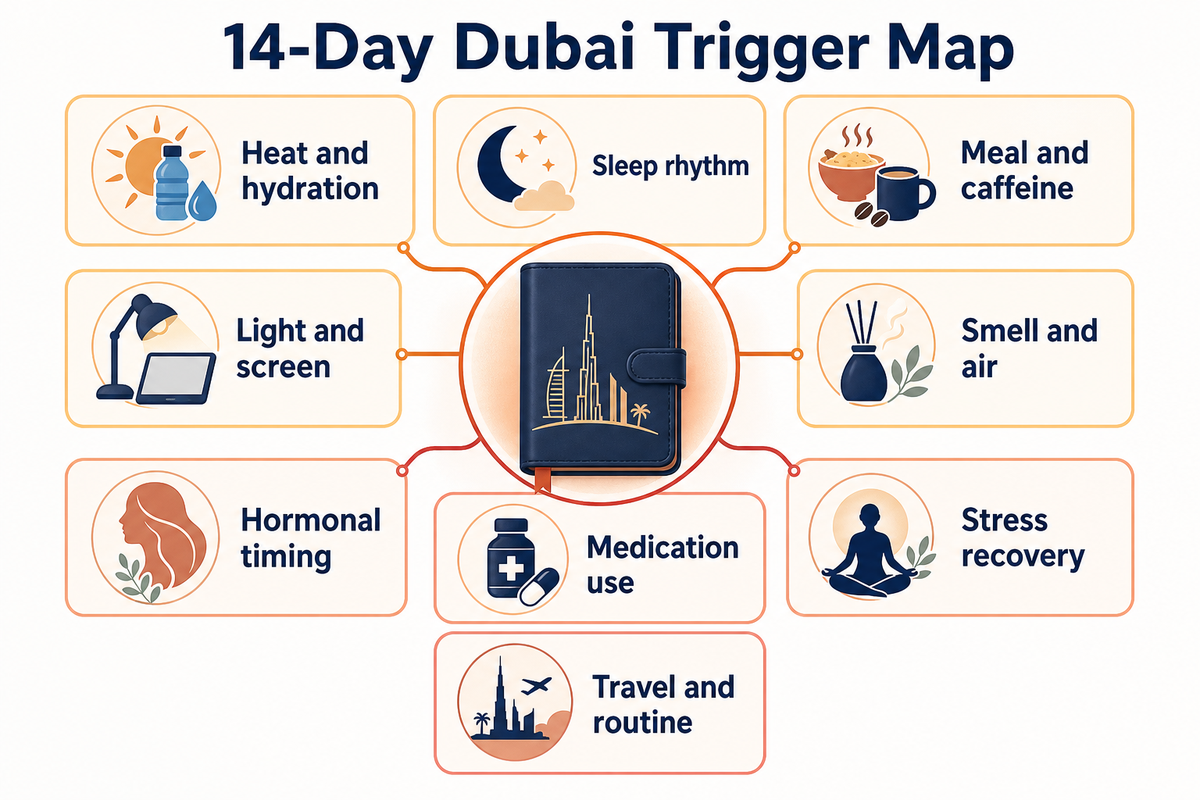
| Trigger type category | Dubai context | What to track for 14 days | Escalation boundary |
|---|---|---|---|
| Heat and hydration cluster | Summer heat, gym sessions, long outdoor walks, or taxi-to-metro transfers. | Record heat exposure, fluid pattern, urine color notes, and headache timing over the next 4 to 72 hours. | Seek urgent advice if an attack lasts more than 72 hours or feels unlike your usual pattern. |
| Sleep rhythm cluster | Late-night work, shift changes, jet lag, or wake-up headaches after short sleep. | Write bedtime, wake time, naps, screen cutoff, and whether sleep was under 6 hours. | Discuss frequent morning attacks, severe vomiting, or neurological changes with a doctor. |
| Meal and caffeine cluster | Fasting, delayed lunch, skipped breakfast, coffee changes, or dehydration during errands. | Note meals delayed more than 4 hours, caffeine timing, nausea, and medicine response. | If vomiting prevents oral medicine, ask for medical advice rather than repeating doses. |
| Light and screen cluster | Mall lighting, phone glare, office screens, night driving, or bright clinic corridors. | Record screen blocks over 30 minutes, light sensitivity, aura timing, and whether rest helped. | Vision loss, new aura, or aura lasting more than 1 hour needs medical assessment. |
| Smell and air cluster | Perfume, oud, smoke, cleaning products, AC changes, or crowded indoor spaces. | Log exposure minutes, nausea, dizziness, light sensitivity, and whether symptoms started within 24 hours. | New breathing difficulty, fainting, or sudden severe pain should not be managed as routine migraine. |
| Hormonal timing cluster | Cycle days 1 to 5, fertility treatment, pregnancy, postpartum weeks, or contraceptive changes. | Record cycle day, aura, nausea, medicine use, and whether this repeats across 2 cycles. | Pregnancy or recent childbirth with headache should be treated as a medical review priority. |
| Medication-use cluster | Frequent painkiller, triptan, anti-nausea, or rescue medicine use during busy weeks. | Count acute medicine days, including use over 2 days per week or more than 10 days per month. | High use can worsen headache patterns and should be reviewed before adding herbs. |
| Stress recovery cluster | Work peaks, exams, family pressure, poor sleep after stress, or weekend let-down attacks. | Rate stress from 0 to 10, note relaxation time, and check symptoms again after 24 hours. | Seizure, confusion, weakness, or a sudden worst headache is urgent care, not stress tracking. |
| Travel and routine cluster | Flights, long drives, Ramadan schedule shifts, hotel sleep, or air-conditioning changes. | Track time-zone shift, meal timing, hydration pattern, sleep length, and attack onset within 3 days. | New neurological signs after travel need medical assessment before TCM treatment. |
Look for clusters, not single-day blame. One missed coffee may not explain everything. But three attacks after short sleep, heat exposure, and delayed meals create a more useful pattern. The goal is personalized migraine planning, not a rigid list of forbidden foods.
A TCM Consultation Path at Tong Ren Tang Dubai
A 2024 UAE expert consensus on acute migraine treatment was developed by neurologists to help standardize acute migraine care in the UAE. That local medical context matters: TCM support should not pretend that all migraine care is the same as wellness care. For acute treatment, changing symptoms, chronic migraine, severe migraine, or complex neurological disorder questions, a neurology pathway remains important.
For the local UAE medical context, see the PubMed-indexed UAE acute migraine consensus.
Tong Ren Tang Dubai presents DHA licensed physicians, a Dubai Healthcare City clinic, multilingual English, Arabic, and Chinese support, major insurance acceptance, and authentic premium herbs. Its treatment page also presents TCM modalities such as acupuncture, moxibustion, cupping, and Tui Na/remedial massage. These facts help a reader understand the service environment; they do not prove that every migraine patient should choose the same care plan.
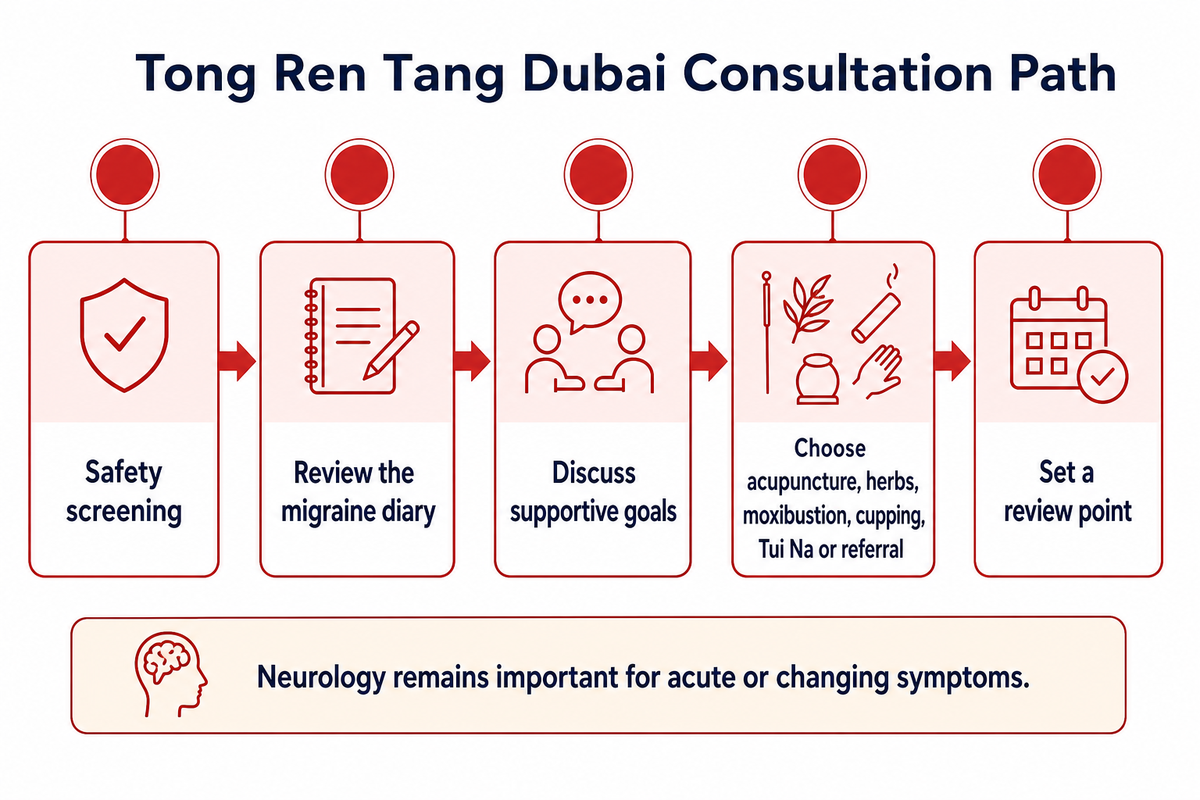
A balanced first visit can work like this:
- Start with safety screening: red flags, medical history, diagnosis, neurological symptoms, medicine list, pregnancy status, and previous imaging or specialist notes.
- Review the migraine diary: headache days, severity, aura, nausea, vomiting, triggers, medication days, and recovery time.
- Discuss supportive goals: reduce frequency and severity, manage symptoms, improve sleep regularity, reduce neck tension, and support pain management.
- Decide whether acupuncture, herbs, moxibustion, cupping, Tui Na, or referral back to a neurologist is appropriate.
- Set a review point: what would count as improvement, what would count as no response, and what symptoms require urgent care.
Readers who want to understand the clinic background can review Tong Ren Tang Dubai, compare acupuncture in Dubai, check pricing and packages, and read the practical guide on how many acupuncture sessions may be needed for different goals.
Bring your diary before asking for a plan
A trigger record, medicine list, and red-flag history help the practitioner decide whether TCM support is appropriate or whether neurology review should come first.
How to Prepare for Your Appointment
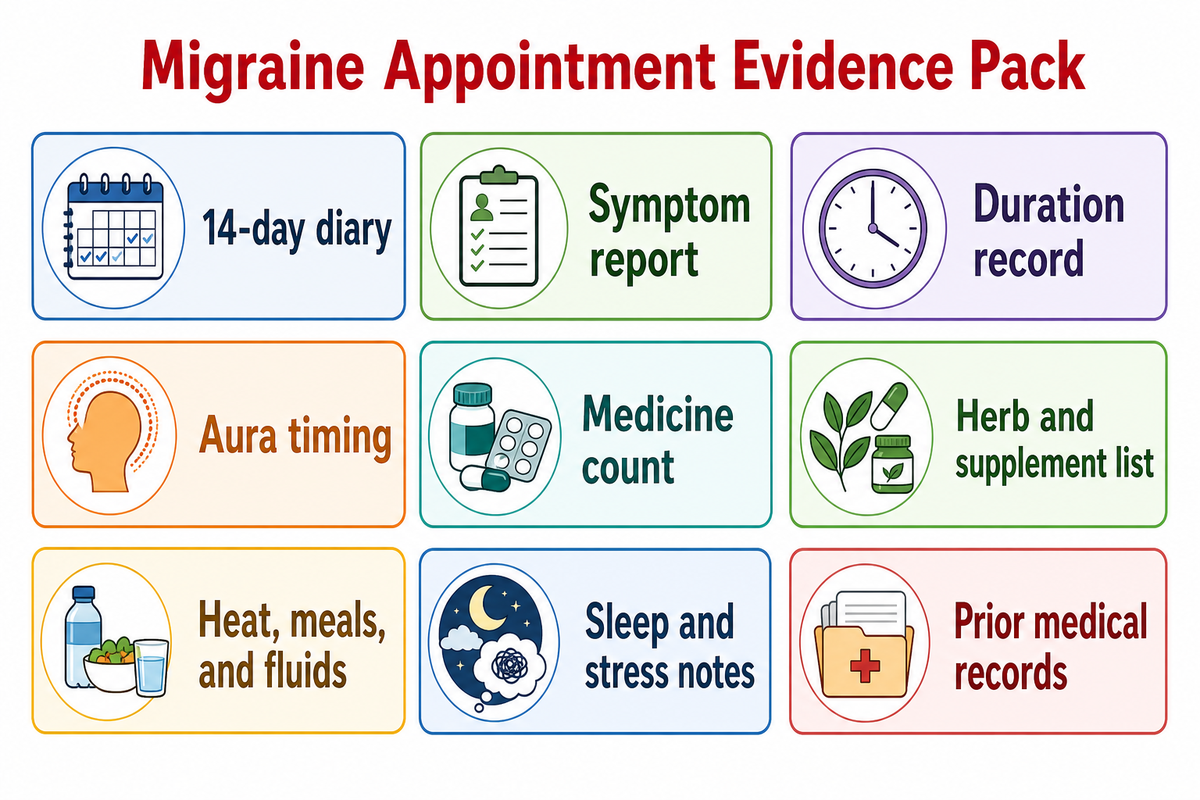
Preparation makes migraine care more precise. Bring a written diagnosis if you have one, the names and doses of medicines, allergy history, supplement list, previous MRI or CT scan notes if relevant, and details of any neurological examination. If you have never been diagnosed, say that clearly. If another clinician has told you that you have migraine, vestibular migraine, hemiplegic migraine, or another headache condition, bring that record.
Also bring context that is easy to forget: sleep pattern, shift work, travel, air-conditioning exposure, fasting periods, menstrual timing, caffeine changes, alcohol intake, gym dehydration, stress peaks, perfume or smoke exposure, screen use, and whether attacks occur before, during, or after the workday.
Migraine Appointment Evidence Table
| Evidence source | Reference value to bring | Decision it informs | Clinical boundary |
|---|---|---|---|
| 14-day diary | Attack dates, start time, recovery time, and missed work or sleep. | Shows whether the pattern is occasional, several times a month, or changing. | A diary supports assessment; it is not a diagnosis. |
| Symptom report | Pain side, nausea, vomiting, aura, tingling, numbness, light sensitivity, and 0 to 10 severity. | Helps compare migraine symptoms with other headache types. | New weakness, seizure, confusion, or vision loss needs urgent care. |
| Duration record | Whether attacks last 4 hours, 24 hours, 72 hours, or more than 3 days. | Separates familiar episodes from prolonged or changing attacks. | More than 72 hours should be escalated for medical advice. |
| Aura timing | Start time, visual changes, speech symptoms, tingling, and whether aura exceeds 1 hour. | Guides safety screening before acupuncture or herbs. | Aura longer than 1 hour needs medical assessment. |
| Medicine count | Name, dose, response, side effects, use over 2 days per week, or use over 10 days per month. | Helps identify medication-overuse risk and coordination needs. | Do not stop prescribed medicine without the prescriber. |
| Herb and supplement list | Product names, ingredients, start date, and any bleeding, liver, pregnancy, or surgery concerns. | Supports interaction screening before adding Chinese herbal medicine. | Natural products can still interact with medicines. |
| Heat, meals, and fluids | Heat exposure, delayed meals over 4 hours, caffeine change, and fluid pattern; do not treat this as a hydration prescription. | Helps compare Dubai-specific trigger context with symptom timing. | Severe dehydration or fainting needs medical care. |
| Sleep and stress notes | Sleep under 6 hours, late screen use, stress rated 0 to 10, and symptoms after 24 hours. | Shows whether prevention support should focus on rhythm, stress load, or neck tension. | Stress does not explain red-flag neurological symptoms. |
| Prior medical records | Diagnosis letters, imaging dates, medication trials, allergies, and specialist notes from the last 12 months. | Prevents the visit from repeating work already done by a GP or neurologist. | Changing symptoms may require updated medical review. |
Good questions include:
- Do my symptoms fit migraine, or should I be assessed for other types of headaches first?
- Are any warning signs present that make acupuncture or herbs inappropriate today?
- How will this treatment plan coordinate with my neurologist or GP?
- What should I do if pain escalates, aura changes, or vomiting prevents oral medicine?
- Which herbs or supplements should I avoid with my current medicines?
- What outcome are we tracking: fewer attacks, lower intensity, shorter duration, better sleep, or fewer medication days?
The best appointment is not the one that gives the longest list of treatments. It is the one that protects safety, understands your pattern, and sets a clear review point.
For preparation around supplements and safety disclosures, use the same NCCIH supplement-safety guidance that underpins the herb discussion above.
Frequently Asked Questions
Is migraine 100% curable?
No reliable migraine guide should promise a 100% cure. Treatment usually aims to manage symptoms, reduce headache-day frequency, and improve function. Treat a permanent-solution promise as a safety concern; NCCIH headache guidance keeps the same safety-first boundary for patients comparing care options.
Can acupuncture help migraine?
Acupuncture can be part of the management of migraine for some people, especially as supportive or preventive care after red flags have been excluded. It should be performed by a qualified practitioner using sterile needles and should not delay urgent medical care or replace prescribed acute medicine. Track headache days, attack duration, medicine use, sleep, neck tension, side effects, and goals before a defined review, then compare the record with your clinician.
Are herbs safe for migraine?
Some herbs and supplements may be unsafe for certain patients or may interact with medicines. Safety depends on your medical history, pregnancy or breastfeeding status, liver or kidney concerns, planned surgery, and current prescriptions. Discuss herbs before taking them, especially if you already use migraine medicine.
How long should I track triggers?
Start with 14 days before an appointment, recording sleep, meals, fluids, medicine use, heat, light, smell, and stress. Continue longer if attacks are infrequent, if the pattern changes, or if your clinician asks for a wider record before a later clinical review.
When should I see a neurologist in Dubai?
See a neurologist when symptoms are severe, worsening, difficult to control, frequent, unusual for you, or linked with neurological changes. Neurologists in Dubai can diagnose migraine, rule out other conditions, and advise acute and preventive treatment options. TCM support can then be discussed around that safety boundary.
References & Sources
- NHS: Migraine
- NCCIH: Headaches and complementary health approaches
- NCCIH: Headaches – what you need to know
- NCCIH: Using dietary supplements wisely
- The Migraine Trust: Keeping a migraine diary
- American Migraine Foundation: Top migraine triggers
- PubMed: Acute Treatment of Migraine – UAE expert consensus statements
- PMC: Migraine management and non-pharmacological points
![Postpartum TCM Care: Safety Questions for Dubai [Guide]](https://tongrentang.ae/wp-content/uploads/2026/09/postpartum-tcm-care-blog-featured-768x512.png)