Get in Touch with Tongren Tang Gulf

Updated August 2026
Moxibustion heat therapy uses moxa or a related heat source near, on, or through selected treatment sites. This guide does not diagnose a “cold pattern,” clear anyone for treatment, rank benefits, or teach home technique. It prepares better questions for a qualified consultation and shows when medical assessment should come first.
Moxibustion heat therapy is not one standardized dose. Technique, combustion, distance, duration, room conditions, skin condition, and a person’s ability to report heat all change the exposure. A TCM cold-pattern discussion therefore cannot replace medical diagnosis or individualized safety review.
Before You Use This Guide
- This is an educational conversation guide, not a validated screening test.
- A reassuring answer does not rule out disease or guarantee that heat therapy is suitable.
- New, severe, progressive, acute, or unexplained symptoms need an appropriate medical assessment.
- No temperature, body-point, treatment duration, or self-use instructions are provided here.
- Do not change prescribed medication because symptoms improve; speak with the prescriber.
Quick Answer: What Moxibustion Heat Therapy Is
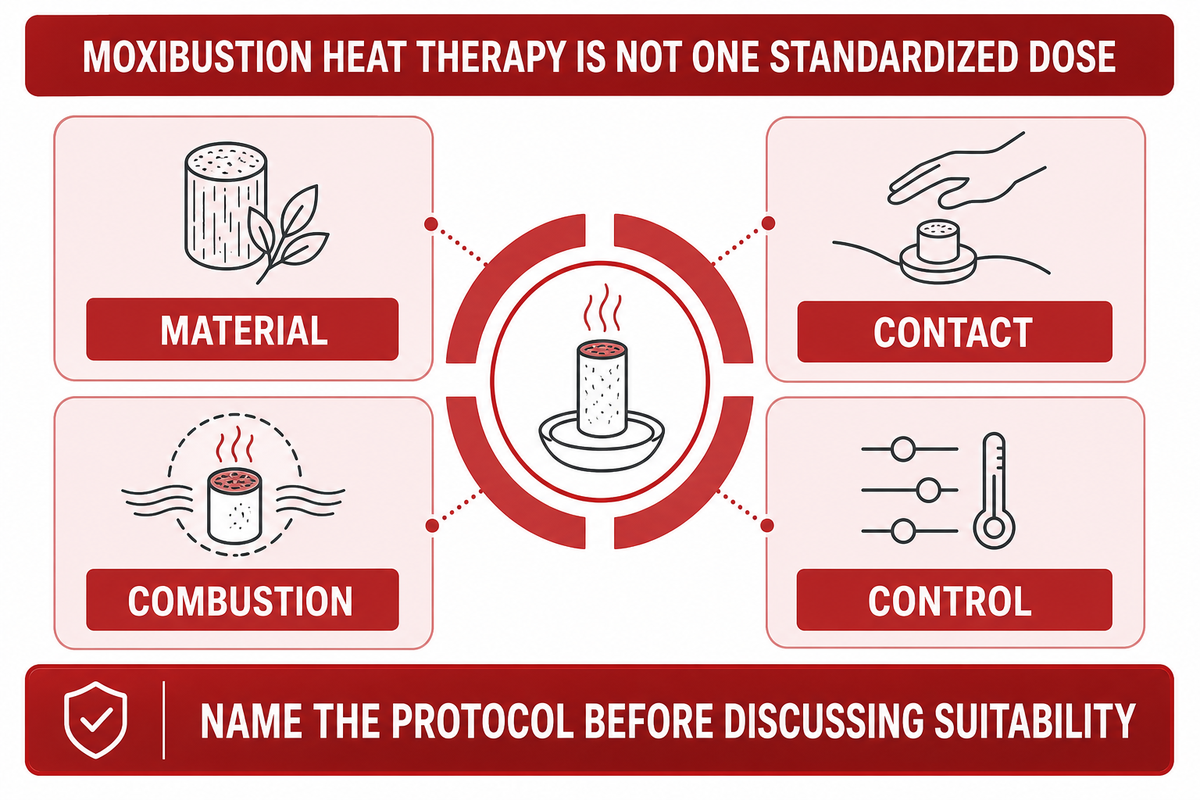
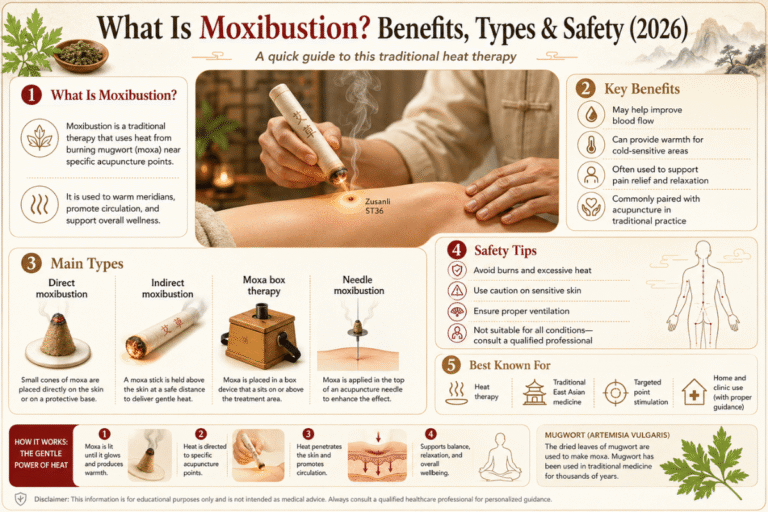
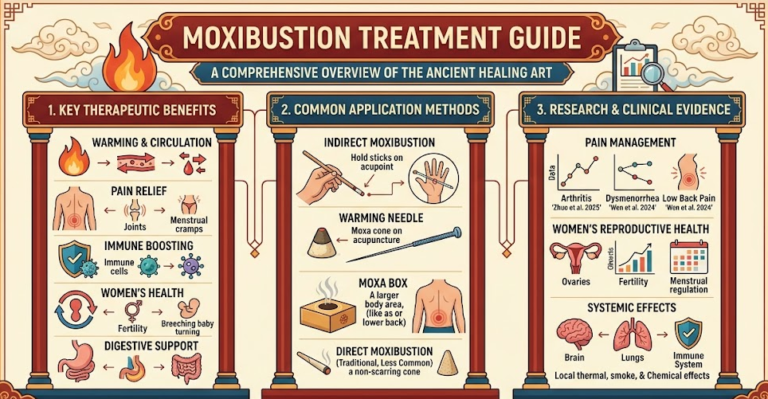
Moxibustion is a form of heat therapy with several protocols. Traditional methods process mugwort into moxa wool, a moxa cone, or a moxa stick, then apply heat directly on a protected site, above the skin, or in connection with an acupuncture needle; newer methods may change the material or heat source. Those safety boundaries include keeping prescribed-medication decisions with the prescriber, whatever heat protocol is discussed.
University of Minnesota’s moxibustion overview describes direct moxibustion and indirect moxibustion. In TCM explanations, a practitioner may connect an acupuncture point with qi or a meridian; those concepts remain traditional-theory terms rather than biomedical mechanisms. Peer-reviewed mechanism research adds that method, insulating material, combustion, and distance change thermal exposure.
The practical risk is protocol mismatch because the same label can hide different contact, combustion, smoke, and control conditions. A consultation should name the proposed technique before anyone discusses suitability.
| Dimension | Question | Why it changes interpretation |
|---|---|---|
| Material | Burning moxa, charcoal moxa, or a non-combustion device? | Heat and smoke characteristics are not identical. |
| Contact | On the skin, insulated, suspended, or connected to a needle? | Skin contact and radiant exposure create different pathways. |
| Combustion | Visible smoke, reduced-smoke material, or no burning? | Respiratory and shared-room questions change. |
| Control | Who controls distance, time, location, and feedback? | A label does not establish a reproducible exposure. |
What a “Cold Pattern” Means, and What It Cannot Diagnose
Cold-pattern terminology describes a Traditional Chinese Medicine interpretation assembled from symptoms and practitioner findings. Feeling cold can be part of that discussion, but it does not identify the biomedical cause of cold sensitivity, fatigue, pain, numbness, fever, circulation changes, or another symptom. That protocol mismatch is separate from the question of how a cold pattern is interpreted.
Practically, this distinction affects referrals. Dubai Health Authority’s 22-page TCAM scope document says practitioners should recognize the limits of their specialty and advise medical diagnosis when signs suggest an underlying pathological condition. Detailed guidance in that PDF is dated August 2011, so practitioners and facilities should verify current requirements through the current DHA policies and scope index.
The word “cold” does not mandate treatment. One trial in a narrowly defined cancer-related fatigue group reported that moxibustion is mainly associated with deficiency/cold theory but is also applied in excess/heat patterns. That does not create a general indication; it blocks the shortcut “cold label equals treatment.”
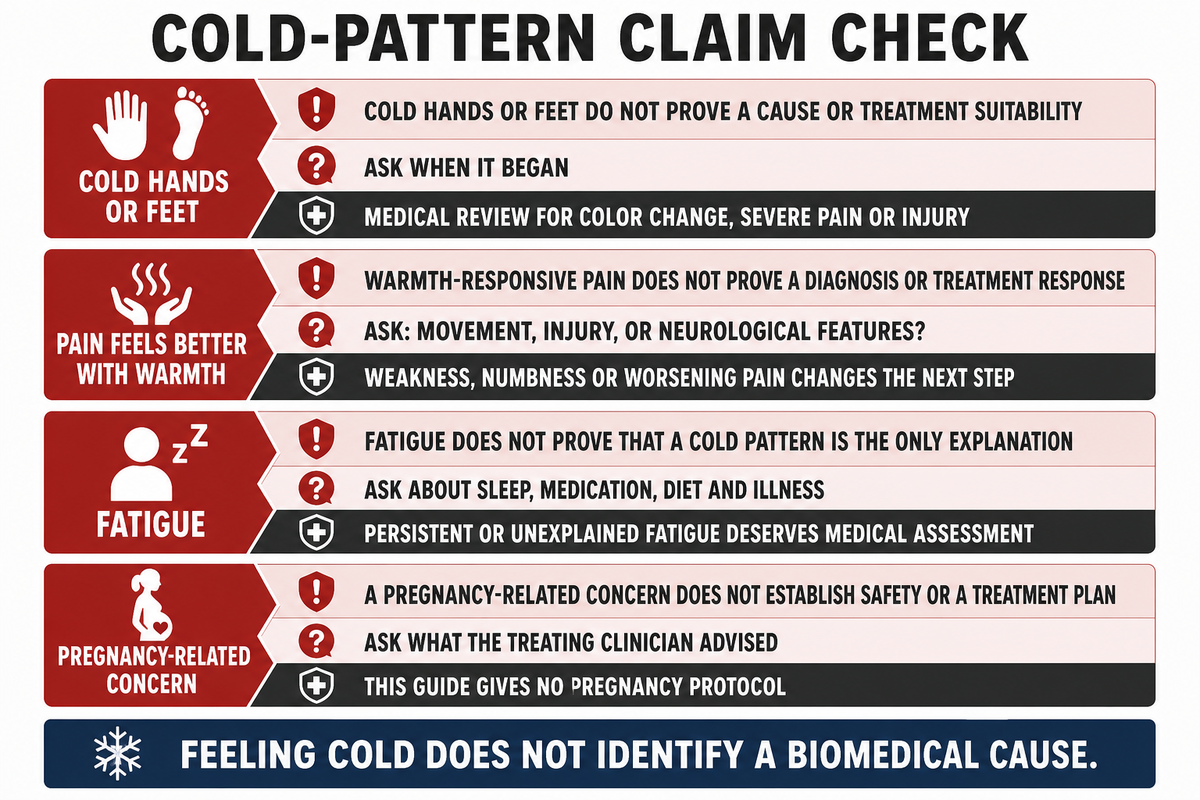
Cold-Pattern Claim Check
Cold-Pattern Claim Check is a consultation worksheet, not a diagnostic score. It helps keep observations, questions, and medical boundaries in separate columns.
| Observation | It cannot establish | Consultation question | Medical boundary |
|---|---|---|---|
| Cold hands or feet | Cause or treatment suitability | When did it begin, and is it symmetrical? | New color change, severe pain, or tissue injury needs medical review. |
| Pain feels better with warmth | Diagnosis or moxibustion response | What movement, injury, or neurological features are present? | Weakness, numbness, trauma, or worsening pain changes the next step. |
| Fatigue | A cold pattern as the only explanation | How do sleep, medication, diet, illness, and activity relate? | Persistent or unexplained fatigue deserves medical assessment. |
| Menstrual or pregnancy-related concern | Safety or a treatment plan | What has the treating clinician advised? | Pregnancy-related use must be clinician-led; this guide gives no protocol. |
| Digestive discomfort | Cause, severity, or heat suitability | Are there acute, progressive, bleeding, or systemic features? | Urgent or unexplained symptoms need medical evaluation. |
| Tongue or pulse finding | A biomedical diagnosis | How does it relate to the full history and examination? | Pattern language does not cancel conventional testing or referral. |
Heat Is an Exposure, Not a Diagnosis
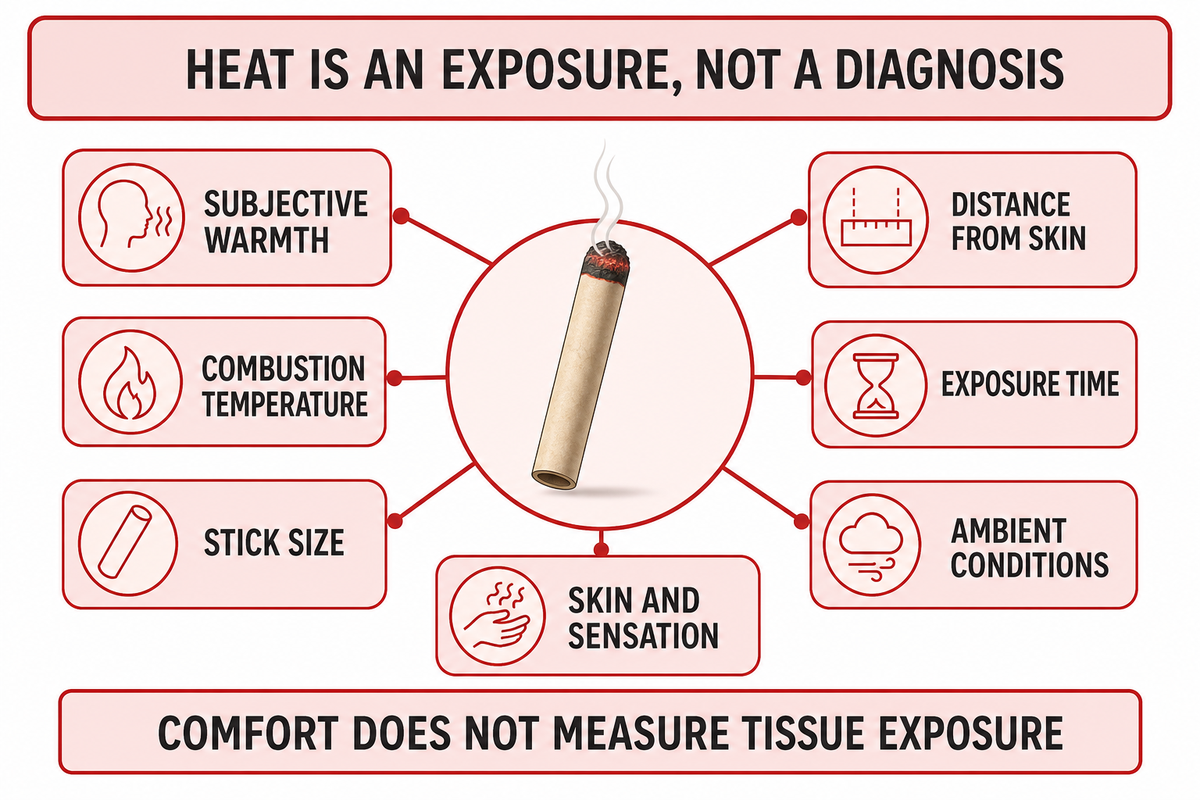
A warm or radiating sensation is subjective feedback, not a thermometer, dose meter, diagnosis, or proof of benefit. Moxa construction, combustion temperature, stick size, distance from skin, exposure time, ambient conditions, body site, and tissue characteristics can change the thermal exposure. With the diagnostic boundary set, the next question is the physical exposure.
In 2022, numerical and experimental work modeled several of those variables together. Its value here is the opposite of a treatment recipe: it shows why one person’s “comfortable warmth” cannot be converted into a universal setting. Healthy-subject thermal research also found local and distal temperature responses under controlled conditions; it did not validate a clinical outcome or home dose.
The risk is false reassurance because comfortable warmth does not reveal tissue exposure. That is why sensation belongs beside technique, distance, duration, skin condition, and room context rather than replacing them.
Heat Is an Exposure, Not a Diagnosis
Comfort can change before tissue exposure becomes obvious, and reduced sensation can remove the warning signal. A practitioner therefore needs technique, site, time, distance, skin, sensation, and room context, not a single “how hot did it feel?” answer.
Heat Therapy Is Not One Protocol
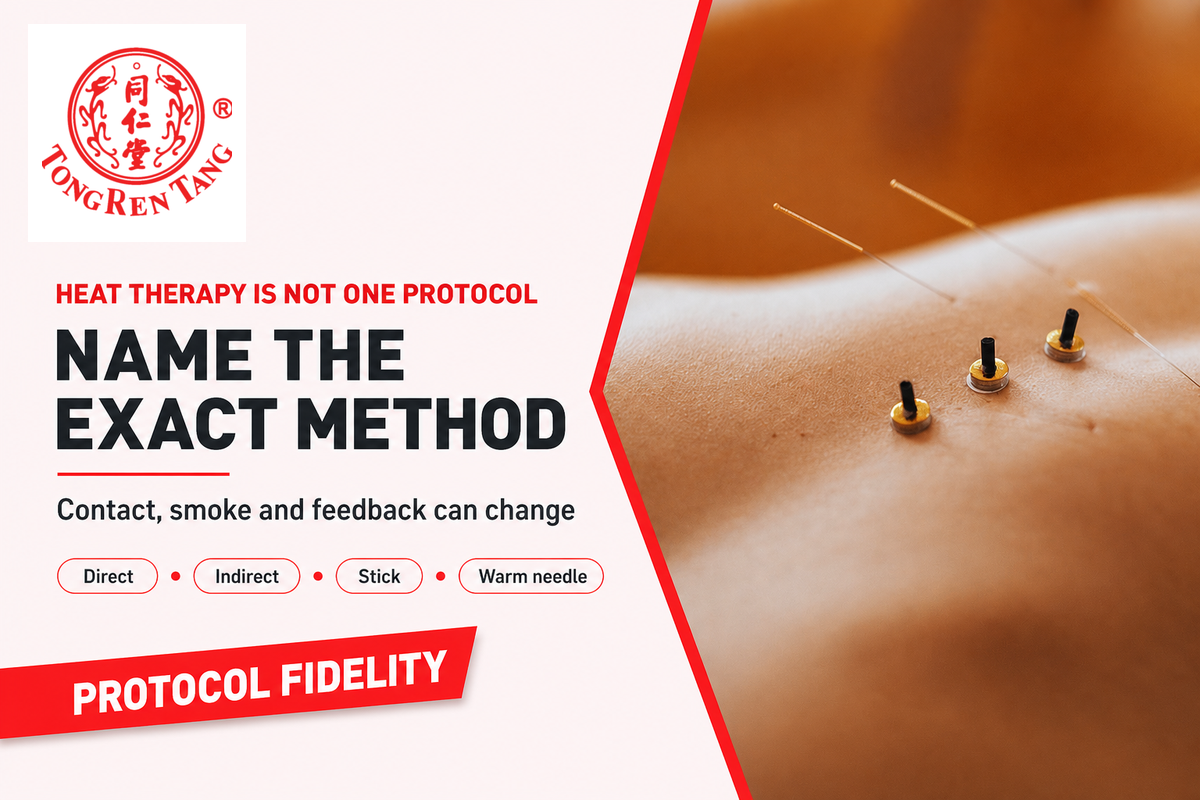
Method names describe different exposure pathways. Direct, insulated, suspended-stick, warm-needle, reduced-smoke, and non-combustion techniques can differ in skin contact, embers, smoke, conductive or radiant heat, and how quickly a practitioner can respond to feedback.
Tong Ren Tang’s public service page currently lists direct, indirect, moxa-stick, smokeless, and combined acupuncture-plus-moxibustion options. That proves service descriptions, not clinical superiority. Technique selection still depends on a consultation, and evidence about one protocol cannot validate all of the others.
| Technique label | Exposure question | Feedback question | Does not prove |
|---|---|---|---|
| Direct moxa | Will burning material contact skin, and is scarring intended? | How will heat and skin changes be monitored? | Greater benefit or acceptable injury |
| Insulated indirect | What barrier separates heat from skin? | How are barrier changes and hot spots detected? | Burn-free treatment |
| Suspended moxa stick | How are distance, ash, and movement controlled? | What sensation should be reported immediately? | A reproducible dose from distance alone |
| Warm needle | How do needle and combustion risks interact? | What changes if discomfort occurs? | Evidence equivalent to moxa alone |
| Reduced-smoke material | What is reduced: visible smoke, odor, particles, or combustion? | How is room exposure managed? | Zero emissions or zero burn risk |
| Modern heat device | Is moxa burned, heated, or absent? | What safety controls and evidence apply to this device? | Clinical equivalence to traditional moxa |
Research Terms Are Not Treatment Claims
Indexed literature uses overlapping phrases: moxibustion therapy, direct moxa therapy, acupuncture and moxibustion, needle moxa, moxa boxes, and different moxibustion methods. The physical characteristics of moxibustion change when clinicians place the moxa directly on the skin, suspend ignited moxa, use a burning moxa stick, or combine moxa heat with a needle. Those labels describe protocol families; they do not establish equal outcomes.
Mechanism papers also discuss the thermal effect of moxibustion, physical and chemical effects, the flow of qi, and the idea that moxibustion has a dual effect. Phrases such as therapeutic effects of moxibustion, thermolytic effects of moxibustion, antipyretic action of moxibustion, and antipyretic and thermolytic effects belong to specific theory or experiment contexts. Their appearance in research does not prove a patient benefit, diagnosis, or suitable use of moxibustion to treat an individual complaint.
Other indexed expressions, mechanisms of moxibustion, importance of moxa, moxa material, suppurative moxibustion, and clinical acupuncture and moxibustion, need the same source check. This page does not compile benefits of moxibustion or generalize studies of moxibustion on knee osteoarthritis. Readers who feel the heat still need the method, population, comparator, and outcome before interpreting a claim.
Traditional medicine sources sometimes describe moxibustion as an application of heat from dried plant materials. The use of moxa can include a burning material held above skin or moxa on the acupuncture needle, while modern variants may remove combustion. Moxibustion is often discussed through theory and mechanism together; any claim about the mechanism of moxibustion effects still needs a matching experiment, population, and outcome.
What Can a Patient Use Instead of Moxa for Heat Therapy?
Do not assume that a hot compress or heating pad can substitute for practitioner-led moxibustion. The material, application protocol, body site, exposure control, and supporting literature can differ significantly. Ask what the proposed alternative is meant to accomplish and what outcome will be reviewed; a stronger heat sensation does not make it an evidence-equivalent match.
The 5-Zone Heat Exposure Question Map
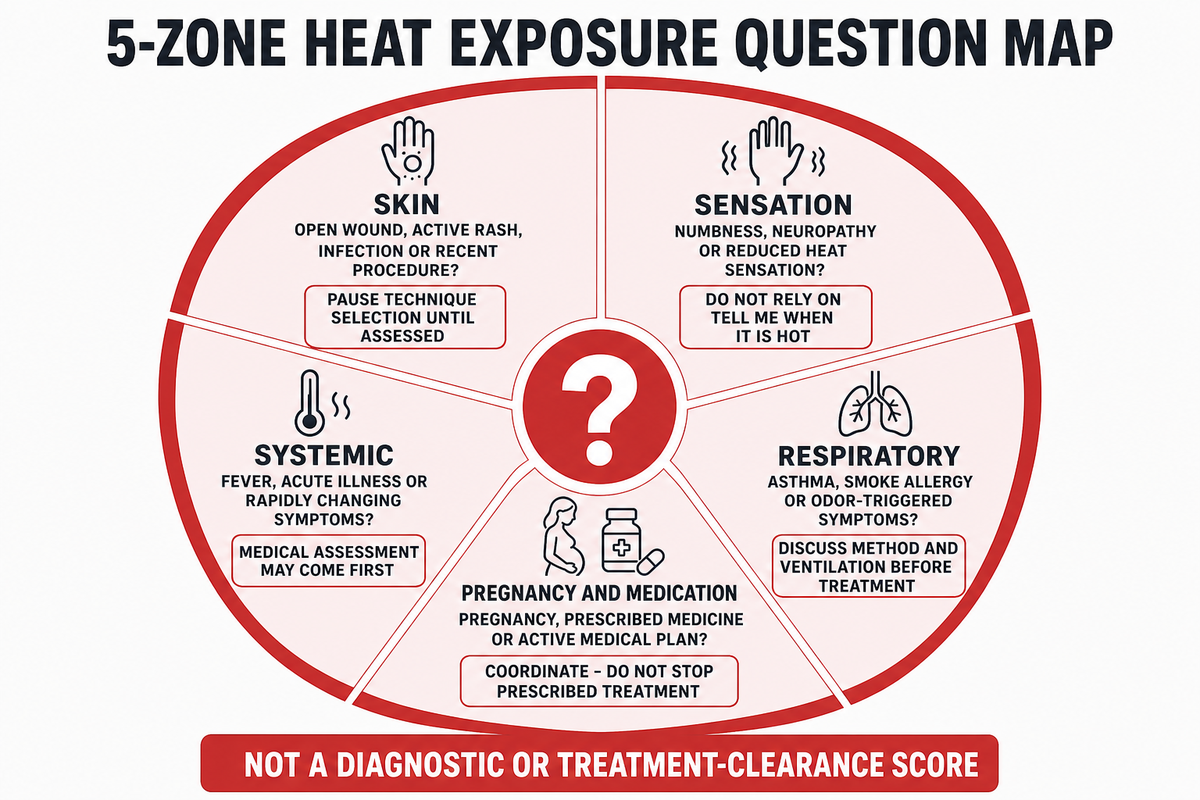
5-Zone Heat Exposure Question Map organizes questions about skin, sensation, respiratory exposure, systemic state, and pregnancy or medication context. It is an editorial aid with no validated diagnostic accuracy, inter-rater reproducibility, rule-out performance, scoring threshold, or treatment-clearance function.
Those protocol differences create a risk of false clearance because a reassuring answer in one zone cannot settle the others. Each category therefore ends with an action boundary and an explicit limitation.
Available evidence supports asking these questions, not turning them into a score. In 2014, a systematic review assembled 64 adverse-event cases from 24 case-report articles, including 43 burn cases across 6 reports. Those counts show that harms have been documented; they cannot tell us the incidence among everyone treated.
“Burns can be caused by direct contact … or by radiant heat.”
Review findings include burns following both direct contact and indirect radiant heat. One case report involved a person with sensory disturbance who could not give timely pain feedback. That makes sensation history a separate question from the technique name.
| Question category | Question to raise | Action boundary | Limitation |
|---|---|---|---|
| Skin | Any open wound, active rash, infection, burn, or recent procedure at the site? | Pause technique selection until appropriately assessed. | No self-inspection rules out deeper problems. |
| Skin | Any previous blistering, scarring, keloid, or mugwort reaction? | Tell the practitioner before consent. | Past tolerance does not guarantee future tolerance. |
| Sensation | Any diabetes, neuropathy, numbness, paralysis, or reduced heat/pain sensation? | Requires clinician/practitioner review and modified risk planning. | “Tell me when it is hot” may be unreliable. |
| Sensation | Can the person communicate discomfort promptly and consistently? | Do not treat communication as a minor convenience. | A calm appearance is not a dosimeter. |
| Respiratory | Asthma, COPD, chronic throat symptoms, smoke allergy, or odor-triggered symptoms? | Discuss method and room exposure before treatment. | “Smokeless” does not prove zero exposure. |
| Respiratory | How are ventilation and staff/bystander exposure managed? | Verify room controls, not just product marketing. | Odor and pollutant exposure are different questions. |
| Systemic | Fever, acute illness, active infection, or rapidly changing symptoms? | Medical assessment may come first. | A TCM pattern label cannot rule out illness. |
| Systemic | Severe pain, weakness, breathing difficulty, chest symptoms, or neurological change? | Seek urgent medical evaluation as appropriate. | Complementary care is not emergency treatment. |
| Pregnancy | Pregnant, possibly pregnant, or receiving fertility/obstetric care? | Discuss with the relevant treating clinician and qualified practitioner. | This guide gives no pregnancy protocol. |
| Medication and care | Any prescribed medicine, cancer care, immune suppression, or active medical plan? | Coordinate; do not stop or alter prescribed treatment. | The guide does not declare universal contraindications. |
Do
- Describe the planned technique before consent
- Disclose reduced sensation and respiratory history
- Agree on stop-and-report signals
- Keep prescribed medication decisions with the prescriber
Don’t
- Use the guide as a clearance score
- Assume indirect means burn-free
- Use “cold pattern” to dismiss urgent symptoms
- Treat smokeless as zero exposure
What Are the Risks of Moxibustion?
Moxibustion risks documented in case reports include burns, skin injury, allergy, infection, coughing, and other uncommon serious events. The case-report design cannot estimate how frequently these occur. Technique, distance, duration, smoke, room conditions, practitioner skill, patient health, and feedback ability can all change risk. Discuss individual circumstances rather than relying on a generic “safe” label.
Moxa Smoke, Ventilation and Smokeless Options
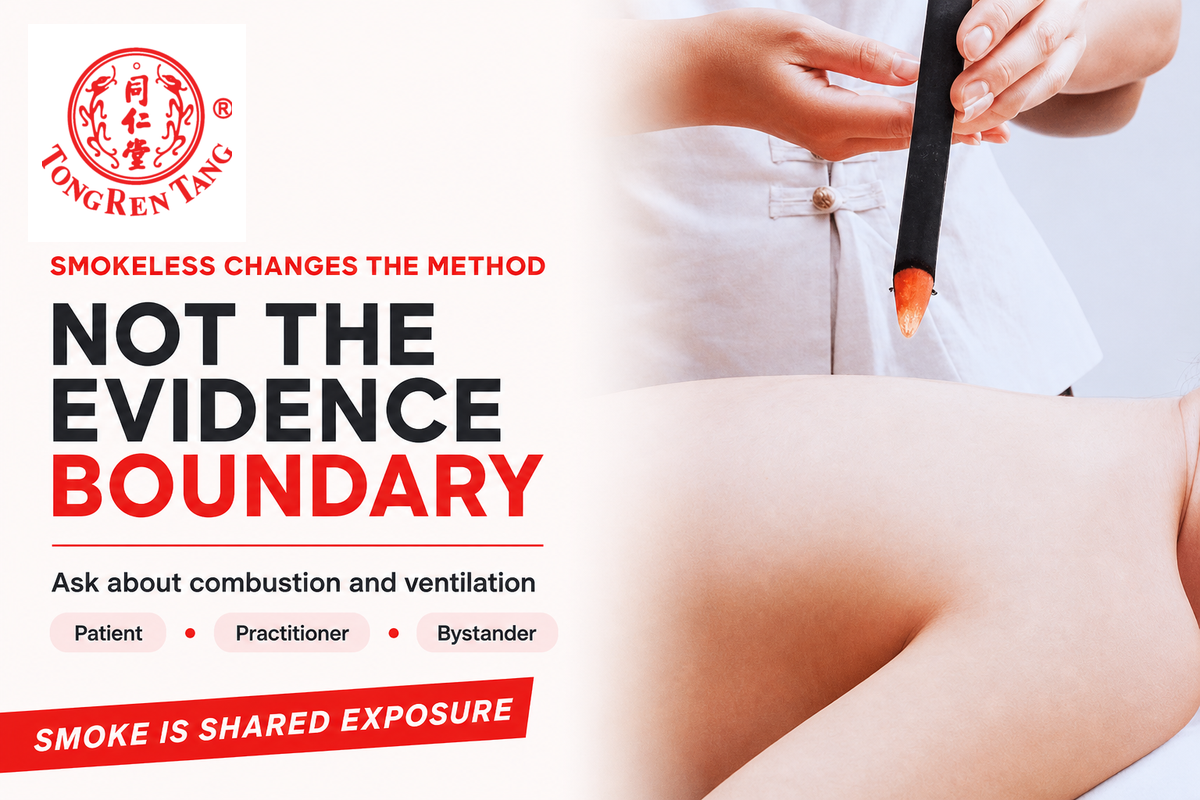
Moxa smoke is a shared-room exposure question, not only a smell preference. Patient respiratory history, practitioner and bystander exposure, ventilation, combustion material, treatment frequency, and the meaning of “smokeless” should be discussed before selecting a method.
Researchers in 2020 identified many components in the tested moxa smoke and recommended adequate ventilation. Their study used a particular product and computational toxicity analysis; it did not establish a universal human dose-response or indoor exposure limit. Interviews published in 2025 with 13 registered Hong Kong TCM practitioners also treated ventilation and fire safety as implementation barriers, not as minor housekeeping.
| Question | What may change | What remains unproven |
|---|---|---|
| Visible smoke | May be reduced with certain materials or devices | Zero particles or zero combustion products |
| Odor | May be less noticeable | Respiratory suitability |
| Heat source | Material and combustion may differ | Zero burn risk |
| Clinical effect | Protocol may target a similar consultation goal | Equal outcomes for every condition |
When Medical Assessment Should Come First
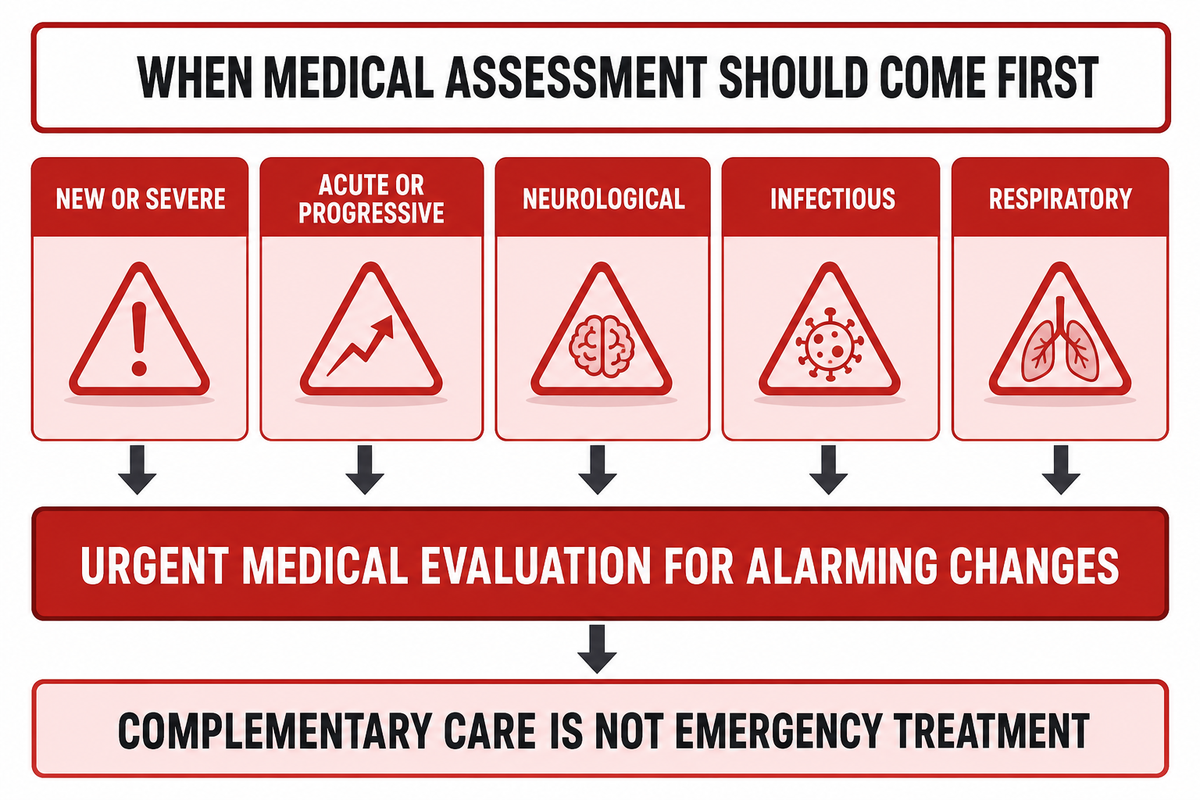
When symptoms are new, severe, acute, progressive, unexplained, neurological, infectious, respiratory, or otherwise concerning, medical assessment should occur before a cold-pattern discussion. Moxibustion education cannot evaluate emergencies, exclude pathology, or replace the clinician responsible for a diagnosed condition or prescribed medication. That referral boundary also applies when smoke exposure triggers concerning respiratory symptoms.
DHA’s TCAM scope document says practitioners should refer signs of possible underlying pathology for medical diagnosis, avoid claims that imply cure, and not treat acute or critical emergencies. Because that detailed scope is dated August 2011, readers should treat it as a documented boundary paired with the current DHA index, not as a complete 2026 moxibustion rulebook.
After heat exposure, urgent medical evaluation is appropriate for severe or rapidly worsening pain, difficulty breathing, chest symptoms, fever with spreading redness or warmth, pus or drainage, significant blistering, or another alarming change. The required response depends on the situation; this page cannot triage an individual case.
Who Should Not Do Moxibustion?
No short public list can decide suitability for every person. Open or infected skin, reduced sensation, respiratory disease or smoke allergy, pregnancy-related concerns, fever or acute illness, inability to report heat, and complex medical treatment should trigger qualified review before technique selection. Severe or urgent symptoms need medical assessment rather than a complementary-treatment decision.
What a Professional Dubai Consultation Should Verify
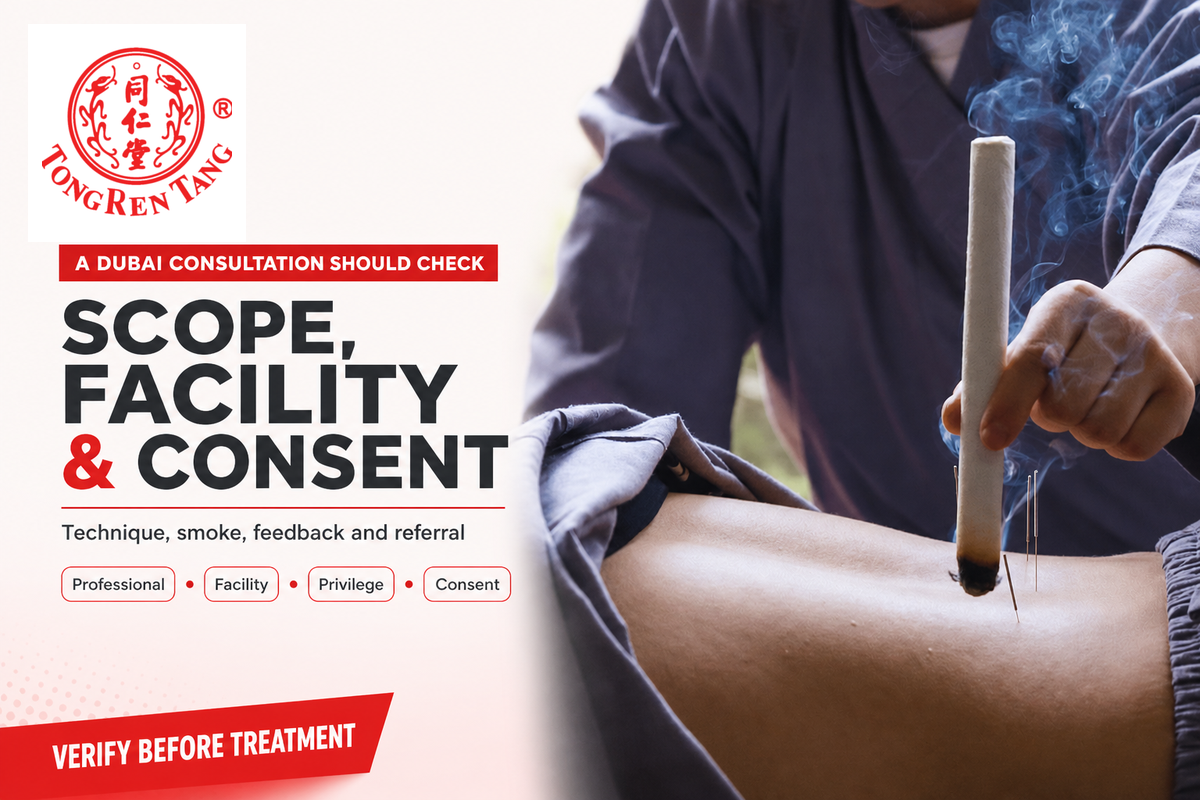
Dubai consultations should verify more than a person’s name in a registry. Active professional license and title, the facility’s authorized service, any required clinical privilege, informed consent, proposed technique, smoke management, feedback controls, referral limits, and emergency boundaries are separate questions.
Current DHA scope material notes that facility management and the medical director or clinical privileging committee may need to approve specialty scope or privileges. Registration, professional licensing, facility authorization, and permission to perform a particular procedure should therefore be checked as distinct states.
- Verify the professional — confirm the active DHA-granted title and current license.
- Verify the facility — ask whether the location is authorized to provide the planned service.
- Clarify privileges — ask whether the professional has any facility-level permission required for the technique.
- Name the method — direct, insulated, suspended, warm-needle, reduced-smoke, or another method.
- Define expected skin effects — state whether contact, blistering, or scarring is intended or unacceptable.
- Review exposure — discuss sensation, smoke, ventilation, staff and bystander conditions.
- Set stop signals — agree what sensation or skin change requires immediate adjustment.
- Confirm referral and consent — document alternatives, limits, urgent symptoms, medication continuity, and when medical care comes first.
After those questions are addressed, review Tong Ren Tang’s page for professional moxibustion treatment in Dubai. It is a service handoff, not evidence that treatment is suitable or effective for a particular person.
Frequently Asked Questions
The consultation and verification steps above lead to six practical questions readers commonly ask before choosing a technique.
Is moxibustion the same as acupuncture?
Moxibustion and acupuncture are related TCM methods, but they are not identical: moxibustion centers on controlled heat, while acupuncture uses needles; some protocols combine both.
Moxibustion may be performed near the skin, with insulating material, or together with an acupuncture needle. Acupuncture does not automatically include burning moxa. Technique names, exposure, risks, and supporting evidence should be stated separately rather than treating both methods as one interchangeable intervention. A professional may combine them, yet evidence for the combined protocol should not be attributed to either component alone.
Does moxibustion really work?
Moxibustion evidence depends on the exact condition, technique, comparator, outcome, co-treatment, and follow-up period, so results from one protocol cannot prove a general benefit overall.
Broad yes-or-no answers hide substantial variation. Direct, indirect, warm-needle, suspended, and modern methods are not one protocol. Research on a named condition can differ by comparator, co-treatment, outcome measure, follow-up, and risk of bias. A result from one protocol cannot establish a general benefit for every symptom, body site, or person. For that reason, this page does not rank conditions or promise outcomes. It helps readers ask whether evidence matches the exact method being proposed and whether medical assessment should happen first.
How often should you do moxibustion?
No universal moxibustion schedule exists: frequency in a study applies only to that condition, method, population, and outcome window, not as a self-care dose alone.
Frequency in a research protocol applies to that condition, method, population, and outcome window. It is not a self-care dose. A qualified practitioner should explain why a method and review interval are proposed, how response and skin are monitored, which concurrent care continues, and what finding would stop or change the plan.
Can I do moxibustion myself?
Moxibustion self-use cannot be made safe by a generic points chart or timing rule; burns, reduced sensation, smoke exposure, skin condition, and medical context require qualified review.
Burns can occur through contact or radiant heat, and reduced sensation can delay warning feedback. Ask a qualified practitioner to assess the goal, technique, site, skin, sensation, smoke exposure, and medical context before considering any application. Product instructions do not replace that assessment.
Is moxibustion safe when delivered as a patch?
Moxibustion patches are not automatically safe: materials, heat generation, adhesives, duration, body site, sensation, pregnancy, medication, and medical conditions all change the suitability question beforehand.
Moxibustion patches vary in materials, heat generation, duration, adhesives, and instructions. Marketing under the same product category does not guarantee the same temperature profile or evidence. Ask what research applies to the exact product, intended body site, exposure period, and user population. People with reduced sensation may not detect rising heat reliably. Pregnancy, active skin problems, respiratory reactions, cancer care, immune suppression, or prescribed treatment should be disclosed to the appropriate clinician. Stop using a product and seek suitable care for significant pain, blistering, breathing symptoms, spreading redness, fever, drainage, or another concerning reaction.
What does moxibustion heat feel like?
Moxibustion heat may feel warm or radiating, but sharp, escalating, stinging, or burning discomfort needs immediate attention because comfort alone does not measure tissue exposure.
Sensation differs by method, site, distance, material, room conditions, and the person’s sensory function. Feeling comfortable does not measure tissue exposure. Agree on feedback and stop signals before treatment, report changes early, and do not wait for warmth to become painful or leave visible injury.
Bring Better Questions to Your Consultation
Use the Cold-Pattern Claim Check and 5-Zone Heat Exposure Question Map to organize your history. They do not replace assessment or guarantee suitability.
Why This Guide Uses Boundaries, Not Promises
Moxibustion pages often mix TCM theory, product descriptions, clinical studies, and service claims. This guide separates those evidence roles. It treats cold-pattern language as a consultation framework, identifies heat and smoke questions, and directs possible pathology or urgent symptoms to appropriate medical assessment.
Related Tong Ren Tang Resources
References & Sources
- Moxibustion overview University of Minnesota
- The Mechanism of Moxibustion: Ancient Theory and Modern Research Evidence-Based Complementary and Alternative Medicine
- Numerical Simulation of Temperature Distribution during Mild Moxibustion Evidence-Based Complementary and Alternative Medicine
- The Effect of Moxibustion Stimulation on Local and Distal Skin Temperature in Healthy Subjects Europe PMC
- Safety of Moxibustion: A Systematic Review of Case Reports Europe PMC
- Analysis of the Components in Moxa Smoke Evidence-Based Complementary and Alternative Medicine
- Feasibility and Barriers of Utilizing Moxibustion Therapy in Hong Kong BMC Complementary Medicine and Therapies
- Policies and Regulations: Scope of Practice Dubai Health Authority
- Traditional, Complementary and Alternative Medicine Scope of Practice Dubai Health Authority, August 2011