Get in Touch with Tongren Tang Gulf

Premature Ejaculation Treatment in Dubai: What to Discuss With a Clinician, and Where TCM Fits

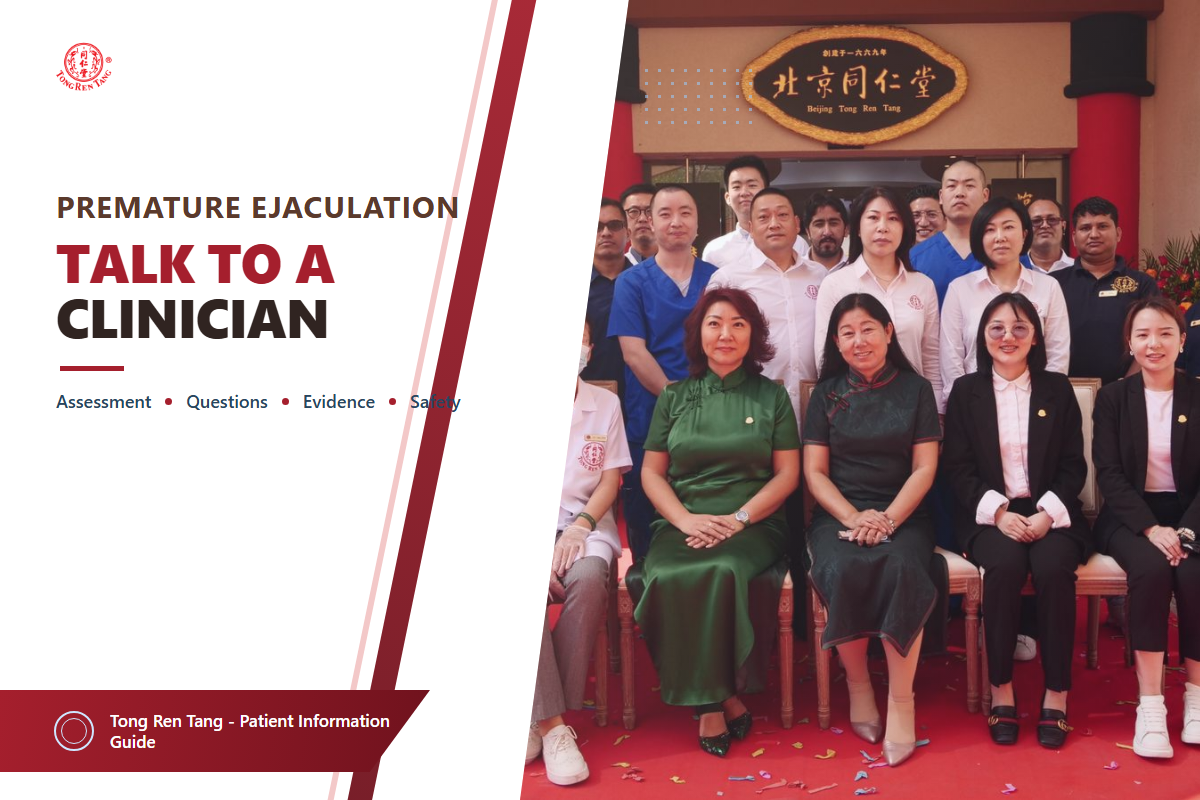
Premature Ejaculation Treatment in Dubai: What to Discuss With a Clinician, and Where TCM Fits
Talking to someone about premature ejaculation can be overwhelming. Many adults put it off for longer than they’re hurting because it feels embarrassing. We wrote this for you in Dubai as a simple, actionable guide to preparing for that conversation. Please understand that this article isn’t a diagnosis for anyone, a prescription, or a guarantee; it’s focused on a more practical slice of the puzzle: what clinicians typically look for, what care conversations can cover, what the evidence for traditional Chinese medicine looks like at the moment, and what to expect if you arrange to see a professional in Dubai.
Start with a conversation, not a cure claim
Brief episodes where you or your partner come earlier than expected aren’t usually a concern in themselves, and there’s no specific diagnosis unless there’s a more defined pattern. What makes it worth bringing up is a perceived inability to control ejaculation consistently, a condition you or your partner finds distressing. The most accepted clinical guidelines, developed by urologic professional groups in the US and North America (the AUA/SMSNA), define it by lack of control combined with distress, and medical sites like Mayo Clinic strongly recommend bringing it up if the issue happens in a majority of sexual encounters.
This particular way of phrasing it’s key, because a lot of what’s out there frames premature ejaculation as a problem to be solved through consumer products, procedures, or the relentless application of a countdown device. A more sensible approach for you in Dubai is to identify whether you’ve a persistent concern, consider what an assessment actually entails, understand how care conversations might go, know the actual evidence for TCM, and manage your expectations going into an appointment. What follows directly addresses these points, again, none of which requires you to guess what’s going on.
Understanding premature ejaculation
Don’t assume premature ejaculation is solely determined by a stopwatch. Based on the AUA/SMSNA guideline, clinically recognised presentations fall into one of two main types. You can have something that’s present your whole adult life, known as lifelong premature ejaculation – describing poor ejaculate control and accompanying concerns from your first experiences. Or you can develop a loss of control after a period where this wasn’t an issue: called acquired premature ejaculation. Each one considers factors besides a mere figure, and neither is a self-diagnosis quiz or a substitute for consultation with a clinician who’s properly credentialed to diagnose you.
A simple and effective way to make the abstract more concrete is a four-part snapshot you can note privately before any appointment. Forget the digital timers and instead of comparing yourself with an online chart, list these down: whether the concern is new to your experience, or something that has been with you a long time. Whether it happens in nearly all situations, or a limited few. The degree to which it has caused you or your relationship pain. Whether any other health or major life changes coincided with the development of the concern. These key points largely reflect what an evaluating doctor will want to ask about.
When a private assessment is worth arranging
If a problem with ejaculating early persists or is uncomfortable or has occurred following a time of having no problems controlling ejaculation, you may want to schedule a private consultation. The NHS advises people with persistent ejaculation problems to discuss them with a clinician, who may talk with them, examine them, or refer them to a specialist where appropriate. The purpose of the appointment is not to pre-select a treatment; it is to give a professional enough context to evaluate the concern properly.
Sexual health, relationship experience, and general health can all be relevant, so you do not need to decide in advance which details matter. Erection concerns, changes in desire, stress, and relationship questions can form part of the same conversation, and raising them together often gives the clinician a clearer picture than separating them.
There are some circumstances that indicate a need for professional review rather than self-management: a recent change plus pain, a recent change plus urinary symptoms, or a recent change beginning a few days after a new drug was started. The first two don’t certainly indicate a serious condition, but all three are reasons to consult a professional instead of searching the web for a product.
What an evidence-based assessment may consider
The AUA/SMSNA guideline structures the discussion through medical history, relationship history, sexual history, and an exam as needed. You can expect your visit to be slightly different from this, but it highlights why a one-product conversation often doesn’t make sense. An AUA practitioner is considering the background to help understand why there might be an issue before deciding what options to pursue.
If you want to make this conversation dramatically more useful, bring short, honest notes. If you do no other work for the conversation, bring this list:
- What happens and when — for example, whether the concern occurs in most sexual situations or only in specific ones.
- How long it has been happening, and whether it began recently or has been present since early sexual experience.
- How distressing it feels for you and, where relevant, for your partner or relationship.
- Relevant health changes, such as new symptoms, erection changes, stress, or sleep problems.
- Your current medicines and supplements, including over-the-counter products and traditional remedies.
The Mayo Clinic’s appointment-preparation guidance say to take stock of your symptoms, sexual and medical history and all of your medications. The point is not to prove that something is wrong; it simply helps the clinician understand your situation faster and with less guesswork.
What recognised care discussions can include
Counselling is about so much more than just one product. The AUA/SMSNA guideline mentions behavioural methods, referral to a mental-health professional with sexual-health expertise where appropriate, and clinician-led consideration of medical options. Similarly, the NHS outlines psychosexual counseling as one option, with the addition of behavioral techniques and support for relationship issues.
In practice, these discussions often run across three domains. behavioural and psychosexual aspects – these will cover how, anxiety and your wider relationship situation, topical or oral forms – some of which may be considered where they’re appropriate for you by your doctor, and comorbidities – some of which as the outcome of the survey, like erection conditions or problems with other health conditions, may be appropriate to be addressed separately. Which of these belongs in your plan depends on your circumstances, your other health conditions, and your current medicines. Suitability is a clinical judgement, not a menu choice, and this article deliberately does not name, dose, compare, or recommend any medicine, injection, topical product, or procedure.
One safety point deserves explicit wording: do not stop, start, or change any prescribed medicine without first consulting the clinician who prescribed it. This applies whether or not the medicine seems related to the concern, and it applies regardless of what any article — including this one — describes in general terms.
TCM for premature ejaculation: an honest evidence boundary
Many readers in Dubai have a genuine interest in traditional Chinese medicine, and raising that interest in a healthcare conversation is entirely reasonable. What the evidence currently support, however, should be stated plainly. The AUA/SMSNA guideline finds the evidence insufficient to support alternative therapies for premature ejaculation. The Mayo Clinic likewise notes that more research is needed to determine the effectiveness of alternative treatments, including acupuncture.
The ethical boundary is clear: TCM may be discussed as a complementary area of interest, but it may never be presented – by a website, in an advertisement, or in a journal article – as an alternative that has been demonstrated to improve upon medical care. The U.S. National Center for Complementary and Integrative Health (NCCIH) advises against using an unproven product or practice as a substitute for conventional medical treatment, or as a reason to postpone seeing a health care provider.
If you are considering a TCM approach, three questions keep the discussion grounded:
- What evidence supports this approach for my specific concern?
- Are there any possible risks or interactions with my current medications or supplements?
- How will this fit in with the care and support I’m receiving or planning for?
Herbal preparations also need extra consideration. The quality and content can differ from one supplier to another and certain herbs can cause interaction with prescribed medication. By providing the clinician or pharmacist with details of all supplements being taken (including traditional preparations) interactions can be checked rather than assumed.
A consultation-ready checklist for Dubai readers
The following checklist summarizes this article into a manageable form of what you can realistically take in with you to an appointment:
- When did it start, when does it flare and for how long.
- An up-to-date list of your medicines and supplements (including over-the-counter, herbal and prescription products).
- Top Questions about the assessment, potential levels of care, safety concerns, and follow-ups
- A definite hand-off – which stage do you transition to after your appointment, who’s to organize it and how are you going to be told or approached.
For readers weighing both medical and complementary routes, the three-column decision table below separates the same preparation into parallel tracks. It is a preparation aid, not a treatment recommendation.
| Medical assessment | Medication safety | Complementary-care (TCM) questions |
|---|---|---|
| When to raise it: persistent or distressing early ejaculation, or a change from previously typical control. | When to raise it: whenever you start, stop, or consider changing any medicine — always with the prescriber first. | When to raise it: when you are genuinely considering TCM and want it coordinated with, not substituted for, medical care. |
| What to bring: a short symptom-and-context note covering what happens, when, and since when. | What to bring: a complete, current list of prescription medicines, over-the-counter products, and supplements or herbs. | What to bring: the name and source of any TCM product or practice you are considering, so interactions can be checked. |
| What to ask: what the assessment is trying to clarify, and which care categories fit your situation. | What to ask: whether any current medicine could be contributing to the concern, and what a safe adjustment process would look like. | What to ask: what evidence supports the approach, what risks or interactions apply, and how it fits with existing care. |
| What to avoid: self-diagnosis from a single time measurement or an online quiz. | What to avoid: stopping or changing prescribed medicines without the prescriber, or buying unlabelled products online. | What to avoid: treating TCM as a proven replacement for assessment, or delaying professional care to try an unproven product. |
Preparing for a consultation in Dubai: practical next steps
A first consultation in Dubai usually follows a simple pattern. You should bring the written notes and medicine list described earlier; you’ll likely be asked a series of questions about your physical health, sexual and romantic life, and the impact of the symptoms that prompt your visit; and a clinical exam or any tests ordered will be explained to you beforehand. Follow-up is typically arranged at the end of the visit — for example, a review call with results, a referral where indicated, or a check-in on any plan you agree on. If any part of the hand-off is unclear, ask before you leave.
A short preparation list for the day itself:
- Your symptom note, your questions, and your full medicine and supplement list from the checklist.
- Practical details the clinic requests when booking, such as identification and insurance information where applicable.
- Enough time and privacy for the appointment, and a way to note down the agreed next steps afterwards.
In Dubai, sexual-health consultations are provided through licensed healthcare facilities, and you can verify a facility’s or practitioner’s licence through official Dubai Health Authority channels before booking. This article doesn’t rank clinics, and no directory listing or article, this one included, is evidence of outcomes, quality, or cost.
If you would like local appointment information, Tong Ren Tang’s premature ejaculation service page describes how to request an assessment at the clinic, and the contact page provides administrative details such as location and booking. These links are provided for access only; they aren’t evidence of treatment effectiveness or a recommendation for a particular treatment.
Frequently asked questions
Is an occasional early episode the same as PE?
No. A single incidence or minor episode can’t be classified as premature ejaculation, and doesn’t warrant a clinical evaluation in isolation. Persistent symptoms that feel difficult to control and cause distress are the ones worth discussing. It’s appropriate to raise a pattern of such occurrences with your clinician without worrying about judging any one particular episode.
Can an appointment include relationship or erection concerns?
Yes, and it should. The Sexual Medicine Society of North America / the American Urologic Association sexual-medicine assessment model takes into account prior experiences as well as other sexual-health matters, including difficulty managing erection. No prior judgment of importance about each piece of information should be made. Present it naturally to your clinician and they’ll determine how relevant it is to your overall condition.
Can TCM replace a medical assessment?
No. The AUA/SMSNA guideline finds the evidence insufficient to support alternative therapies for premature ejaculation, and NCCIH advises against using an unproven product or practice as a substitute for conventional medical treatment, or as a reason to postpone seeing a health care provider. Interest in TCM is welcome as a discussion topic, but it must not replace a proper assessment.
References and sources
If the concern is persistent or distressing, arranging a confidential assessment is a reasonable and discreet next step, whether through the routes mentioned above or any other licensed provider in Dubai.
This article provides general health information only. It is not individual medical advice, it does not diagnose or recommend treatment for any person, and reading it does not create a doctor–patient relationship. Decisions about your care belong with a qualified clinician who knows your history.
![Postpartum TCM Care: Safety Questions for Dubai [Guide]](https://tongrentang.ae/wp-content/uploads/2026/09/postpartum-tcm-care-blog-featured-768x512.png)