Get in Touch with Tongren Tang Gulf

Sciatica Treatment Guide: Causes, Relief & Recovery (2026)

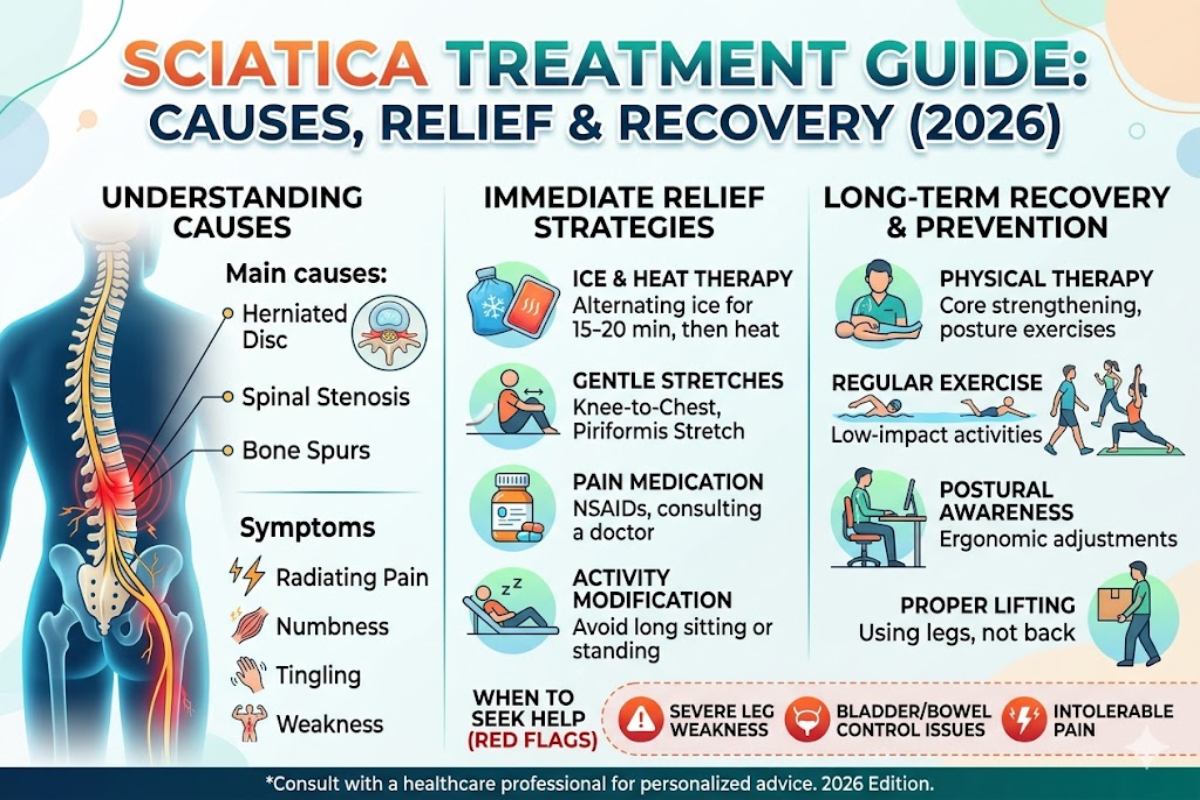
Sciatica Treatment: A Complete Guide to Causes, Symptoms, Relief & Recovery
Contains medically-reviewed information Last reviewed: April 2026 Reading time: 12 minutes
Sciatic nerve: The body’s largest nerve, defined by nerve roots originating from L4 to S3.
Resolution rate: 80–90% of cases resolve without surgery
#1 cause: Herniated disc – made up 90% of causes.
Exercises: 5 evidence-backed stretches and movements for relief
Alerta roja: perdida del control del esfínter urinario o anal = situación de urgencia
Recovery timeline: Most patients improve within 3–12 months
What Causes Sciatica? Understanding the Sciatic Nerve

The sciatic nerve originates in your lower back, passes through your hips and buttocks, and travels down each leg—in fact, it’s the biggest nerve in the whole body, made up of the nerve roots from L4 to S3. If this nerve becomes compressed or inflamed at any point along its course, then you will experience the symptoms of sciatica.
If you knew what was causing that pressure on the sciatic nerve, you would know how to treat it because there is no method of treatment that would work unless that was known, and understanding the specific causes of sciatica — starting with the most common cause — is the first step toward effective treatment:
1. Herniated Disc (~90% of cases)
A nucleus pulposus protrudes or burst out of a lower back disc and places pressure on surrounding nerve root. This causes pain 99.9% of the time. Discs at L4-L5 and L5-S1 levels are responsible for most herniations that cause sciatic pain.
2. Spinal Stenosis
Spinal canal narrows (usually from the aging process) and crowds the nerve roots as they leave the spine. It usually affects people over 60 and is worsened by walking or standing.
3. Piriformis Syndrome
Piriformis–a muscle located deep in the buttocks. It can spasm or tighten so it squeezes the sciatic nerve passing beneath it. It is sometimes referred to as ‘wallet sciatica’ as sitting on a large wallet can causes aggravation.
4. Spondylolisthesis
One vertebra moves forward on top of another, reducing the size of the neural foramina, where the roots exit. This change in structure results in direct pressure on the nerve, so the sciatic symptoms are regularly provoked by extension movements.
5. Bone Spurs & Degenerative Disc Disease
Because the discs in the spine gradually decrease in height and water content over decades, the body develops osteophytes or bone spurs to further support the segment. These can protrude into the neural foramen and irritate the nerve root.
6. Pregnancy
The addition of the weight, the offset, the hormonal laxity of the ligaments, and the growing uterus are capable of creating pressure on the sciatic nerve. Sciatic pain during pregnancy is usually at its maximum during the third trimester and disappears postpartum.
Learning point: Approximately 30-40% of 50+ year olds have imaging evidence of herniated disc on MRI with no symptoms. A herniated disc on scan does NOT necessarily mean theres sciatica; correlation with what you actually feel is essential.
Sciatica Symptoms — How to Know If It’s Really Sciatica

Sciatica pain has a distinctive character that sets it apart from ordinary back pain. The hallmark symptom is a shooting or burning pain that starts in the lower back or buttock and radiates down one leg — often past the knee and into the foot. Many people describe it as an electric shock traveling along the leg. Numbness, tingling (pins and needles), and muscle weakness in the affected leg are also common.
The pain typically affects only one side of the body. It often worsens when sitting, coughing, or sneezing — anything that increases pressure within the spinal column.
Here is how sciatica compares to general back pain:
| Feature | Sciatica | General Back Pain |
|---|---|---|
| Pain location | Radiates down the leg, often past the knee | Stays in the lower back area |
| Pain character | Shooting, burning, electric | Dull, aching, stiff |
| Numbness / tingling | Common in leg and foot | Rare |
| Usually affects | One side of the body | Both sides possible |
⚠️ RED FLAGS — Seek Emergency Care Immediately:
- Loss of bowel or bladder control (inability to control urination or defecation)
- Saddle anesthesia(missing sensation in groin, inner thighs or buttocks)
- Bilateral leg weakness (both legs affected simultaneously)
- Rapidly progressive neurological deficit
Symptoms such as these could be suggestive of cauda equina syndrome a rare but serious condition which occurs when the bundle of nerves at the end of the spinal cord is compressed. It is essential to have operation within 48 hours in order to prevent permanent damage to bowel, bladder and sexual function.
5 Exercises & Stretches That Relieve Sciatica Pain

If you have sciatica, the urge to lie in bed is understandable – but evidence suggests otherwise. A notable study in the New England Journal of Medicine showed that bed rest offered no benefit over expectant management, for sciatica patients. Gentle, targeted movement can help relieve your sciatic pain, reduce pain signals along the nerve, and strengthen the muscles supporting your spine — helping you find relief faster than rest alone.
These five exercises are supported by clinical research and experience in PT. Do not push to the point of sharp or intensifying pain. Take slow progression.
💡 1. Knee-to-Chest Stretch
Decreases ache in lower back and allows more room for the nerve roots
- Lie comfortable on your back with both knees flexed and both feet flat on the floor.
- Lift one knee up toward your chest by holding behind your thigh (not over the kneecap) with hands.
- Hold for 30 seconds with your lower back lightly flattening into the floor.
- Change sides and repeat, returning to starting position.
Reps: Hold 30 seconds, 3 reps each side.
💡 2. Piriformis Stretch (Figure-4)
Acts directly upon the piriformis muscle which is the possible cincompressionment to the sciatic nerve.
- Lying on your back bend both knees. Cross the one with the problem over the other knee to get into a “figure 4” position.
- Reach through and clasp your hands behind the uncrossed thigh.
- Pull that thigh toward your chest until you feel a deep stretch in the buttock of the crossed leg.
- Keep your head and shoulders relaxed on the floor throughout.
Reps: Hold 30 seconds, 3 reps each side.
💡 3. Sciatic Nerve Glide (Neural Flossing)
Improves nerve mobility and reduces neural sensitivity
- Sit upright on a chair with both feet flat on the floor.
- Straighten the affected leg out in front of you while pointing your toes toward the ceiling.
- Slowly bend the ankle to point your toes back toward your shin, then point them away from you. Think of it as gently “flossing” the nerve through surrounding tissues.
- Return to the starting position and repeat. The movement should be slow and controlled.
Reps: 10–15 gentle repetitions, 2–3 sets.
💡 4. Cat-Cow Stretch
Mobilizes the entire spine and improves spinal flexibility
- Start on all fours with your wrists under shoulders and knees under hips.
- Cow: Inhale, let your belly drop toward the floor, lift your chest and tailbone upward.
- Cat: Exhale, round your spine toward the ceiling, tuck your chin and pelvis.
- Flow between the two positions slowly, coordinating with your breath.
Reps: 10–15 cycles, performed slowly.
💡 5. Glute Bridge
Strengthens core and gluteal muscles for spinal stability
- Lie on your back with knees bent, feet flat on the floor hip-width apart, arms at your sides.
- Squeeze your glutes and push through your heels to lift your hips off the floor until your body forms a straight line from shoulders to knees.
- Hold at the top for 2–3 seconds, squeezing glutes firmly.
- Lower slowly back to the starting position.
Reps: 10–15 repetitions, 3 sets.
Can’t I just stay active and wait this out? Rule for exercise: Any exercise that worsens pain radiating below the knee should be stopped. Interestingly, centralization (movement of the pain from the leg toward the back) is actually a sign of recovery—it indicates the pressure on the nerve is decreasing. Peripheralization (decreased movement of pain downward) is a red flag and should be stopped immediately. Contact a health care professional immediately.
Home Remedies & Self-Care for Sciatica

Here are some simple tips to ease the pain and promote recovery—especially during the critical first few weeks of the problem:
Ice and Heat Protocol
In the first 48-72 hours, apply a damp towel or cloth covered in an ice pack to the affected area (either the lower back or buttock). When placed on areas of inflammation, ice reduces swelling and may speed up recovery. After this initial period, switch to dry heat (such as a hot water bag or heat pack) to soothe tight muscles and encourage blood flow. Some people alternate ice and heat throughout the day as needed.
Over-the-Counter Anti-Inflammatories
Non-steroidal anti-inflammatories (NSAID’s) such as ibuprofen (Advil, Nurofen) and naproxen (Aleve) can be effective aids in reducing inflammation around the nerve root. Follow instructions on pack labels and do not take for longer than 2 consecutive weeks without medical advice. The painkiller paracetamol (Tylenol) can be effective against neuropathic pain but does not have anti-inflammatory properties.
Posture Correction
Incorrect posture—particularly sitting for long periods—produces increased pressure on the sciatic nerve root and aggravates the pain. Some practical solutions:
- Take a walk at least every 30 minutes if your job involves sitting
- Choose an office chair with a lumbar (lower back) support to maintain your spine’s inherent inward curve.
- Modify your car seat so knees are elevated to be parallel with or slightly higher than hips.
- Avoid crossing your legs while seated
Sleeping Positions
Poor sleeping position in a flared-up episode disrupts sleep and can accentuate pain. Successful sleeping positions include:
- Lying on the unaffected side, with knees slightly bent with a pillow between them for spinal alignment.
- Lying on your back with knees bent and a pillow beneath them to reduce pressure on the lower back and sciatic nerve.
Gentle Walking
Walking—one of the most common activities sciatica sufferer’s report to hasten recovery—has the effect of ramping blood circulation to painful areas, reducing muscle stiffness and encouraging healing. You do not have to walk far or fast. Several small daily walks encourage slow, steady recovery.
Professional Treatment Options — From Physical Therapy to TCM
When home remedy does not suffice, one can move on to a whole spectrum of treatment options from less to more invasive depending on your unique presentation. This spectrum includes:
1. Physical Therapy (First-Line Treatment)
The recommended first line of treatment is physiotherapy—either in the form of specific exercises designed to accelerate recovery, manual therapy to relieve nerve pressure, and instruction on proper movement during activities of daily living. Several systematic reviews have demonstrated that an early physical therapy program produces better outcomes than general advice to “stay active”. Treatment programs are generally 6-8 weeks long.
2. Medication
In addition to OTC anti-inflammatories, muscle relaxants may be prescribed for an acute spasm or analgesics such as gabapentin or pregabalin for severe nerve pain that causes disturbed sleep and interferes with daily life. Oral steroids (usually a brief course of prednisolone) are occasionally used on severe flare-ups to decrease inflammation around the nerve root. Opioids should be avoided in sciatica as they do not have much evidence for benefit and have many dangers.
3. Epidural Steroid Injections
For patients whose severe pain from sciatica has persisted for several weeks despite conservative management, epidural steroid injections directly target the inflamed nerve root with anti-inflammatory drugs. The effect of the injections—relief—may only be temporary (~3-6 months), but the pain reduction can provide more time for the effect of physical therapy. Is injections are costly and most physicians restrict usage to three injections/year.
4. Acupuncture & Traditional Chinese Medicine (TCM)
Acupuncture for Sciatic nerve pain is gaining clinical evidential support. Seven RCT metaanalysis (n=589) conclude that acupuncture provides a clinically significant 1.78 pointc reduction on the VAS score for pain over analgesics alone with less side effects and lower relapse scores during follow up.
According to traditional Chinese medicine, sciatica is considered to be a blockage of qi, blood stagnation along the Bladder meridian and Gall bladder meridian. Acupuncture of the acupuncture points along these meridians is often used in conjunction with herbal medicine to relieve inflammation and promote circulation. If you have sciatica and are looking for a treatment based on acupuncture in Dubai then view our sciatica treatment program at Tong Ren Tang.
5. Chiropractic Care
Spinal manipulation conducted by a registered chiropractor may alleviate some people’s pain in the short-term. This method aids in realignment of the spine and alleviation of pressure applied to the nerve. There is some evidence of moderate benefit when using this method in cases of acute sciatica, although individual results differ.
6. Surgery (Last Resort)
Surgery is indicated in certain circumstances where conservative treatment has been unsuccessful or where there is an emergency. The most frequent surgical options are microdiscectomy, where a part of the protruded herniated disc pressing against the nerve is removed, and laminectomy, where bone is taken out widening the vertebral canal. Both are minor procedures done on an outpatient basis with 4-6 week recovery periods.
Surgical Indications may be comprised of; (1) Cauda equina syndrome = time is no longer your friend so you need to operate quickly (2) Gradual progression of motor loss despite a minimum of 6weeks conservative therapy (3) Unbearable pain unresponsive to 6-12 weeks non-surgical intervention. Success rates for ideal surgical candidates are about 85-90%.
FAQ — Sciatica Treatment Questions
Can sciatica be cured permanently?
Approximately 80 – 90% of all cases of sciatica resolve without surgery. Unfortunately, recurrent episodes are common and research suggests that 15-35% of individuals will suffer a recurrence of symptoms within a year of initial resolution. The most successful prevention strategies revolve around activity, specifically exercise – to reduce deconditioning- (especially core strengthening) and avoidance of excessive weight gain combined with good postural habits.
Long-term resolution is possible but needs to be reinforced through the adoption of recurring pressure modifications.
How long does sciatica usually last?
The duration of an acute sciatica is generally 4–8 weeks. The ATLAS cohort study shows that approximately 60% recover after 3 months and 70% have a good outcome at 12 months,however 8–23% of patient will have been persistently symptomatic after 1 year. treatments given in the early stages of the episode have a greater potential to result in quicker recovery.
What is the fastest way to relieve sciatica pain?
For immediate relief of a flare-up, you can use ice to the area, do gentle sciatic nerve glides, [see Exercise #3 above] and take ibuprofen (an over-the-counter anti-inflammatory). Walking for 10 minutes every 2 hours is also suggested. Do not sit for extended periods of time as this increased pressure on the nerve.
If pain is high, lying on a hard surface with knees flexed and a pillow under knee will reduce lower back pressure.
Is walking good for sciatica?
YES, walking is one of the best things you can do for sciatica. It was the self-help activity most often mentioned by recovered patients and a number of studies recommend gentle walking as opposed to bedrest. Walking increases circulation to the nerve the affects, prevents muscle de-conditioning and encourages the body’s natural ability to self heal.
Walks should start small (even 10 minutes) and increase as pain permits,
Can acupuncture help sciatica?
Clinical studies indicate that acupuncture is associated with a decrease in pain of 1.78 point mean difference on the VAS scale relative to medication alone, by meta analysis of Seven RCT’s. Patients treated with the TCM procedure experienced fewer adverse effects and had a lower rate of relapse relative to those receiving conventional treatment alone. Come and learn about our approach to treatment of sciatic at Tong Ren Tang Dubai.
What makes sciatica worse?
There are also many actions that consistently make sciatica worse. Sitting for long periods, particularly on a soft, lowchair, heavy lifting in poor style, lying too long in bed (beyond the first 48 hours), and anything where there is impact, like jumping, running etc., will make sciatica flare. Postures which hold the hips bent forward, or twist the back, or cause the sitting bones to cross will all exert additional pressure on the nerve.
Should I rest or stay active with sciatica?
Keep moving. The important NEJM work has shown that rest is no better than watch and wait for recovering from sciatica. Long periods of bed rest (greater than 48 hours) cause further atrophy of the abdominal and paraspinal musculature, delayed recovery, and future episodes of low back pain due to de-conditioning.
It seems that – within reason – the best management includes controlled activity during these episodes of pain and some rest when the pain is too severe.
When does sciatica require surgery?
Surgery is indicated under three circumstances (a) development of cauda equina syndrome loss of control of bowels or bladder, saddle anesthesia, or paradoxical bilateral leg weakness- emergency surgery indicated, (b) continued progressive weakness of muscles in spite of conservative therapy for six or more weeks or (c) persistent incapacitating pain despite appropriate non operative measures of treatment for a full 6-12 weeks (which also includes physical therapy and injections in addition to rest). Only 5-10% of all cases of sciatica require surgical intervention.
References
- StatPearls / NCBI Bookshelf – Davis D, Maini K, Vasudevan A. Išijas. izdavač StatPearls. ncbi.nlm.nih.gov
- Mayo Clinic- Sciatica: Diagnosing and Treating. mayo clinic.org
- Cleveland Clinic / AANS – Cauda Equina Syndrome: Signs, Causes, and Emergency Signs. cleveland clinic.org
- New England Journal of Medicine – Vroomen PC et al. Rest in treatment of sciatica not effective. NEJM 1999;340:418-23. nejm.org
- AAOS (American Academy of Orthopaedic Surgeons) – Lumbar Microdiscectomy: Indications and Post-Operative Results. orthoinfo.aaos.org
- PMC / PubMed Central – Meta-analyses examining acupuncture effectiveness on sciatica (Ji M et al. 2015) and systematic review of physical therapy. ncbi.nlm.nih.gov/pmc
Related Articles
- Sciatica Treatment at Tong Ren Tang Dubai
- Back Pain Relief with Acupuncture & TCM
- Neck Pain and Cervical Nerve Compression: TCM News Circulations
- Sciatic Nerve Pain: Causes and How Natural Treatment can Help
- All Treatments at Tong Ren Tang Dubai
Are you suffering from Sciatic pain? Our DHA-licensed TCM specialists at Tong Ren Tang Dubai use various treatment methods including acupuncture, Chinese herbal remedies and therapy techniques specifically to treat sciatic nerve compression. Make an appointment today