Get in Touch with Tongren Tang Gulf

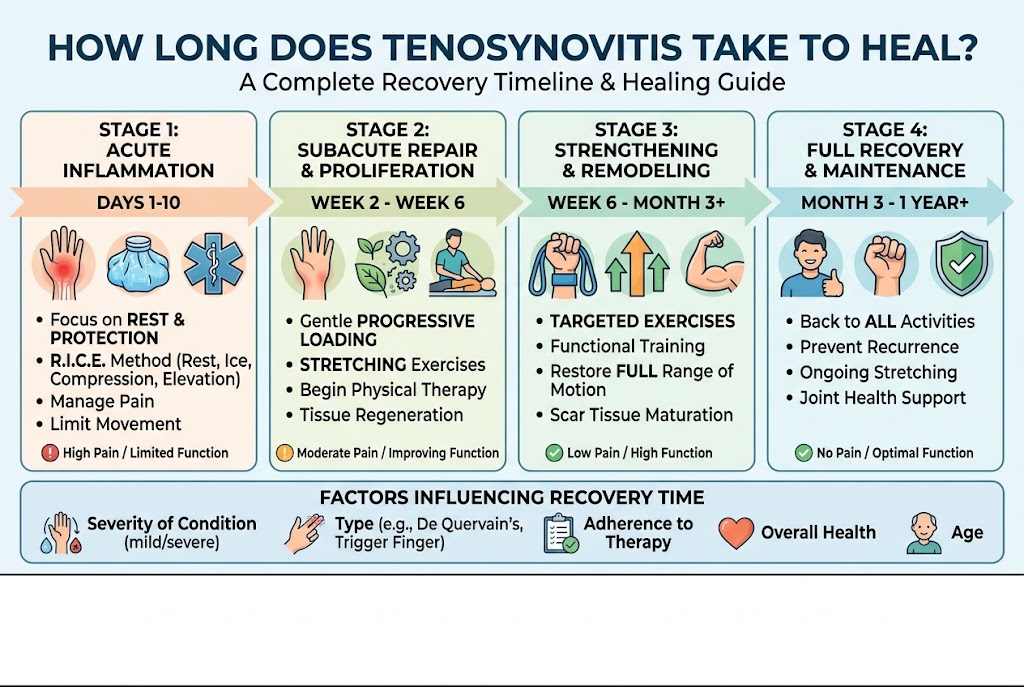
How Long Does Tenosynovitis Take to Heal? A Complete Recovery Timeline
What is tenosynovitis recovery time? If you’ve been diagnosed with tenosynovitis, this is probably the question running through your head. Tenosynovitis recovery time can be difficult to know precisely as it depends on your exact type, severity of your particular tenosynovitis, and its treatment path. Some patients see improvement in weeks, others take months. Here, we give you exactly this, in a week-by-week tenosynovitis recovery timeline, supported by clinical research, treatment comparison tables with real success rates, and expert data to back up each stage, drawn from peer-reviewed research studies. We use The 3-Phase Recovery Rule framework to give you an accurate picture of exactly what happens at each step of healing.
What Is Tenosynovitis? Symptoms and Types You Should Know

Tenosynovitis involves the inflammation of the tendon sheath – the protective lining found around a tendon – when this sheath becomes inflamed. When the sheath swells, the tendon cannot glide smoothly, causing wrist pain, stiffness, and restriction of movement. Even though it can develop anywhere in the body, most commonly we see it in the hand and wrist.
The most famous, de quervain’s tenosynovitis was first described by Swiss doctor Fritz de Quervain in 1895. It affects the tendons on the thumb side of the wrist, particularly the abductor pollicis longus and extensor pollicis brevis tendons. However, there are several variations:
- de quervain’s tenosynovitis is the most common form affecting the thumb and wrist
- Flexor tenosynovitis involves the tendons that flex the tendon sheath in the fingers or hand
- Stenosing tenosynovitis (trigger finger) causes the tendon to catch or lock when it is being moved into the bent position
- Infectious tenosynovitis occurs when bacterial infection develops, an emergency requiring the tendons be treated urgently
According to data published in StatPearls (NIH/NLM), the prevalence of de quervain’s tenosynovitis is around 0.5% in men and 1.3% in women. It most commonly occurs between the ages of 40 and 50, and is around three times more common in women than men, in particular around periods of gestation such as pregnancy and birth. Coming into contact with a hormone surging during this period significantly increases health risks.
Common Symptoms of De Quervain’s Tenosynovitis:
- Pain on the thumb side of the wrist, particularly when gripping, twisting
- ✔ Swelling near the base of the thumb
- ✔ Difficulty gripping objects or making a fist
- Snapping or catching when moving the thumb
- ✔ Pain that worsens with repetitive wrist movements
- ✔ Tenderness along the tendon sheath when pressed
Symptoms, including these two common signs, need to be identified as early as possible as the longer the inflamed tendons go untreated, the more difficult your recovery road becomes. Use our free symptom assessment quiz to judge your state of health. Tenosynovitis can exhibit the same features as other inflammatory conditions, including arthritis and inflammatory conditions, so an accurate diagnosis is critical.
Tenosynovitis Recovery Timeline: What to Expect Week by Week

Recovery from tenosynovitis is rarely a linear progression. While many patients believe in a simple “rest and heal” path, the suggested course incorporates specific biophysical actions at each design phase. We explain this with The 3-Phase Recovery Rule, a framework which applies to how tendons heal.
Phase 1: Protection
Week 0-2
Immobilize, reduce inflammation, RICE protocol
Phase 2: Restoration
Week 2-6
Gradual ROM, controlled loading, splint weaning
Phase 3: Rebuilding
Week 6-12+
Strengthening, return to full activity
| Phase | Timeframe | Goals | Key Activities | Warning Signs |
|---|---|---|---|---|
| Protection | Week 0-2 | Pain management, reduce swelling | Splint/brace, ice 15-20 min 3x daily, NSAIDs, rest from aggravating activities | Increasing redness, fever (may indicate infection) |
| Restoration | Week 2-4 | Begin gentle range of motion | Gradual splint weaning, gentle wrist stretches, thumb circles | Sharp pain during movement (back off immediately) |
| Restoration | Week 4-8 | Increase activity tolerance | Strengthening exercises, gradual return to daily tasks, continued stretching | Swelling that returns after activity |
| Rebuilding | Week 8-12+ | Full return to activity | Sport/work-specific training, ergonomic adjustments, monitor for relapse | Pain recurring in previously healed areas |
Clinical data supports this tenosynovitis recovery timeline. According to StatPearls and Cleveland Clinic, most patients with conservative treatment see improvement within 4 to 6 weeks, and a 2023 meta-study in JAMA Network Open (30 papers, 1663 patients) revealed that the combination of corticosteroid injection and immobilization for 3 to 4 weeks works best as First Line Tx.
Important: the oft-quoted “4 to 6 weeks” estimate for recovery time is misleading. This number is based on the period of initial improvement; it is not indicative of permanent resolution. According to StatPearls, full recovery from corticosteroid injections takes 3 to 9 months. Most patients are surprised when their pain and swelling persist far beyond that initial period of improvement.
Does Tenosynovitis Ever Go Away?
Yes, tenosynovitis does resolve for the majority of patients. A study by Pacific Northwest University shows over half of patients take no injections or surgery—just rest, splinting, and physical therapy—for treatment. For the subset of patients who do require intervention, corticosteroid injections and surgical release have excellent success rates. The trick is allowing enough time for recovery—you can’t just jump right back into aggravating activities. For a detailed breakdown of your expected recovery, use our personalized recovery timeline tool.
Real Patient Experience: “I’m 10 months in and still dealing with flare-ups. Seeing a physio regularly, stretching and exercising every day. It’s way longer than the 4-6 weeks I was originally told.” This is an unfortunate reality for many with tenosynovitis and surprises many clinicians: how long does tenosynovitis last will vary from patient to patient and patience is definitely a part of treatment.
De Quervain’s Tenosynovitis Surgery Recovery Time

Surgery is generally indicated as the next step if conservative management of persistent symptoms fails after three or more months. This is known as de quervain’s release surgery and is performed as an outpatient procedure. Your surgeon makes a small (2cm) transverse incision over the first dorsal compartment, releases the tendon sheath, and restores mobility to the tendons on the thumb side of the wrist.
Here is what de quervain tenosynovitis surgery recovery looks like in real life:
| Period | What to Expect | Activities |
|---|---|---|
| Day 1-3 | Post-operative swelling, moderate pain | Rest, elevation, ice packs placed below the brace (not directly on incision), prescribed pain medication |
| Week 1-2 | Sutures removed, initial healing | Begin gentle finger movements, wound care, keep incision dry |
| Week 3-6 | Progressive rehabilitation begins | Physical therapy 1-2x per week for approximately 6 weeks, gradual range of motion exercises |
| Week 6-12 | Strengthening and return to normal use | Grip strengthening, return to daily activities, gradual return to work tasks |
Postoperative outcomes have been found to be promising, with a meta-analysis of 21 studies involving 939 patients showing a 95% complete pain remission rate after de quervain’s release surgery. Pain on the VAS decreased an average of 5.7 points. However, this same paper notes an 11% complication rate—including nerve injury, tendon subluxation, and scarring—higher than most patients expect. Many competitive resources gloss over surgery’s complications.
“Meta-analysis of 939 patients who underwent de quervain’s release surgery shows a 95% complete pain remission rate, but clinicians should warn patients about the 11% complication rate. No statistically significant difference was demonstrated between open versus endoscopic intervention.”
— Findings from PMC Meta-Analysis (2022), 21 studies
In closing it is important to note that 5% of patients retain some residual pain after surgery, and an absence of statistically significant results between the open and endoscopic groups was identified. Both procedures resulted in comparable pain and functional outcomes. The choice between the open and endoscopic techniques should be based on surgeon experience and patient specifics, not assumed distinctions.
💡 Patient Experiences After Surgery:
“My physical therapist had me coming in twice a week for about six weeks after surgery. The first two weeks were just about getting the swelling down and restoring basic movement. Real strengthening didn’t start until week four.”
Keep the ice packs beneath rather than on top of the brace. My surgeon was very particular about that – direct cold on the incision site impedes wound healing.
Treatment Options and How They Affect Recovery Speed
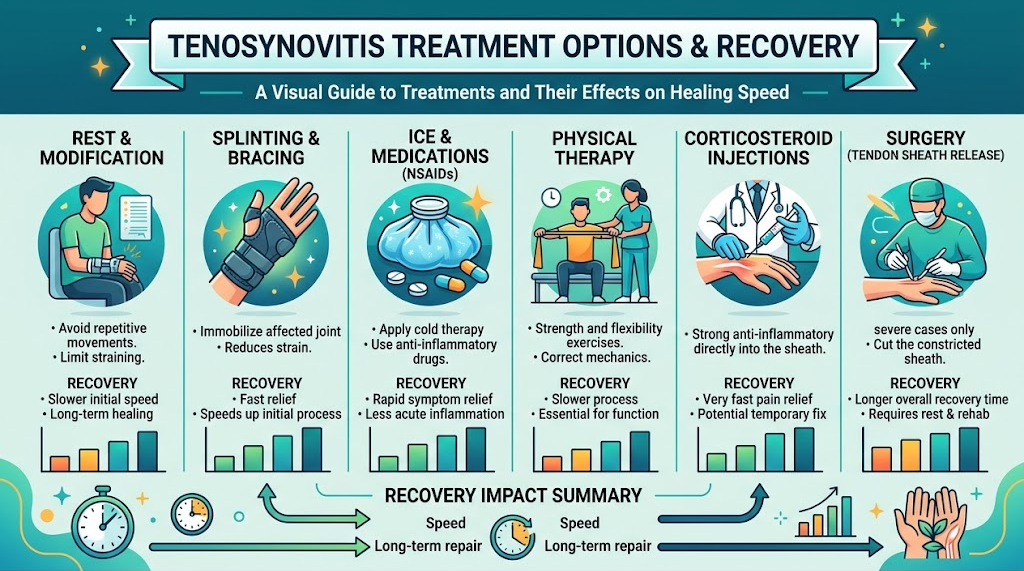
Selecting the appropriate treatment for de Quervain’s tenosynovitis among those available directly impacts your rate of recovery. Presented herein is a comparison treatment plan options including course duration, reported efficacy, and optimal candidates.
| Treatment | Typical Recovery | Success Rate | Best For |
|---|---|---|---|
| Rest + Splint | 4-6 weeks | ~55% manage conservatively | Mild, early-stage cases |
| NSAIDs | 2-4 weeks symptom relief | Symptom management only | Pain and swelling reduction |
| Corticosteroid Injection | 2-4 weeks initial, 3-9 months full | 73.4% within 2 injections | Moderate, persistent symptoms |
| Physical Therapy | 6-8 week program | Part of conservative management | Range of motion restoration |
| Surgery (Release) | 6-12 weeks | 95% complete remission | Severe/chronic (>3 months) |
| TCM / Acupuncture | Ongoing alongside primary treatment | Preliminary evidence | Complementary pain relief |
Corticosteroid injection is the most researched intervention. Efficacy at 2 injections was 73.4%, with 51.8% responding to a single injection (Oh et al. (2016)). Efficacy rates on StatPearls range from 52-90%, depending on technique and patient-related factors.
The 2023 JAMA systematic review established corticosteroid injection + thumb spica splint is the most efficacious conservative treatment for de Quervain’s tenosynovitis intervention.
For those who wish to avoid injections, these were not required in 54.5 percent of patients in the PNWU study. Conservative measures were the use of splint to prevent movement of the thumb and wrist, administration of anti-inflammatory medications (nsaids), and modification of activities involving repetitive wrist movements. Treatment is normally advanced from conservative to interventional measures when possible.
Additionally, newer methods are being developed. De Quervain’s tenosynovitis has been shown to respond favorably to platelet-rich plasma (PRP) injections, with early results showing improvement. Larger studies must be performed before PRP injections can be recommended on a regular basis.
PRP injections for de quervain tenosynovitis with the recovery time of PRP may vary from corticosteroid injections.
What Is the Most Effective Treatment for Tenosynovitis?
According to existing evidence corticosteroid injection plus immobilization is the best conservative management of treatment for de Quervain’s tenosynovitis. This was illustrated by the JAMA 2023 review of 30 studies. Mild cases can often be managed with splint and rest and more than half of patients will resolve in this way.
Surgery will lead to remission in 95% of cases when conservative management does not resolve symptoms in three months. Your choice would be governed by grading of the problems, how long they had been present and your other risk factors.
According to some practitioners, acupuncture could be a helpful complement to orthodox medical treatment by virtue of its different mode of action on pain and inflammation. Possessing ideas from the TCM framework of tendon, the tenosynovitis was believed to be related to stagnation of liver blood and qi. As a supplementary treatment for tenosynovitis, clinical evidence for acupuncture is still at an early stage but worth exploring.
Investigate tenosynovitis treatment options at Tongren Tang to understand more about how TCM could be integrated into your recovery plan or compare treatment approaches side by side.
💡 Patient Experiences with Treatment:
I combined physiotherapy with acupuncture sessions and I found the combo useful. The physio realigned my range of motion and the acupuncture appeared to reduce inflammation in between treatments.
5 
Not everyone heals at the same rate. There are five main factors, according to research, which affect the speed of your tenosynovitis healing.
Factor 1: Severity and Time elapsed prior to presentation. Early treatment, on average, leads to better results. Those presenting in the first 6 months all tend to recover more quickly than those presenting later.
The longer inflamed tendons go without treatment, the more chronic the condition becomes; chronic tenosynovitis is significantly more difficult to treat with conservative methods.
Factor 2: Body Composition. Body Mass influences outcome in a quantifiable way. Oh et al. managed to show that individuals that had a BMI over 30 had 2.4 times the odds of injection failure than individuals at a normal weight.
The increased body mass causes increased mechanical stress on the hand and wrist tendons and may influence distribution of the corticosteroid within the tendon sheath.
Factor 3. Sex and hormone factors. Oh et al. also identified female gender as having 3.23 times the odds of injection failure.
This can be associated with the hormone factors- as pregnancy and the post-partum period are major risk factors for de quervain’s tenosynovitis (both wrists being common in new mothers due to repetitive lifting/holding infants).
Factor 4: Anatomical Variation. According to a JAMA review, 90% of patients with tenosynovitis at de quervain have a separate subcompartment for the EPB tendon. This variation will directly influence the accuracy of injections as a single corticosteroid will be unable to administer the injection effectively if it is not in the correct compartment.
Ultrasound guided injections may be beneficial in improving the accuracy of such injections.
Factor 5: Activity & Occupation: Activities that involve repetitive wrist movements and excess use of the wrist e.g. typing, building work, childcare, sport, have an immediate impact on recovery rate. Resumption of these activities before they are due to be resumed is the most common factor in a relapse. Ergonomic adaptation of the work environment & a stepwise return to activity is necessary to maintain the benefits of treatment.
Pro Tip: Progressive tendon loading – gradually increasing stress on the tendon through controlled exercise – produces better long-term results than pure rest alone. Complete immobilization for extended periods can actually weaken the tendon. Work with a physical therapist to find the right balance between protection and controlled movement.
Patients who follow a structured progressive loading protocol report fewer relapses than those who simply rest until pain stops.
We present to you the most overlooked reason for the major setback; wrong ending to splint. The pain may go away within 3 to 4 weeks, but the true tendon sheath inflammation itself will not be completely free of symptoms. Most clinicians will have instructed patients to wear the splint for the prescribed time period, but for the complete few weeks, then slowly reduce rather than suddenly stop the use.
If you happen to be managing comparable repetitive strain, you might find useful our strategy for tennis elbow recovery, which is based on many of the similar principles.
Exercises and Stretches to Support Healing

How Long Is Therapy for Tenosynovitis?
Most patients will see noticeable benefit within approximately 4-6 weeks of beginning treatment. A complete rehabilitation period will last between 6 and 8 weeks, with treatment occurring between once and twice a week. Patients suffering with persistent or severe tenosynovitis may require longer rehabilitative periods.
Your therapist will plan timelines accordingly based upon your situation and disease severity.
Treatment exercises for tenosynovitis consist of a three-phased approach, similar to The 3-Phase Recovery Rule. Injury-specific exercises require us to perform the appropriate exercises at the appropriate time, because performing too much too soon can set you back, while waiting too long prolongs your recovery.
Phase 1 — Gentle Range of Motion (Week 2-4):
- Wrist flexion/extension – slowly flex and extend the wrist. 5 seconds each. Repeat 10 times in each position. 3 sets daily.
- Thumb circles – gently circle the thumb in both clockwise and counter-clockwise directions. Repeat 10 times in each direction.
- tendon glides – pump open and close your hand. Curl fingers into an open hand, then a hook fist, then a straight fist, and finally into a closed fist. Repeat 10 times.
Phase 2 — Stretching (Week 4-6):
- Modified Finkelstein stretch – gently tilt your thumb across your palm. Straighten out the wrist so it tilt toward your pinky finger. Hold for 15-30 seconds. Note: the finkelstein test is used diagnostically, a softer version can act as a therapeutic stretch.
- wrist and thumb nerve glides – straighten your arm, bend the wrist, then the thumb. Hold for 3 seconds in each position.
- Forearm stretches – extend arm with palm facing down, gently pull your fingers down toward your body with your other hand. Hold 20 seconds.
Phase 3 — Strengthening (Week 6+):
- Theraband exercises – squeeze pinch spread putty to regain grip strength. Use soft resistance and build to firm resistance.
- Grip strength exercise – pinch grip strengthen an implement like a soft stress ball or a hand grip trainer. 3 sets of 10 with as little resistance as possible.
- Eccentric wrist loading – holding a light weight (about 0.5-1 kg), slowly lower the wrist (over 3 seconds) from extended to flexed position. This form of progressive tendon loading builds up your tendon resilience over time.
⚠️ When NOT to Exercise:
- During acute inflammation with significant swelling and redness
- Within 48 hours following a corticosteroid injection
- After surgery, until your surgeon clears you for movement
- Sharp, increasing pain while exercising (acceptable pain can be dull but not sharp)
Proper management for pursuing hand and wrist conditions require patience. The use of stretches and exercises can assist with healing your wrist and thumb tendons but it take sustained effort on your part over the course of many weeks for lasting results.
Frequently Asked Questions
Q: Is tenosynovitis very painful?
View Answer
Pain can be mild aching pain or severe stabbing pain that hinders grip strength. Pain intensifies with pinching, grasping, or twisting motions.
Q: Can de Quervain’s tenosynovitis be prevented?
View Answer
While not always within our control, you can significantly reduce your risk of tenosynovitis. Take frequent breaks while performing repetitive hand and wrist tasks, adjust your workstation ergonomics, strengthen your forearm muscles with preventive exercises. For new parents, learn to lift your child correctly, distributing their weight evenly across both hands instead of relying on your thumb. If you experience early signs of pain, wearing a splint at night can help prevent progression of the injury.
Q: What happens if de Quervain’s tenosynovitis goes untreated?
View Answer
Left untreated, tenosynovitis typically worsens with time. inflammation progresses from acute to chronic, commencing the thickening of the tendon sheath, while the pain from the thumb side of your wrist radiates into your forearm. Grip strength diminishes, and everyday tasks become hard to perform. Early-stage tenosynovitis can be relieved through conservative treatment, but uncontrolled, chronic observations tend to require injections or surgery.
Q: What is the relationship between de Quervain’s tenosynovitis and pregnancy?
View Answer
Pregnancy and pregnancy-related conditions are significant risk factors. Hormonal changes during pregnancy cause fluid retention and swelling that increases pressure on the tendon sheath. After delivery, repeated lifting and holding of a newborn stresses thumb and wrist tendons. A common presentation is for the mother to develop bilateral wrists – the right and left wrists are both afflicted. Excessive breast-feeding positions and constant handling of the newborn worsen the condition. Most cases related to pregnancy will resolve within several months after delivery once lifting activities are scaled down, and conservative management with splinting and antiinflammatory medications is sufficient.
Q: How is de Quervain’s tenosynovitis diagnosed?
View Answer
Diagnosis is clinical in nature. Your doctor will perform the Finkelstein test: you make a fist over your thumb, then bend your wrist toward the pinky side. Sharp pain along the thumb-side tendons confirms the diagnosis. Ultrasound imaging may be used to assess tendon sheath thickening and rule out other conditions.
Q: Will I need surgery for de Quervain’s tenosynovitis?
View Answer
Surgical intervention is not necessary for the majority of the patients. studies have demonstrated that 54.5% of patients are effectively managed with healthcare including splinting, activity modification, and use of the is treatment without the need for surgery. Up to 73.4% of patients with corticosteroid injections show improvement through conservative management. Surgery should be employed after a minimum of three months of trial activity modification and splinting therapy if the condition does not improve with conservative management. Post-surgical results have shown 95.0% of patients to have complete loss of any pain associated with the disease in follow-up.
📐 Take the Free Symptom Assessment Quiz
📐 Compare Treatment Options
According to the Tongren Tang practitioners combine modern rehabilitation guidance with traditional techniques.
Our Perspective on This Guide
This Tenosynovitis recovery guide was developed by the clinical team at the Tongren Tang based on peer-reviewed orthopedic literature and our hands on experience as TCM practitioners in the treatment of tendon and joints. We aim to present acupuncture in light of tradition and as a compliment instead of a replacement to standard care. Evidence is noted where present, and citations are provided for every piece of treatment information.
References & Sources
- StatPearls — De Quervain Tenosynovitis (NIH/NLM) — https://www.ncbi.nlm.nih.gov/books/NBK442005/
- JAMA Network Open — Systematic Review and Network Meta-Analysis (2023) — https://jamanetwork.com/journals/jamanetworkopen/fullarticle/2811119
- PMC — Surgical Outcomes Meta-Analysis (2022) — https://pmc.ncbi.nlm.nih.gov/articles/PMC9076451/
- PMC — Corticosteroid Injection Effectiveness, Oh et al. (2016) — https://pmc.ncbi.nlm.nih.gov/articles/PMC5484456/
- Cleveland Clinic — Tenosynovitis Overview — https://my.clevelandclinic.org/health/diseases/23448-tenosynovitis
- PNWU — De Quervain’s Tenosynovitis: Trends in Treatment — https://www.pnwu.edu/dequervains-tenosynovitis-trends-in-treatment/
- PMC — PRP for De Quervain’s Tenosynovitis — https://pmc.ncbi.nlm.nih.gov/articles/PMC11948868/