Get in Touch with Tongren Tang Gulf
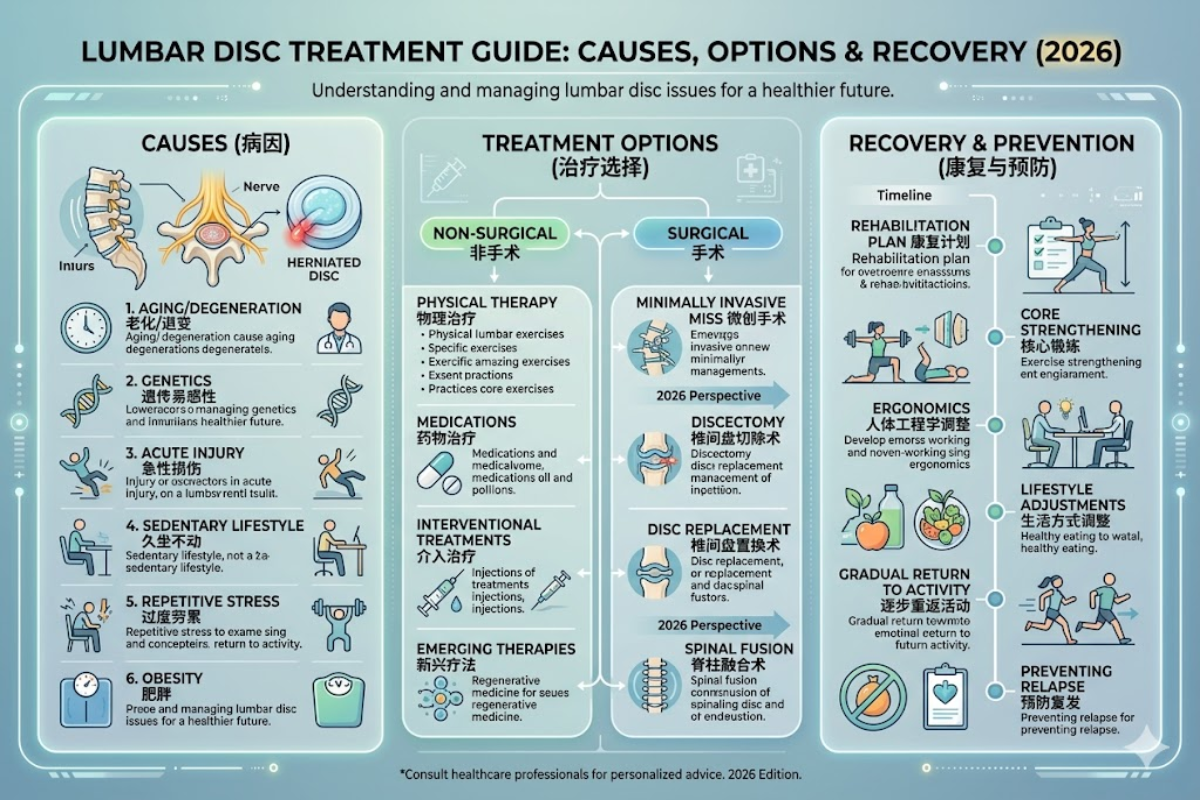
Lumbar Disc Treatment Guide: Causes, Options & Recovery (2026)

Lumbar Disc Treatment: A Complete Guide to Herniated, Bulging & Degenerative Disc Recovery
Medically reviewed content | Last updated: April 2026
📋 Quick Facts — Lumbar Disc at a Glance
- Lumbar discs (L1-S1) bear about 80% of the load on the spine in erect position and in motion14
- 90% of herniated disc conditions get better without operation within 6-12 weeks14
- Most common levels affected: L4-L5 and L5-S1
- Conservative treatment success rate: 80-90%
- Surgery success rate (properly selected patients): 85-95%
- Red flag: Loss of bowel or bladder control = emergency – go straight to hospital
Back pain from a lumbar disc problem can make even routine tasks – sitting at your desk, lifting groceries, even sleeping – agonising. The good news is that most disc conditions improve by themselves – the challenge is choosing the right treatment to suit you, and avoiding the most common pitfalls.
This article steps through herniated disc, bulging disc and degenerative disc disease causes, symptoms, diagnosis and treatment options, with evidence from the world’s largest clinical studies.
Understanding Lumbar Disc Problems — Herniation, Bulging & Degeneration

There are 5 intervertebral discs in your lumbar spine, between the vertebrae L1 down to S1. Each disc is composed of two elements: a tough outer ring known as the annulus fibrosus, and a soft-pudding like centre known as the nucleus pulposus. Both of these components work together as a shock absorber – dispersing load, and allowing mobility, and protection of the spinal cord and nerves of the spinal nerve roots that exit at each vertebral level of the lumbar spine.
Most common disc pathology can be described as falling into one of three categories:
| Feature | Bulging Disc | Herniated Disc | Degenerative Disc Disease |
|---|---|---|---|
| Mechanism | Disc extends beyond vertebra edge but annulus stays intact | Nucleus pulposus breaks through the annulus (disc material leaks out) | Gradual disc breakdown — loss of height, hydration, and structural integrity over time |
| Severity | Usually mild; often found incidentally on imaging | Moderate to severe; can compress spinal nerve roots directly | Variable — ranges from asymptomatic to chronic pain |
| Typical Symptoms | Dull ache in lower back; mild stiffness | Sharp leg pain (sciatica), numbness, tingling along the affected nerve path | Chronic low back pain that worsens with sitting; stiffness after rest |
| Typical Treatment | Activity modification, physical therapy, posture correction | Conservative treatment first; surgery if symptoms persist beyond 6-12 weeks | Long-term pain management, exercise, lifestyle changes; spinal fusion in severe cases |
Risk factors that accelerate disc problems include:
- age: After the age of 30, discs begin to dehydrate, and are therefore at increased risk of tears and prolapse
- repetitive strain: jobs with frequent heavy lifting, twisting movements or prolonged vibration
- poor posture: slouching increases abnormal loads on the disc by up to 40%
- Smoking: Reduces blood flow to discs, accelerating degeneration
- obesity: increased body weight causes sustained additional load on the lumbar vertebral bodies
- Sedentary lifestyle: Weak core muscles leave discs unsupported
Lumbar disc herniation (also known as disc herniation in some technical publications) is most common in between the ages of 30-50, with a male to female ratio of about 2:1. The lifetime risk of having symptomatic herniation is about 1-3%.
Symptoms — How to Recognize a Lumbar Disc Problem

Disc pain and back pain are not always the same. The level at which your pain develops – and the pattern it follows – is fundamentally determined by which lumbar level is affected. Every vertebral level in the lumbar spine supplies nerves to an area of the leg, known as the dermatome:
- L3-L4 disc (L4 nerve root): Pain and pins and needles in the in inner shin and ankle. Weakness in knee extension. Absent knee jerk reflex.
- L4-L5 disc (L5 nerve root): Pain down the sides of the leg to the top of the foot and great toe. Weakness in ankle dorsiflexion (foot drop seen in severe cases). The most common level to herniate.
- L5-S1 disc (S1 nerve root): Pain running down the back of the leg to the outside of the foot and toes. Weakness in walking by pushing off. Absent ankle jerk reflex.
Not all low back pain originates from a disc. If you can differentiate between true disc pain, and muscular pain, your treatment pathway will change dramatically. Here’s how:
| Feature | Disc Pain | Muscle Pain |
|---|---|---|
| Location | Radiates into the leg (follows a specific nerve path) | Stays in the lower back or nearby muscles |
| Character | Sharp, burning, or electric; may include numbness or tingling | Dull ache, tightness, or cramping |
| Aggravating factors | Sitting, bending forward, coughing, sneezing | Specific movements, prolonged postures, muscle use |
| Relieving factors | Lying down, walking (sometimes), extension positions | Rest, stretching, heat or ice, massage |
🚨 Red Flags — Seek Emergency Care Immediately
These are the initial findings associated with cauda equina syndrome, a serious condition involving the compression of the collection of nerves at the bottom of the spinal cord. If left untreated with urgent surgery (within 24-48 hours) permanent paralysis could occur:
- Incontinence or loss of control of the bowels or bladder (abdominal muscles cannot work)
- Numbness in the saddle area (inner thighs, groin, buttocks)
- Rapidly progressing weakness in both legs
- Severe or worsening leg pain with new numbness
Diagnosis — What Tests Actually Tell You (and What They Don’t)
Identifying a disc lesion includes a clinical exam before sending for radiographic testing. Experienced clinicians may be able to identify the affected disc level without any imaging.
Physical examination findings:
- SLR tests: raising the symptomatic leg while supine causes pain at 30-70 degrees of elevation. This is pathognomonic for a lesion at the disc
- Motor examination: specifically testing the key muscles for each nerve root level (toe-walking for S1, heel-walking for L4) helps make an accurate diagnosis
- Sensory testing: mapping areas of numbness helps correlate the level of cord injury
- Reflex abnormalities: decreased ankle or knee reflexes verify the impact of the disc lesion on the nerve
Imaging — when and which type:
- MRI: the best method for visualizing the discs, nerves, and soft tissues. Ordered in people with symptoms lasting more than 4-6 weeks or in those who have any red flags
- CT: provides imaging of bones. Less sensitive than MRI, and used if MRI is not available
- X-ray: does not directly image the discs and nerves; used only to exclude trauma or tumor
Important note: A landmark trial in the New England Journal of Medicine demonstrated that in 98 asymptomatic volunteers, 52% had abnormal disc bulges and 27% had a protrusion. An abnormal scan does not always mean you need to be treated; symptoms must correspond to the imaging findings.
Conservative Treatment — The First Line for Most Disc Problems

Most of the time – 80-90% of the time – a lumbar disc herniation will heal with nonoperative treatment. The condition represents a spontaneous herniation, and the disc material is gradually reabsorbed; in cases of a sequestered disc herniation, 96% of the time the disc disappears on its own and in extruded herniations 70% of cases resolve spontaneously.
The following is a current evidence-based approach to treating lumbar disc herniation, in order of progression to more invasive therapies:
1. Activity modification + short rest (not bed rest)
Take it easy for a couple of days. Avoid activities that seem to aggravate your pain, but do not lie in bed longer than 48 hours. Over bed rest actually weakens the stabilizers of the lumbar, and delays healing. Gentle walking is actually encouraged from Day One.
2. Physical therapy — McKenzie method & core stabilization
Physical therapy forms the foundation of conservative management for disk herniation and lower back pain. Using the McKenzie treatment concept (Mechanical Diagnosis and Therapy), the therapist guides you through specific repetitive movements here mainly extension movements in order to cause the pain to localize toward the center of the disc, called centralization. Studies show that McKenzie therapy causes a significant decrease in pain and disability scores, which lasts for over 6 months. Strengthening the lumbar stabilizers (core stabilization exercises) enhances this effect.
3. Medications: NSAIDs + muscle relaxants (short-term)
Anti-inflammatory drugs (ibuprofen, naproxen) may be used to control pain and decrease the inflammation around the compressed nerve. Muscle relaxants if there arectspasmmay help during the first 1-2 weeks. Neither should be relied upon in the long term- the treatment is symptomatic whilst the disc degrades and reabsorbs.
4. Epidural steroid injections (for severe radiculopathy)
Epidural steroid injections- Medical treatment of severe leg pain unresponsive to TCM herbal medication, acupuncture etc. is best achieved by an epidural injection of corticosteroids around the inflamed nerve root. Relief can last anywhere from weeks to months, blocking the pain to allow the natural disc resorption process to take its course. Usually limited to 3 injections/year.
5. Acupuncture & Traditional Chinese Medicine (TCM)
A systematic review of the world literature reporting RCTs of acupuncture for disc persisting pain (including 33 RCTs with 3,503 participants) published by a Scottish team concluded that acupuncture showed a significantly higher total effective rate than lumbar traction, ibuprofen, diclofenac sodiumandmelo-xicam, and better pain scores(VAS) thantractionanddiclofenac sodiumalone.Accordingly,if you are in Dubai and suffer from disc pain,be sure to check out our expert lumbar disc program at tong Ren Tangwhere our leading DHA licensed Traditional Chinese Medicine team uses pinpoint acupuncture and unique herbal combinations to knock your disc pain out.
📐 The SPORT Trial — Surgery vs. Conservative Treatment
Impact of the Spine Patient Outcomes Research Trial(SPORT)- As noted above, this remains the world’s largest RCTs comparing discectomy against non-surgical care for lumbar disc herniation, with 501 patients enrolled from 13 centers in the USA. The follow-up data revealed that both groups had significantly improved, although the sp surgically treated group had a faster short-term improvement, the long-term resultswereclosely comparable. It was also observed that44% of the group randomized to conservativecareadmitted to having surgery by 4 years. Interestinglyover 80% of those who remained conservative ended up with comparable long term results. At 8 years,15%of surgically treated patients required re-operation. For most patients without red-flag symptoms, conservative treatment should be the first approach.
When Surgery Becomes Necessary — Types & What to Expect

Approximately 5-10% of disc herniations will eventually require spine surgery. When disk pain persists despite months of conservative care, surgery is indicated when
- Cauda equina syndrome- this is a surgical emergency (within 24-48 hours)
- Progressivemotor impairment especially foot drop or inability to walk on heels/toes that worsens despite treatment,
- Failed conservative therapy-severe symptoms lasting over 6-12 weeks of adequate nonsurgical treatment.
Four main surgical options:
Minimally invasive discectomy (Microdiscectomy) is the most common surgical procedure for disc herniations. surgery is carried out by removing only the part of the herniated disc thatispatulouson the affected nerve through a small incisions- usually1-2cm. The 85-95% success rate allows most patients to go home the same day, often with immediate relif of the numbness, pain and with electrical sensations shooting down the leg.
Laminotomy/Laminectomy – removal of part of the vertebral lamina to relieve pressure on the spinal cord or nerve roots. This procedure is usually performed on those cases where adisc herniates sufficiently to cause significant spinal stenosis, or when the disc fragment protrudes thus far that standard microdiscectomy approaches may not reach it.
Artificial Disc Replacement – Damaged disc is removed and replaced with a mechanical device that preserves segmental motion. Artificial disc replacement is suitable for a younger patient with a single disc affected,who does not havea modular degenerative disease affecting his/ her facet joints. Compared to spinal fusion, this avoids the additional stresses imparted to adjacent segments by the fusion.
4. Spinal fusion – Two or more vertebrae are permanently fused together, removing movement at that level. Usually a last resort for instability, repeated herniation at the level, or gross degenerative disc disease with segmental collapse. Longer recovery (3-6 months), and neighboring level may wear out faster.
🕐 Recovery Timeline & Prevention
Conservative recovery timeline:
- Mild herniation:2-6 weeks- most patients will see consistent improvement in leg pain first, back pain last
- Moderate herniation:6-12 weeks- this window is very important for physical therapy to be maximized
- Severe(non-surgical):3-6 months- slow improvement; consider epidural injections if progress stalls
Post-surgery recovery timeline:
- Week 1-2: Walking, basic daily activities, wound care
- Week 4-6: Return to desk work, light driving, start physical therapy
- Month 3-6: Gradual return to activity, including exercising and manual work
Five Prevention Strategies That Actually Work:
Core strengthening – A strong core is like a built in brace for your lumbar spine. 3 exercises with good evidence for protection against disc injury:
Bird Dog: Start on hands and knees. Simultaneously raise your right arm and left leg, keeping your spine and neck neutrally aligned, engauge your core. 5 second hold. Repeat other way, 10 repetitions/2-3 Sets.
Pelvic Tilt: Lay on back, bend knees, put feet flat on the floor. Flatten your low back against the floor by tightening your abdominals to pull your belly button in toward your spine. 5-10 second hold. 15 repetition/2-3 Sets.
Partial Curl-UP( McGill Curl Up): Lay on your back, one knee bent, the other leg sticking out. Place hands under small of your back for support. Just lift your head and shoulders up, do not flex your lumbar spine. 8-10 second hold. 5-8 repetitions/2 Sets.
- Proper lifting technique:Bend at the knees, keep the load close to your waist, never twist while lifting
- Ergonomic work place: Eye level monitor, feet flat on floor, lumbar support. Stand and stretch after every 30-45 minutes.
- Healthy weight: For every pound you gain you are adding around 4 pounds of load to your lumbar spine
- Stop smoking: Smoking cuts off nourishment to your spinal discs via slower blood flow, directly speeding up disc related arthritic changes
The more important factor is regularity, not intensity. Patients who maintains a 15-20 minute core routine annually will exhibit far lower level of recurrence then those only exercising during herniation flare ups.
Frequently Asked Questions About Lumbar Disc Treatment

Can a herniated disc heal on its own?
Yes. Studies show that 80-90% of herniated discs will resolve with Conservative therapy within 6-12 weeks. The body naturally resorbs the extruded disc over time- large herniations(sequestrations and extrusions) resorb at a rate 1.5-3 times higher than smaller bulges.
How long does lumbar disc recovery take?
Initial conservative treatment.. 2-6 weeks for mild, 6-12 weeks for moderate herniation. Post surgically..(Microdiscectomy) 4-6 weeks for initial basic recovery, 3-6 months for resumption of activity.
What is the best treatment for a herniated lumbar disc?
Begin with nonoperative management: PT, primarily McKenzie, anti-inflammatory meds and activity modification. The SPORT study-the largest RCT on this topic- showed that time makes surgery and nonsurgical treatments equivalent.11 For most patients, conservative therapy is a justifiable initial method of treatment.
Is walking good for a herniated disc?
Yes! Gentle walking is actually one of the best things you can do in your recovery. Walking keeps you mobile, brings blood to healing tissues and prevents long term deconditioning.
Begin with gentle, short walks, about 10-15 minutes and work up as tolerated. Do not walk on a steep incline or rough ground during the early stages.
Can acupuncture help with disc problems?
According to many systematic reviews, the use of acupuncture has been effective in alleviating the pain and restoring the function in case of lumbar disc herniation. The meta-analysis based on 30 randomized controlled trials has shown acupuncture to be more effective than various typical drugs used for pain relief. Discover our TCM therapy for lumbar disc at Tong Ren Tang Dubai.
What exercises should I avoid with a lumbar disc herniation?
In the acute phase: do not perform any deadlifts, sit-ups/crunches which further compress the disc, toe touches in standing position, high impact activities such as running or jumping, or any activities, which increase your leg pain or peripheralize your symptoms. Activities should be reintroduced gradually after the acute phase with a physical therapist.
When does a herniated disc need surgery?
It is recommended that surgery be performed in three instances; (1) cauda equina syndrome, an emergency requiring immediate decompression, (2) progressive motor weakness, especially foot drop and (3) no improvement following 6-12 weeks of intensive conservative treatment with persistent severe symptoms. Elective surgery should not be performed in a hurry-sport trial showed patients who initially elected for conservative therapy and then late took up surgery achieved good results.
What is the difference between a bulging disc and a herniated disc?
A bulging disc (or bulging disk) is a protrusion which extends beyond the normal margin of the vertebral body but the annulus fibrosus is still intact. You can compare it to a tire that is flat but not punctured. A herniated disc (or herniated disk) is a rupture or tear in the annulus through which the pulposus protrudes.
Herniations tend to show more nerve root compression and sharp radicular leg pain, while bulges have less significant, more general symptoms. Many bulging discs may go unnoticed if the patient has no symptoms.
📚 References & Further Reading
- Herniated disk Mayo Clinic: Diagnosis and Treatment6
Herniated Disk Mayo Clinic: Diagnosis and Treatment6 It may take some time to develop such progressively, so the symptom in patient is quite similar with other disease. Diagnosis is based on physical examination, medical history and imaging (MRI or CT scan). Treatment will be relief from pain. - Johns Hopkins Medicine — Lumbar Disc Disease
- SPORT Trial: Surgical versus Non-Operative Treatment- 8 year Follow up (PMC3921966)
- AAFP – Acute Low Back Pain: Evaluation and Treatment
- AANS — Herniated Disc Overview
- StatPearls — Lumbar Disc Herniation (NCBI Bookshelf)
- Tang et al.).—Acupuncture wey full I’m back: Systematic review wey E don and meta-analysis (2018)
📄 Related Articles
- Lower-back disc therapy at Tong Ren Tang Dubai – TCM & AcupunctureExperience by doctor treatment for Back issues.
- The Sciatica Treatment Handbook: Causes, Relief & Recovery HowIcanhelp.co.uk This is the complete guide to Sciatica explaining symptoms, diagnosis, treatment options and when to seek medical advice.
- Back Pain and Acupuncture: What the Research Shows
- Degenerative Disc Disease: Slowing Progression with Conservative Care
Battling lumbar disc pain?
The expert DHA-licensed TCM practitioners at Tong Ren Tang Dubai use acupuncture and traditional Chinese herbal medicine to treat the pain at its source. Call now to book your appointment.