Get in Touch with Tongren Tang Gulf

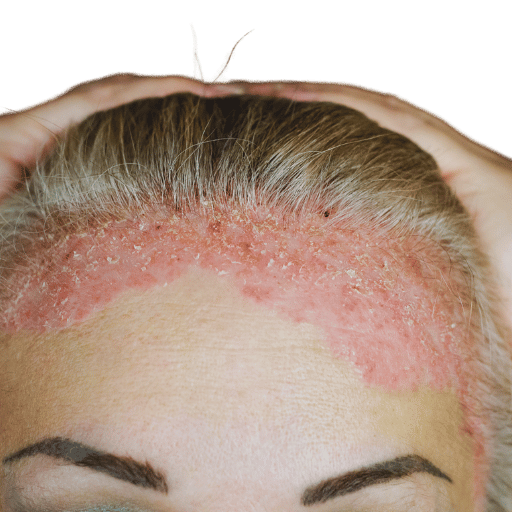
Eczema Chinese medicine treating atopic dermatitis with pattern-differentiated herbal formulas like Xiao Feng San, Acupuncture and diet modification has 2000 years of clinic history in East Asia and an e×panding (yet patchy) modern trial data set. This 2026 primer explores the five TCM eczema patterns you should idenitfy prior to your first consultation, how specific herbs work biochemically, what the 2022-2025 RCT results show (including the null results that competitors prefer to omit), and a six-treatment decision matrix that pits TCM against corticosteroids, biologics, wet wraps, probiotics and elimination diets.
Quick Specs — What This Guide Covers
- Root-vs-branch theory — why surface treatments fail
- Five TCM patterns with patient-facing identification signs
- Herb pharmacology: Xiao Feng San, Ku Shen, Huang Qin, Zi Cao
- 2020–2025 RCT and systematic review evidence map
- Acupuncture points, mechanisms, and honest limitations
- 6-treatment 7-dimension comparison (TCM vs corticosteroids, biologics, wet wraps, probiotics, diet)
- 8 questions to ask before booking a practitioner
- Estimated reading time: 16 minutes · Updated April 2026
Who thisis for: adult and parental patients looking into TCM after poor-topical steroid response and for clinicians seeking an evidence-based patient handout.
Why Eczema Keeps Coming Back — The TCM “Root vs Branch” Framework
Dali and taali, try two weeks of steroids, see the rash return within a month and think you are doing poorly? Nope, the treatment targets only the surface. Local corticosteroids cut off the inflammatory cascade; they do NOT change the immune dysregulation underlying the flare. Modest JFDVD literature reports 12-month relapse rates of 60-70% in moderate-to-severe AD on topical steroid maintenance, and a 2024 survey of British dermatologists found that 13.2% now recognize topical steroid withdrawal (TSW) as a clinical entity separate from eczema relapse.
Pattern-wise, this relapse cycle fits into Chinese medicine for eczema convention: treating the branch (biao) but not the root (ben). The dermatitic biao is the visible (skin); the ben is internal dysfunction of the spleen (dampness and fluid metabolism), kidney (fluid regulation) and liver (stress, qi flow). Dampness collects when the spleen qi fails to transform; heat rises when the liver qi stagnates; wind invades with co-weakness of defensive lung qi. This is how those three structural imbalances manifest as eczema on the skin.
“With TCM, we try to modulate these imbalances using a combination of lotions, creams, baths, teas, pills and sometimes acupuncture, which settle down the immune system into a less reactive state. Organs are not independent of one another.
What organ is connected to eczema in Chinese medicine?
Three major organ systems bear the brunt of the pattern loads. The spleen qi is responsible for fluid metabolism; when it is weak dampness accumulates and appears as weeping, vesicular dermatitis. The lung controls wei qi (immune boundary); weakened wei qi allows wind pathogens to invade and provokes itch. The liver stores blood and organises emotional qi; chronic stress causes liver qi stagnation, which generates heat that shoots to the face and shoulders. Most chronic eczema cases involve more than one of these three systems, and this is why one-formula-does-not-fit-all prescribing often fails to the idiopath-specific approach.
Context counts. A 2024 consensus paper cites adult eczema prevalence in the United Arab Emirates as high as 40%—roughly ten times the global baseline of 1-3%. High ambient temperature, arid atmosphere, and air-conditioned interiors all steer diagnoses toward the moist-heat end of the spectrum endemic to Middle Eastern skin.
Five TCM Eczema Patterns — Which One Describes Your Skin?
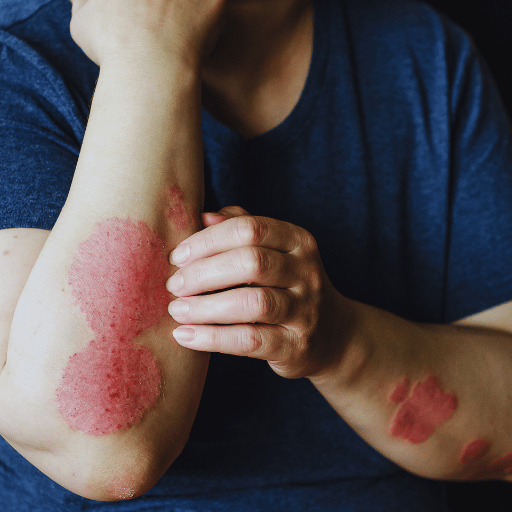
The traditional Chinese categories of eczema range from 4 to 6 (depending who you ask). These five in common use are perhaps a classroom distillation; in practice, pattern overlap happens, and tongue/tackle interactions remain the baseline classifier. Consult this first to focus your weight of reasoning prior to a face-to-face assessment. Not for self-prescription.
You can also take our eczema pattern test to get an initial feel before you make your appointment.
| Pattern | Skin appearance | Systemic signs | Typical demographic | First-line formula |
|---|---|---|---|---|
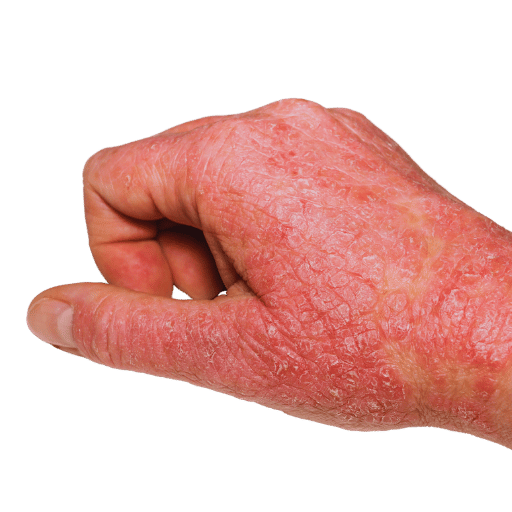
| 1. Damp-Heat | Red, oozing, vesicular, hot to touch; worse lower body | Thirst, bitter taste, yellow urine, tongue red with yellow greasy coat, slippery-rapid pulse | Adults in hot humid climates; UAE summer presentations | Xiao Feng San + Huang Qin, Ku Shen |
| 2. Wind-Heat | Sudden onset, widespread, intensely itchy, dry papules; upper body predominant | Thin rapid pulse, red tongue tip, mild fever or seasonal-change onset | Adults with sudden acute flares post-exposure | Xiao Feng San + Jing Jie, Fang Feng, Niu Bang Zi |
| 3. Spleen Deficiency with Dampness | Dull red, pale, chronic, slow-healing; vesicles with weeping but low heat | Fatigue, loose stools, bloating, poor appetite; pale tongue with thin white coat | Children; adults with chronic digestive weakness | Shen Ling Bai Zhu San + Bai Zhu, Fu Ling |
| 4. Blood Deficiency with Wind-Dryness | Chronic dry, lichenified, cracked; scaling without weeping | Pale face and nails, insomnia, dry mouth, thin pulse, pale tongue without coat | Adults and older patients with decade-long history | Si Wu Tang + Sheng Di Huang, Hei Zhi Ma, Dang Gui |
| 5. Damp-Toxin (Steroid Rebound) | Intense redness, burning, perioral bumps, steroid-use history | Emotional irritability, dry eyes, tight pulse; often post-TSW presentation | Patients tapering mid-to-high-potency topical steroids | Huang Lian Jie Du Tang + Pu Gong Ying, Jin Yin Hua |
What does the dampness pattern feel like versus blood-deficiency?
A spectrum of texture exists between dampness and blood deficiency. Dampness feels wet and sticky; finger tips emerge slimy after scratching off a lesion, the skin thickens and relaxes with oedema, the patient post exam frequently notices damp bedding on arousal with acute flare-ups. Conversely, blood-deficiency manifests with dry, desiccated features; the skin is extremely thin, it tears easily (“suck down” in Traditional Chinese Medicine parlance), the patient reports exacerbations of pruritus during nocturnal repose when blood/essence is believed to be at its most depleted. Dampness responds quickly (in approximately 4 to 6 weeks) to formulas that promote herbal drainage, whereas blood deficiency requires an extended course of blood-nourishing balances, minimum 8 to 10 weeks.
Clinical Note – common diagnostic errors: dull, pale, long-term lesions are often mistaken for “just not enough fire” (damp-heat) and treated with heat-clearing herbs like Huang Qin and Huang Lian. If spleen deficiency-with-damp is present, such bitter-cold herbs actually weaken the spleen and make the condition worse. Tongue coat severity—given the visual diversity of lesions—is the real tip-off.
The Pharmacology Behind the Herbs — How Xiao Feng San, Ku Shen, and Huang Qin Actually Work
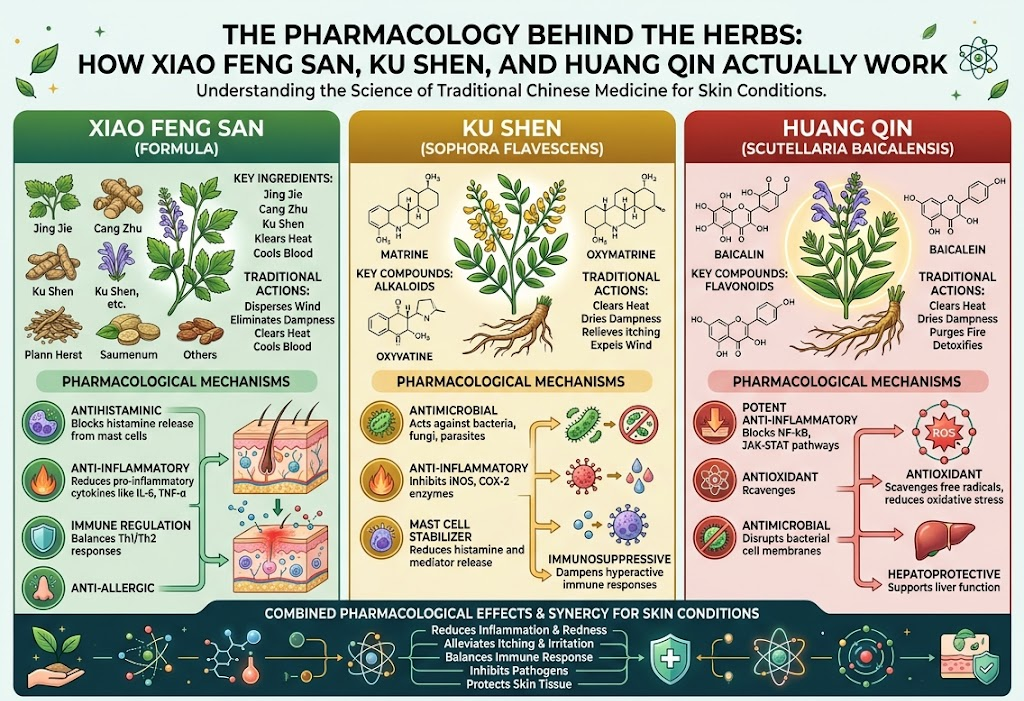
A perennial obstacle in the pejorative assessment of Chinese herbal medicine is the charge “it predates the science.” In truth, recent publications peer-reviewed in pharmacology journals describe active constituent compounds with identifiable mechanisms for most classical herbs applied to eczema. The evidence in the modern chemistry is old; the formulas are old; the chemistry is modern. Here are the five herbs included in most pattern-specific formulae, ranked by volume of mechanistic support.
Xiao Feng San (Clear Wind Powder) — the base formula
Xiao Feng San is a 13-Herb classical formula documented in the Ming period in the classic treatise Wai Ke Zheng Zong, and summarized in modern works such as Scheid, Bensky & Ellis’ Chinese Herbal Medicine Formulas & Strategies (2nd Ed, 2009). Cheng et al. (2011) completed a double-blind, placebo-controlled trial of Xiao Feng San in refractory atopic dermatitis published in the International Archives of Allergy and Immunology, and demonstrated statistically significant reductions in SCORAD and pruritus scores compared to placebo. This is my.default formula when wind-heat or damp-heat indications are clear.
Ku Shen (Sophora flavescens) — matrine and oxymatrine
Ku Shen’s active alkaloids (matrine, oxymatrine) have published antiinflammatory and antipruritic activity, plus direct antimicrobial properties for S. aureus. This is relevant, because Kobayashi et al. (2015) in Immunity identified S. aureus colonisation as a direct exacerbator of atopic dermatitis inflammation – so Ku Shen combats the immune system “misfire” and microbial trigger via the same combination of herbs. Topical Ku Shen decoctions are regularly prescribed for Chinese herbal bath therapy (Guo et al. 2022 PMC9704985 demonstrated meta-analytic benefit from 39 RCTs).
Huang Qin (Scutellaria baicalensis) — baicalin
Baicalin, the flavonoid glycoside of Huang Qin, controls the Th1/Th2 immune balance at the core of atopic disease. A 2016 review in Evidence-Based Complementary & Alternative Medicine documents used antimicrobial, antiviral and anti-inflammatory indications in eczema; always combine with Xiao Feng San when symptoms show heat signs.
Zi Cao (Lithospermum erythrorhizon) — shikonin
Zi Cao’s topical active pigment, shikonin, is the keystone of Traditional Chinese Medicine dermatology. It cools heat in the blood level and aids the healing process when applied as an ointment or oil. A 2021 Lin et al. review clarifies effective antipruritic and tissue-repair actions. It is traditionally prescribed in conjunction with Qing Dai (garden Indigo) in ointments for peri-oral and facial eczema. It remains one of the most-prescribed classic TCM dermatology topical remedies.
Jing Jie + Fang Feng — the anti-wind pair
This classical herb pair tonifies the exterior and dispels wind to relieve extreme itch from the most acute flare. Fang Feng (Saposhnikovia divaricata) has recorded painkilling and immunoregulatory actions (PMC7176574). If your flare is “sudden, moving, intensely itchy and appeared after weather change or pollen exposure,” then this is likely your treatment.
What herb gets rid of eczema?
There is no herb that clears eczema on its own-that would be the Western “one drug-one disease” model that Chinese medicine was explicitly not built to imitate. Xiao Feng San is the most-prescribed basic formula, but its 13 ingredients work synergistically, and only a trained practitioner can customize it effectively according to your pattern. For damp-heat type, Huang Qin and Ku Shen are common; for blood-deficient type, Sheng Di Huang and Hei Zhi Ma. Most prescribers cross-reference herbs to patterns with the TCM herb finder, but it is a useful resource, not a prescription.
What 2020–2025 Clinical Evidence Actually Shows
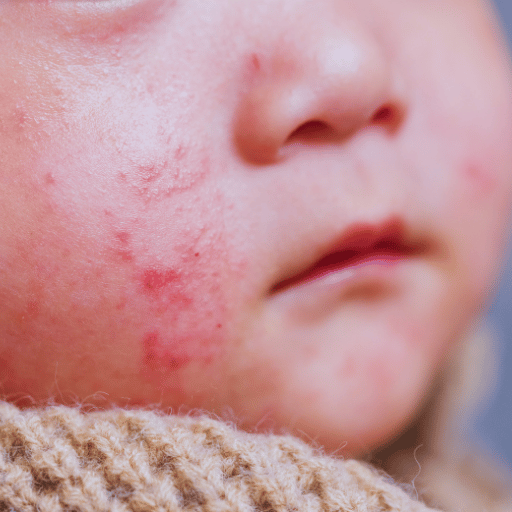
If you have read three articles on Chinese herbal medicine for eczema, and all three sounded consistently promising, you have read marketing rather than evidence. Good eczema decisions require identifying where evidence is solid and where it remains lacking. The honest 2020-2025 picture is variable: evidence shows improvement of skin lesions, inconsistent quality-of-life improvement, and ongoing methodological limitations that Cochrane review authors have highlighted since their original paper in 2013.
| Study | Design | N | Primary finding |
|---|---|---|---|
| Cai et al. 2022 (Frontiers Pharm) | Meta-analysis of 8 RCTs | 662 | CHM superior for ≥90% EASI improvement (RR 3.72; 95% CI 1.76–7.83). No significant QoL difference (MD −0.47). |
| Cochrane Review (Gu 2013) | Systematic review of 28 RCTs | 2,306 | “Could not find conclusive evidence” — cited high bias and inconsistency |
| Guo et al. 2022 (PMC9704985) | Meta-analysis, Chinese herbal bath therapy | 39 RCTs | Effective for paediatric AD; reduced inflammation and improved microcirculation |
| Wu et al. 2024 (PMC10993657) | Asian herbal medicine SR | Multiple RCTs | Effective alternative with fewer adverse events than conventional drugs |
| Acupuncture SR 2024 (PMID 39638592) | Systematic review, acupuncture | Multiple RCTs | Acupuncture “holds promise” — itch reduction documented; effect size variable |
| Ma et al. 2020 (Ann Palliat Med) | RCT, Qinzhuliangxue decoction | 176 | Symptom relief and lower relapse vs control |
The takeaway most patient-facing articles skip on eczema treatment: Cai 2022’s meta-analysis found CHM 3.72× more likely than placebo to achieve ≥90% EASI reduction (RR 3.72; 95% CI 1.76–7.83), yet the same analysis found no statistically significant difference in patient-reported quality of life (MD −0.47; 95% CI −1.30 to 0.37). That mismatch — visible lesions improve measurably, lived experience improves less clearly — is the most honest summary of where the evidence sits. Herbal medicine is not a placebo for eczema; whether it reliably makes you feel better about living with eczema is a fair open question.
Two persistent limitations run through this literature. First, most high-quality trials originate from Chinese research groups — which does not invalidate them but does raise publication-bias questions. Second, the heterogeneity of herbal formulas makes cross-trial comparison difficult. The Cochrane team’s 2013 caution — “high risk of bias in blinding… very low quality evidence for key comparisons” — has not been fully resolved by the 2022–2024 trial wave.
Acupuncture and Complementary Therapies — Points, Mechanisms, Evidence
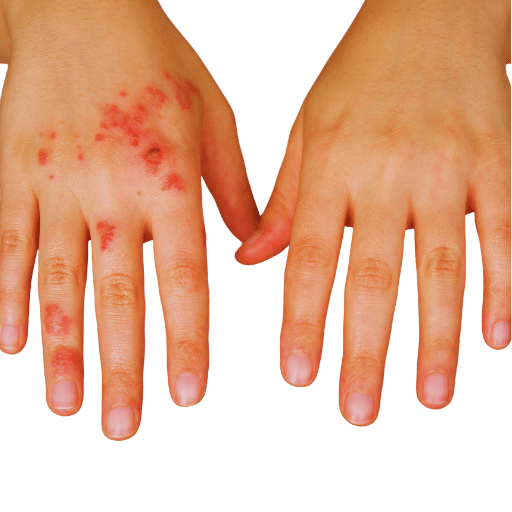
Acupuncture is the other mainstay of TCM dermatology; topical agents alone never do reach zero for itching. The 2024 systematic review of acupuncture for atopic dermatitis concludes the intervention “hold[s] promise” for reducing itching and improving lesion area. A 2012 crossover trial in Allergy (Pfab et al.) found one dose of acupuncture was as good as one dose of oral antihistamine at treating itching from AD in adults.
Think through the specifics of needling: for (as most eczema patients have) damp-heat, the important points are SP10 (Sea of Blood), LI11 (Pool at the Bend), and ST36; SP10 is an isoteric point for cooling blood heat; LI11 clears heat from the face and upper body at the same time you clear heat from the skin and mucauas, using the superficial prick-stick technique; ST36 tonifies spleen qi, preventing the generation of dampness at its source while preventing blood stagnation by tonifying blood at the same time. For blood-deficient syndromes, SP6 and LR3 are added to nourish blood and soothe liver qi respectively; one of the key brain circuits (the insula and anterior cingulate) involved in itch perception has been identified by Napadow et al., in their 2014 Cerebral Cortex imaging of the brain circuits induced by acupuncture at LI11; the basophil-activation work of Pfab adds a peripheral mechanism: acupuncture diminishes allergen-induced basophil activity in AD subjects.
Complementary modalities
- Herbal bath therapy—decoctions of Ku Shen and Di Fu Zi for tepid baths—sometimes of particular help in paediatric cases where no-one can get the patient to take an oral decoction. See our herbal bath therapy overview page for evidence base of Guo 2022 meta-analysis of 39 RCTs (PMC9704985).
- Paediatric tuina—finger-walking massage of the spleen and lung meridians—preferred to acupuncture or needle-based tuina for infants and children under 7. See our tuina massage overview for technique details.
- Cupping—a caveat not a suggestion—despite my use of it below: Hon et al. in 2013, Case Reports in Pediatrics told the story of an eczema flare after cupping; the contact cup shape and sometimes aggressive suction can produce the ever-so-sensitive skin further treatment. Most seasoned practitioners research extensively before avoiding acting directly on erosive chronic eczema districts.
TCM vs Steroids, Biologics, Wet Wraps, Probiotics & Diet — The 7-Dimension Decision Matrix
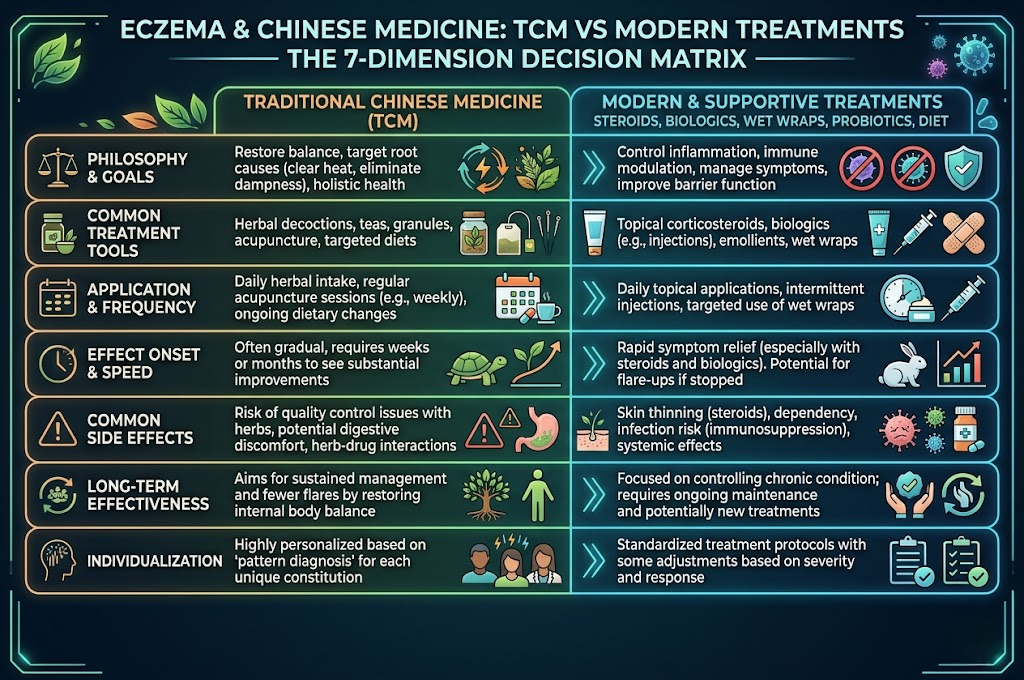
Most articles establishing TCM as superior to “conventional medicine” compare it to exactly one other thing: topical steroids. That sort of binary thinking belongs to the 1980s; a modern-day patient in the worst imaginable circumstance actually must choose from at least six reasonably common choices, in various combinations. Here is how they align through the lens of the decision dimensions:
| Dimension | Topical steroids | Dupilumab (biologic) | TCM (herbs + acupuncture) | Wet wraps | Probiotics | Elimination diet |
|---|---|---|---|---|---|---|
| Speed to visible relief | 3–7 days | 2–4 weeks | 2–6 weeks | 24–72 hours (short-term) | 8+ weeks | 2–12 weeks |
| Addresses root cause | No — suppresses surface | Partial — blocks IL-4/IL-13 pathway | Yes — systemic rebalance | No — barrier support | Partial — gut-skin axis | Partial — trigger removal |
| 12-month relapse risk | High (60–70%) | Low on-treatment; unknown off | Lower if course completed | High (symptomatic only) | Variable | High if reintroduced |
| Known side-effect risks | Skin atrophy, TSW, adrenal suppression | Conjunctivitis (~10–30%), injection site reactions | Mild GI; contamination risk if poorly sourced | Infection risk on broken skin | Minimal | Nutritional gaps if prolonged |
| Approximate annual cost | Low ($100–$500) | Very high (~$35,000/yr in US) | Moderate ($1,500–$5,000 course) | Low | Low ($150–$600) | Variable (dietitian + groceries) |
| Evidence base strength | Strong (decades of RCTs) | Strong (phase III + real-world) | Moderate — mixed (see H2 above) | Moderate | Moderate — inconsistent | Weak in general AD; stronger in confirmed food allergy |
| Patient time commitment | Low (2 min/day) | Low (injection every 2 weeks) | High (daily decoction + weekly visits) | High during flare | Low (daily capsule) | Very high (daily planning) |
What does this cost? The NCBI CADTH price listing for dupilumab shows $978.70 for a 200/300mg prefilled syringe; ICER’s lifetime economic model estimates cumulative cost per patient (drug plus other healthcare) at $509,600. TCM’s high time commitment is its real hidden cost — a daily decoction is harder to sustain than a Dupixent injection every two weeks. The steroid-vs-TCM cost comparison calculator can help model your specific case.
A decision heuristic. If you need relief in under a week for a specific event, topical steroids or biologics are hard to beat. If you have had ≥3 steroid cycles with diminishing remission length, TCM’s systemic approach warrants a serious trial. If cost is the binding constraint and your case is mild-to-moderate, diet plus probiotics plus emollient is the rational starting point before adding higher-cost modalities. You can log flare triggers between visits with our eczema trigger tracker.
How to Choose a Qualified TCM Practitioner — 8 Questions to Ask Before You Book
What TCM regulation is there? In the US, the minimum standard for entry is licensure (L.Ac.) and certification (NCCAOM). In the United Arab Emirates, Ministry of Health and Dubai Health Authority licensure is required to practice; ask to see the specifics of any licence issued. No single registration exists in the United Kingdom; easiest to go with a practitioner accredited with the British Acupuncture Council. These are also useful questions to ask at any clinic, including ours.
- What licensure or certification do you hold and for how long? Minimum: L.Ac. + NCCAOM (US), DHA/MOHAP licence (UAE), or equivalent national registration.
- How many cases of eczema have you personally managed? Just as the generalist acupuncturist who manages only 20 eczema cases/year is different from someone with 200 per year, the TCM dermatologist’s experience managing eczema is an important variable.
- Do you performed full pattern analysis or roll out a preset formula by symptom? A 30-minute tongue and pulse should be routine. Any herbal practitioner selecting formulas based on a 5-minute symptom search should never be your exclusive choice.
- Where are your herbs sourced, and what quality testing is performed? A 2021 review in the Journal of Environmental and Public Health found heavy-metal contamination at or above safety thresholds in 30.51% of sampled herbal products. Ask for certificates of analysis; good clinics have them on file. Our Chinese herb quality checker walks through what to look for.
- What is your approach to drug-herb interactions? Especially relevant if your physician patient is on any immunosuppressive, anticoagulant, or other chronic medication.
- How do you work with a dermatologist? Anyone who refuses to work with conventional medicine practices is sharing a philosophy rather than having your best interests in mind.
- What is the likely outlook and what occurs if I do not improve by week 4? Be prepared for a reassessment plan rather than a reassurance plan.
- How much should I expect to pay including procedure and follow-ups? Cost transparency speaks to integrity.
Red flags. Guaranteed cures, refusal to document your case in writing, pressure to buy proprietary “house formulas” without itemised ingredients, hostility to any conventional medicine the patient is using, and unwillingness to pause treatment if a Western provider requests coordination. If you are in the UAE, you can start with our eczema pattern quiz before booking a consultation.
Frequently Asked Questions
What Chinese tea is good for eczema?
Read answer
For damp-heat patterns, mid-range daily teas include chrysanthemum(Hu Chao) to clear heat, and job’s tears (Yi Yi Ren) to drain dampness. For blood-deficiency patterns, goji (Gou Qi) and red date (Hong Zao) teas are commonly used. These are explanatory, not curative — they support your prescribed formula, not replace it. Avoid online sales of single-herb cooling or warming teas if you don’t have a pattern diagnosis; the wrong therapy can exacerbate your pattern.
Can I take Chinese herbs while using topical steroids?
Read answer
Yes, and this is a common first step. Most practitioners don’t ask you to stop topical steroids on day one — sudden withdrawal can trigger a TSW kind of rebound. The usual method is to continue your current topical regimen for the first 2-4 weeks while the tea works internally, then taper off the steroid (often over 8-10 weeks) as positive signs in external patterns emerge. Drug-herb interactions (alone) is another issue, tell your practitioner any prescriptions you take.
What vitamin is lacking when you have eczema?
Read answer
Studies associate vitamin D deficiency with the severity of atopic dermatitis, with evidence that supplementation may help (Hattangdi-Haridas et al. 2019). Topical B12 is less-supported but still positive. Other nutrients with weak evidence include zinc and omega-3 fats. Blood-test indicates deficiency, but herbal-nutraceutical supplementation alone usually doesn’t clear even moderate or severe eczema.
Is Xiao Feng San safe for long-term use?
Read answer
Xiao Feng San is a wind-heat, wind-damp, or damp-heat flare treatment formula. Large courses usually last 4-12 weeks, according to pattern severity. Some of the formula’s ingredients — Ku Shen and Cang Zhu among them — can be drying and potentially weaken spleen yin if used to treat eczema over a long period, which is useful knowledge if you’re managing a chronic skin condition. Once active lesions resolve, practitioners usually transition patients to gentler maintenance formulas (such as modified Si Wu Tang) for ongoing support. A 2013 Cochrane review indicated temporary elevation in liver-function tests in 3 of 28 various trials, which resolved after formula cessation; occasional liver-function tests are a sensible precaution.
How does TCM for childhood eczema differ from adult eczema?
Read answer
Paediatric protocols rely much more on spleen-c Strengthening herbs (Bai Zhu, Fu Ling) because paediatrics have a constitutions more Spleen and Kidney developing. Needle acupuncture is generally replaced by paediatric tui na (finger-walking on specific meridians) for children under 7. Herbal baths are used more often rather than decoctions for babies and formula based by weight rather than halving the remedy. The Guo et al 2022 meta-analysis of 39 RCT’s documented efficacy of herbal bath therapy in paediatric atopic dematitis specifically. Expectations should reflect there should be a longer course of improvement once under 5 because constitution building takes some time.
Chinese herbal medicine vs acupuncture for eczema — should I do both?
Read answer
Herbal medicine has the biggest therapeutic weight for eczema because it is an internal pattern changing changing 24/7 and not following up with frequent clinical visits. Acupuncture is supportive and helps accelerate relief of the pruritus, down regulate activity of inflammatory mediators (documented through basophil-activation studies), and helps sleep for eczema sufferers who are disturbingly awake by their own disease process. Unless funds or time are limiting most classical TCM dermatologists would suggest prioritising herbs. The combination shows a synergistic effect in several trials including the recent Xiao Feng San + auricular acupuncture review.
Why does my eczema flare in the UAE summer, and does TCM address climate triggers?
Read answer
UAE heatwave – the excessive temperature outdoors, suddenly entering a sometimes over cooled environment and the use of spice and diary in the diet – effectively worsens the damp-heat pattern seen in this geographic patch. Official reports in 2024 showed up to 40% prevalence in the UAE. TCM counters with three approaches: seasonal modification of formulas in summer (adding the heat clearing Sheng Di Huang and Zi Cao), dietary reduction of selected food groups (dairy, deep fried produce, sugar), and acupuncture looking at SP 10 and LI 11 to aid the blood heat effect. Bringing in an Tong Ren Tang practitioner in the UAE will have an extra insight due to the climate modification that many visits an overseas TCM phemon will miss. Keep a record of each trigger in our eczema flare tracker.
Considering TCM for eczema in the UAE?
Tong Ren Tang’s Dubai location combines the classical pattern approach with 350 year old knowledge of royal TCM. Begin with our 5-minute pattern questionnaire or down load a full consult here.
A note on this article.
Here those TCM works well is combined evidence-based medicine (take the best evidence from PMC/NIH, CCOOH, Frontiers, Cochrane), teaching texts, and Tong Ren Tang daily medical practice in establishing TCM dermatological diagnoses. We have deliberately avoided suggesting a reciprocal to included high quality evidence of if the findings are inconclusive which is the case for many TCM eczema outcomes and not sweeping it up as aggregate. Nothing here replaces the consult of a licensed TCM health care provider so if you are reducing steroids discuss with your dermatologist.
References & Sources
- Cai X et al (2022).Efficacy and safety of Chinese herbal medicine for atopic dermatitis: evidence from eight high-quality randomized placebo-controlled trials. Frontiers in Pharmacology.
- Gu SX et al. Chinese herbal medicine for atopic eczema. Cochrane Database of Systematic Reviews – PMC.
- Guo Z et al.. Chinese herbal bath therapy for the treatment of atopic dermatitis.. PMC.
- Asian herbal medicine for atopic dermatitis: a systematic review (2024). PMC.
- Acupuncture for atopic dermatitis: systematic review and meta-analysis (2024). PubMed.
- Cheng HM, et al. (2011). Efficacy and safety of Xiao-Feng-San for refractory atopic dermatitis. International Archives of Allergy and Immunology.
- Pfab F, et al. (2012). Acupuncture compared with oral antihistamine for type-I hypersensitivity itch in AD. Allergy.
- Napadow V, et al. (2014). Brain circuitry mediating antipruritic effects of acupuncture. Cerebral Cortex.
- Kobayashi T, et al. (2015). Dysbiosis and Staphylococcus aureus colonization drives inflammation in atopic dermatitis. Immunity.
- Hon KL, et al. (2013). Cupping therapy may be harmful for eczema. Case Reports in Pediatrics.
- Heavy metal contaminations in herbal medicines (2021). PMC.
- Consensus recommendations for the management of atopic dermatitis in the Gulf region (2024). Springer.
- Dupilumab cost and cost-effectiveness analysis. NCBI/CADTH.
- Economic evaluation of dupilumab for atopic dermatitis. ICER.
- Traditional Chinese medicine and eczema: interview with Xiu-Min Li, MD. National Eczema Association.
- Topical corticosteroid withdrawal in patients with atopic dermatitis (2024). Dermatology Advisor.
Related Articles
- A Patient’s Guide to Chinese Herbal Medicine – Formulas, Safety, and How to Start
- Moxibustion Treatment – Uses, Points, and Clinical Evidence
- Tuina Chinese Medical Massage – Techniques and Conditions Treated
- Hijama Cupping Therapy Guide – Evidence, Technique, and When Not to Cup
- TCM Terms Glossary – Qi, Yin-Yang, Patterns, and Pulse Reading Explained