Get in Touch with Tongren Tang Gulf


Updated September 2026 · By DD (editorial account)
TCM sleep support refers to a conversation about acupuncture, a carefully reviewed herbal product, and daily habits. The useful starting point is your sleep problem, medicines and safety risks, not a promise that one traditional pattern explains every waking night. Persistent sleep trouble may need a medical assessment, and structured cognitive behavioral therapy for insomnia is a recommended treatment for chronic insomnia. Complementary care can be discussed alongside that assessment.
The following will help you decide what to investigate about sleep evidence, safety and your bedtime routine. This will also help you decide what to discuss about your sleep with a care professional. The advice is educational. This means it won’t be able to tell you the reasons for your sleep issues.
Key takeaway
TCM sleep support works best as a documented, safety-conscious discussion: seek assessment when sleep affects daily life, check any proposed herbal product against your medicines, and treat acupuncture evidence as a possibility rather than a personal result.
What Kind of Sleep Problem Are You Having, and When to Seek Assessment?
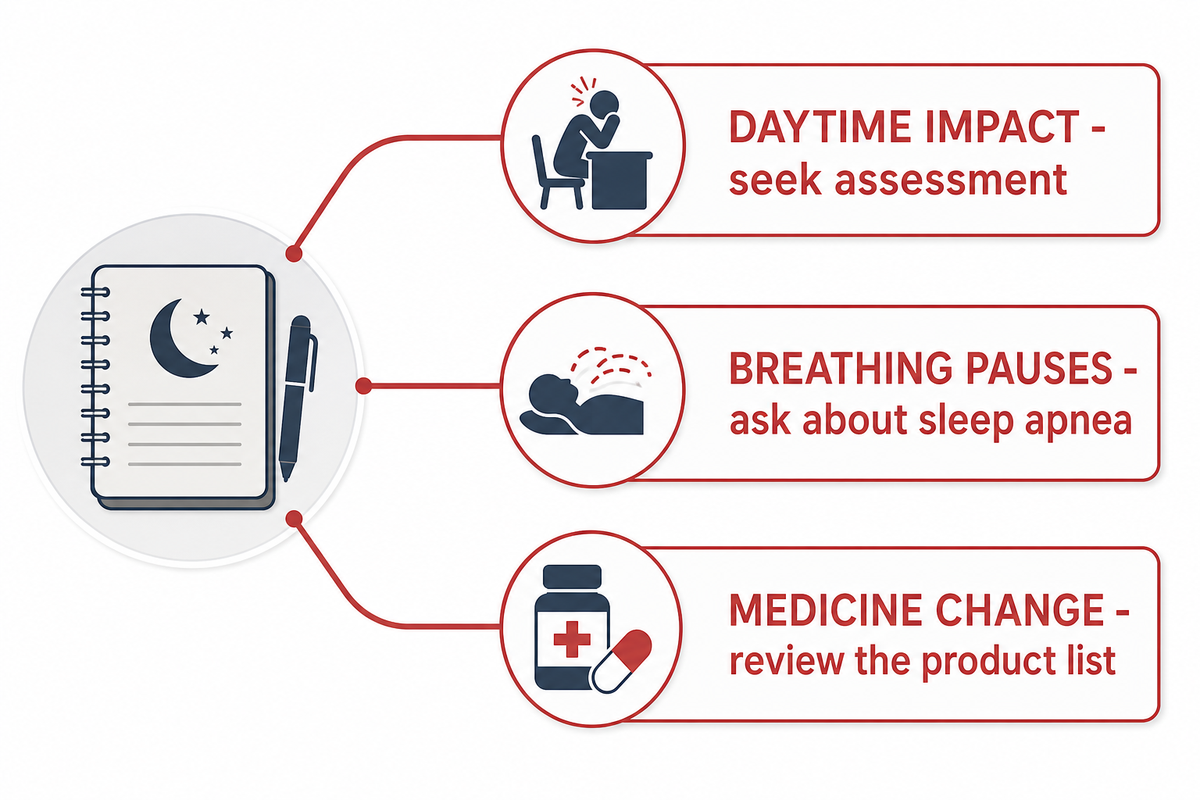
Difficulty falling asleep, repeated waking, waking too early and feeling unrested can lead to different questions. Record your bedtime, estimated time awake, wake time, naps, caffeine or alcohol, current medicines and the next day’s functioning for a few days. A short diary makes a consultation more specific; it isn’t a self-diagnosis. The National Heart, Lung, and Blood Institute advises talking with a doctor when poor sleep affects daily activities.
Chronic insomnia means having insomnia at least three evenings a week for three months in a row. The three month period describes a category and isn’t a waiting period to see if you need to visit a clinician. There are other situations that would warrant an earlier visit to a clinician. These include symptoms of pain or mood disorders, changes in medications, and sleepiness during the day. Once again, other causes of your symptoms are possible, and a clinician can explain suitable treatments. A professional can consider other causes and discuss treatment options, including cognitive behavioral therapy for insomnia when appropriate.
| What you notice | Useful next conversation |
|---|---|
| Trouble sleeping with daytime impact | Ask a clinician about possible causes and evidence-based insomnia care. |
| Loud snoring, gasping or witnessed pauses | Ask for evaluation of possible sleep apnea rather than treating a traditional label as an explanation. |
| New symptoms after a medicine or supplement change | Review the timing and complete product list with the prescriber or pharmacist. |
The National Heart, Lung, and Blood Institute’s sleep apnea guide notes that snoring, breathing pauses and gasping are symptoms to bring up to a doctor. Neither an “organ hour” interpretation nor a sleep diary can rule out a breathing disorder.
How does TCM treat insomnia?
During a traditional Chinese medicine consultation, a practitioner may ask about sleep, stress and other symptoms before discussing acupuncture or herbal medicine. The traditional framework of assessment includes concepts of Qi and imbalance, but it doesn’t establish a diagnosis, rule out a medical condition or explain the reason for symptoms. It’s important to share your medical history and the prescription and over-the-counter medications you’re taking. This history can assist the practitioner in coordinating complementary care with your existing treatment plan.
What Does Traditional Chinese Medicine Mean by Sleep Support?
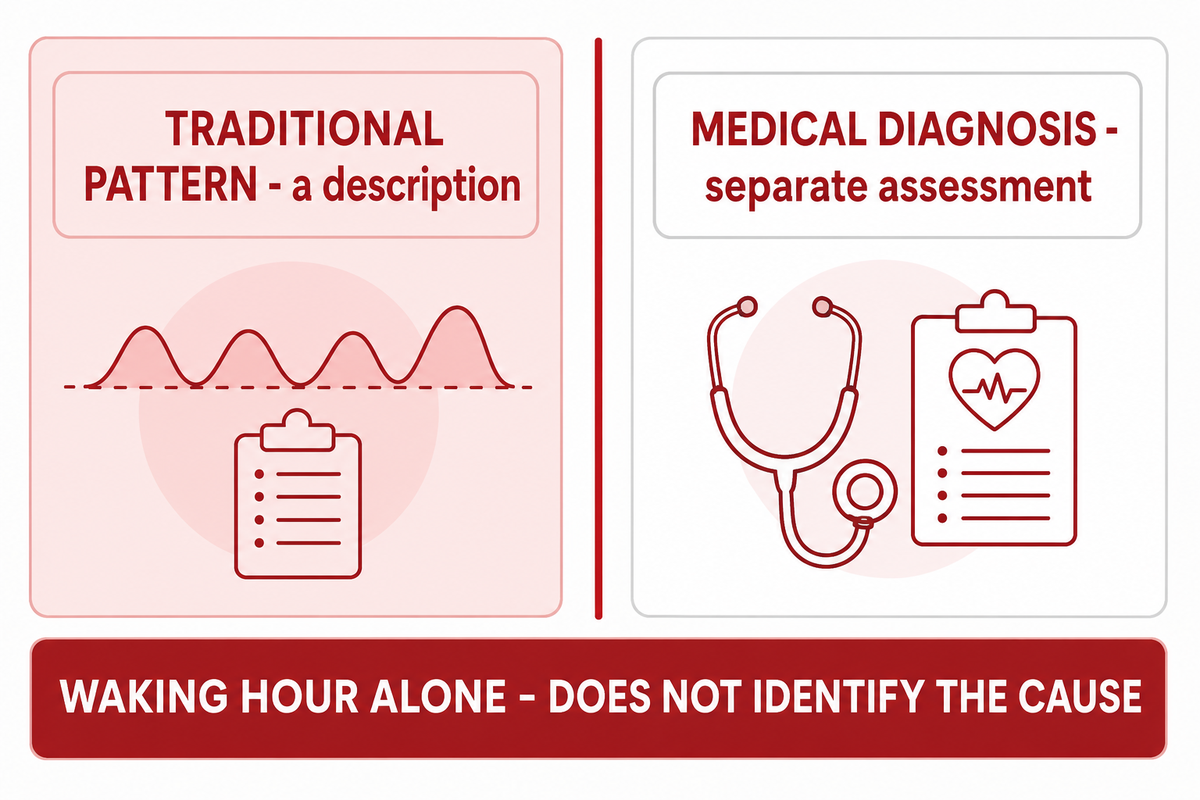
The term “support” is more appropriate than “cure” for articles describing practices with limited evidence. TCM may describe a symptom using a traditional pattern rather than the diagnostic label assigned in sleep medicine. The description, however, won’t provide the reason for the symptom, e.g. why an individual may frequently wake at 3 a.m. A claim that a particular organ may regulate or be associated with a given hour of the sleep cycle does not establish a medical sleep disorder.
Some people want to explore acupuncture, some ask about Chinese herbs, and others mainly need a steadier evening. These choices have different safety questions. Needle technique depends on a trained practitioner; an herbal preparation depends on its exact ingredients and your other medicines; a home routine depends on whether it’s flexible enough to follow. The National Center for Complementary and Integrative Health describes complementary sleep approaches while noting limits in the evidence. Keep the clinical diagnosis and the traditional description separate when discussing both with your care team.
Acupuncture for Sleep: What the Evidence Can Support
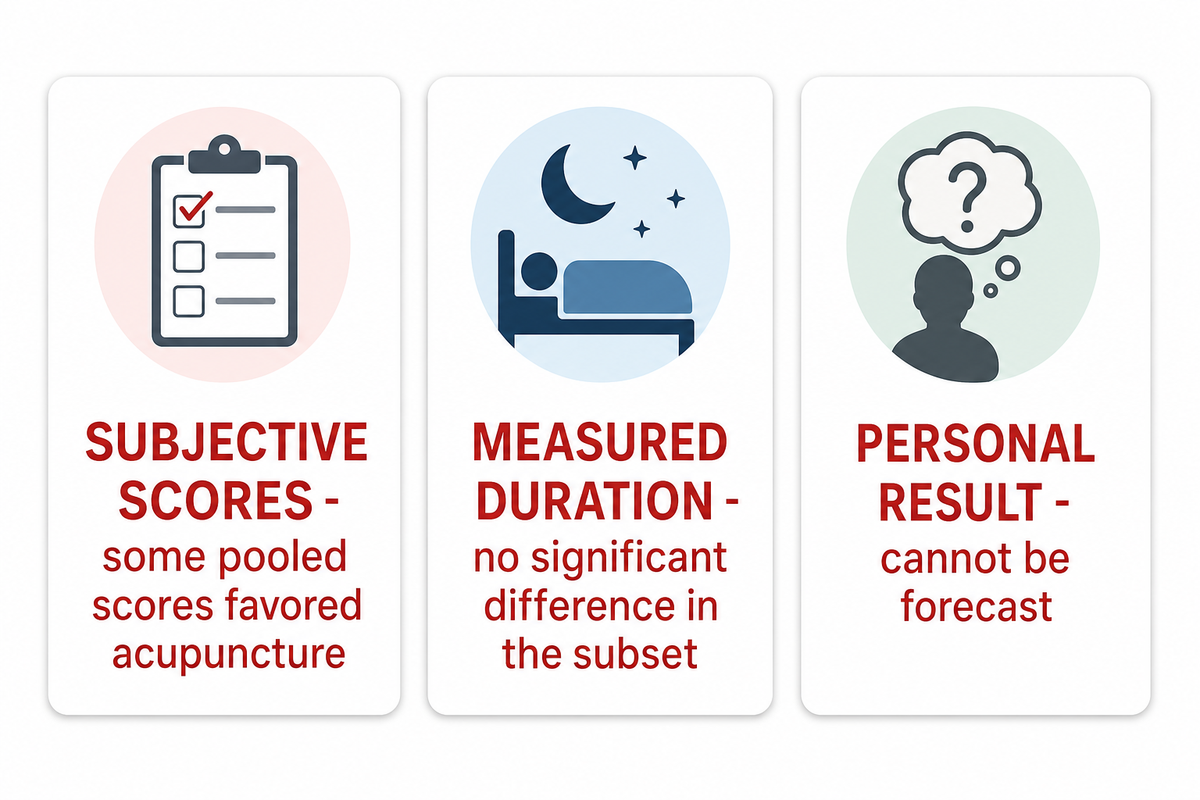
Acupuncture for insomnia has been studied, but review findings don’t predict an individual’s result. A 2021 review summarized by the National Center for Complementary and Integrative Health included 11 studies and 775 participants; the studies were generally small and of low quality. A later umbrella review published in 2025 examined 36 reviews of several traditional Chinese medicine therapies, including acupuncture, massage, exercise and herbal medicine. Twenty of those reviews were assessed as high or moderate methodological quality, but that count doesn’t describe acupuncture evidence alone.
A 2025 synthesis of 10 sham-controlled trials involving 757 people found better scores on subjective sleep questionnaires for acupuncture groups than sham groups. In the objective total-sleep-time analysis, which included three studies and 205 participants, there was no statistically significant difference between acupuncture and sham acupuncture; the review said the sample remained too small for a definitive conclusion. The distinction matters: feeling that sleep has improved and measuring a longer sleep period are different outcomes. Neither finding establishes how much benefit a particular person in Dubai will experience, when any change might appear, or how long it might last.
| Evidence question | What the cited research says | Practical limit |
|---|---|---|
| Reported sleep quality | Some pooled subjective questionnaire scores favored acupuncture over sham. | A group average is not a personal forecast. |
| Measured sleep duration | In three studies with 205 participants, the 2025 synthesis found no statistically significant total-sleep-time difference; the sample was insufficient for a definitive conclusion. | Do not translate a subjective score into extra hours of sleep. |
| Quality and safety | Study quality varies; improper or nonsterile needle use can cause harm. | Ask about training, infection control and coordination with existing care. |
Before booking, ask who would perform the procedure, what training and sterile-needle practices they use, and how progress would be assessed. The National Center for Complementary and Integrative Health’s provider digest notes that improper delivery can cause serious complications. Don’t try self-needling from an online sleep diagram.
How to improve sleep TCM?
Symptoms, medicine, a possible evening schedule, and any effects during the day are the things that you can usually recognize. When you consult with a practitioner, ask what possibilities they see and how these fit your current plan of care. Many options are available to a practitioner, but a product name alone doesn’t establish herbal safety. It’s possible that a clinician determines structured insomnia treatment or testing for another sleep disorder is warranted. A particular waking hour, by itself, does not establish a medical diagnosis or determine a treatment course.
Chinese Herbs for Sleep: A Formula-Specific Safety Checklist
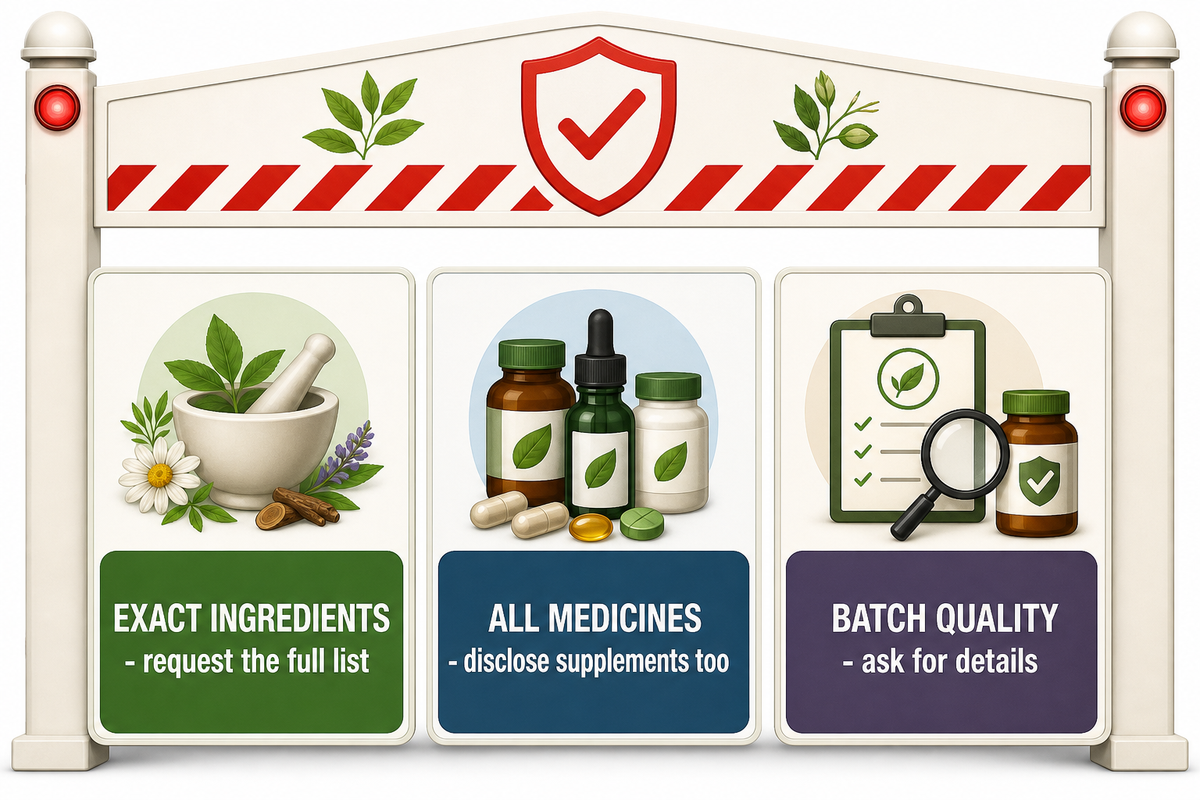
The term “Chinese herbs” doesn’t refer to a single product. Different products may contain the same or similar ingredients. Tea, powders and capsules may also differ in concentration. A product isn’t necessarily safe to use based on its name alone; its exact ingredients, intended amount, manufacturer and batch information still need review. The National Center for Complementary and Integrative Health provides the herb-drug interaction digest to explain why the safety of herbs must be assessed alongside medicines, not from a product name alone.
Bring a list of prescription medicines, over-the-counter products and supplements, including what you take only occasionally. Mention allergies, pregnancy or breastfeeding, and medical conditions. Ask the prescriber or pharmacist to review the precise formula before starting it, particularly if you use medicines whose effect could be changed by another product. Don’t stop prescribed care to test an herb. The phrase “natural” doesn’t establish that a preparation is safe, uncontaminated, effective or appropriate for every person; see the NCCIH safety guidance.
Do
- Request the full ingredients and product identity.
- Share every medicine and supplement you use.
- Ask about batch and quality information.
Don’t
- Assume a traditional name proves a formula is safe.
- Copy a dose from another person’s recommendation.
- Replace an existing treatment without medical advice.
The herbal medicine consultation overview describes the site’s service area. Read the site’s Chinese herbs safety guide for broader product questions. Those pages are navigation, not evidence that a particular sleep formula has been assessed for you. A qualified professional needs the actual ingredient list and your health history to discuss suitability.
A Simple Evening Routine That Fits Evidence-Based Insomnia Care
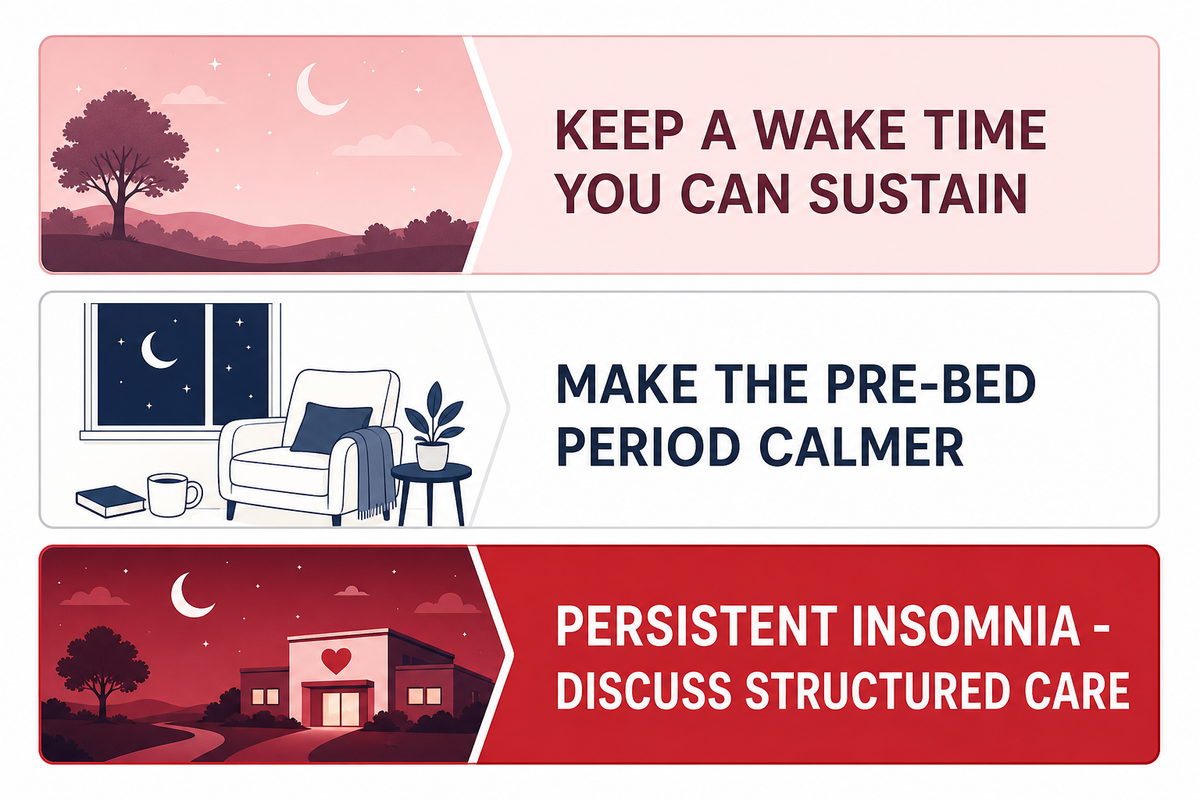
Achieving predictability without introducing an intolerable new standard for performance should be the goal when designing a new routine. Choosing a wake time you can usually keep is a practical first step when planning your bed time. Make the time immediately preceding bed time quieter, with dimmer light and less demanding auditory or visual input. The NHLBI healthy sleep guidance recommends a consistent schedule and a quiet hour before bed. The timing of caffeine, alcohol and meals, or the flow of a changing work day, may affect your sleep. Identify strategies to improve your sleep and discuss with a qualified professional if the problem persists.
The use of calm, relaxing activities, including reading, is one example for an evening routine; it isn’t a promise that your sleep will improve. The absence of an activity or product from this routine doesn’t mean treatment has failed; the routine doesn’t require an herbal product. Documenting your functioning may support an assessment of the effects of poor sleep.
Sleep hygiene alone isn’t a substitute for structured care when insomnia persists. The American Academy of Sleep Medicine advises against using sleep hygiene as the sole treatment for chronic insomnia. The 2025 VA/DoD guideline recommends cognitive behavioral therapy for insomnia. If sleep difficulty is disrupting work, mood or safety, ask a clinician about this approach and whether another condition needs evaluation. An evening routine and a consultation about complementary care can be discussed without postponing effective treatment.
“CBT-I by itself is the most efficacious first-line treatment for insomnia.”
— Dr. Daniel J. Buysse, guideline lead author, American Academy of Sleep Medicine
The Sleep Support Decision Map
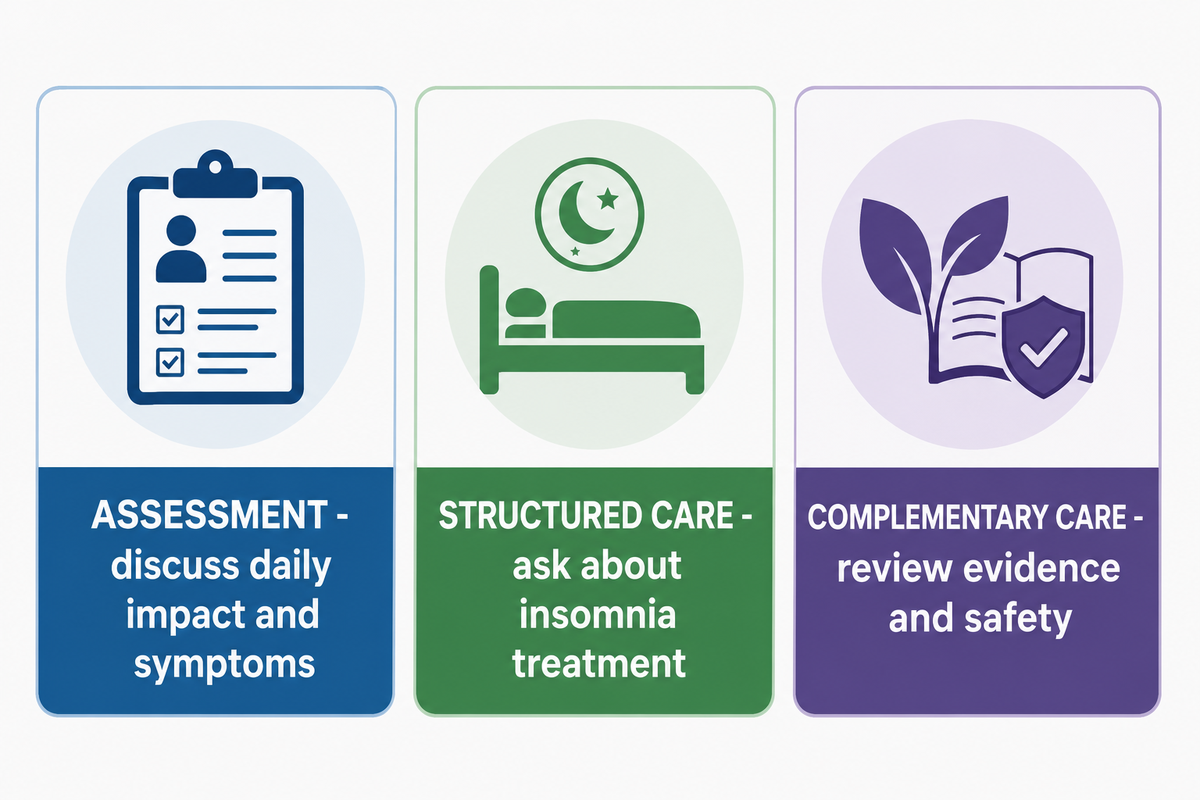
This diagram is based on publicly available information and offers a general synthesis of advice regarding sleep and complementary health care. The advice in this diagram isn’t clinically validated and shouldn’t be construed as diagnostic; it cannot tell you which diagnosis you have. The purpose of this diagram is to provide the public with general information to support discussion with a health care professional.
| Category | Situation | Next conversation | Why |
|---|---|---|---|
| Assessment | Poor sleep affects daily activities. | Contact a clinician and describe the daytime impact. | Daily impairment is a reason to seek assessment now. |
| Assessment | Snoring, gasping or witnessed breathing pauses occur. | Ask about evaluation for possible sleep apnea. | Breathing symptoms need a different assessment from insomnia habits. |
| Assessment | Sleep changed after a medicine or supplement change. | Review the timing and full product list with the prescriber or pharmacist. | A product effect or interaction may need consideration. |
| Structured care | Insomnia has persisted and disrupts daily life. | Discuss cognitive behavioral therapy for insomnia. | Guidelines support structured treatment for chronic insomnia. |
| Structured care | A calmer evening has not resolved ongoing insomnia. | Ask about treatment beyond sleep hygiene. | Sleep hygiene alone is not the recommended sole treatment. |
| Structured care | A sleep diary shows repeated waking or early waking. | Bring the diary to a clinician for a wider assessment. | Timing alone does not establish a traditional or medical cause. |
| Complementary care | You are considering acupuncture. | Ask about training, sterile needles and realistic outcomes. | Research and safety both have important limits. |
| Complementary care | A Chinese herbal product is proposed. | Request exact ingredients and a medicine-interaction review. | Safety depends on the product and your health context. |
| Complementary care | You already have a diagnosis or treatment plan. | Ask how any complementary plan would be coordinated. | Existing medical care should remain part of the decision. |
Sources for the map are the NHLBI insomnia guidance, NHLBI sleep apnea symptoms, the VA/DoD guideline, and the NCCIH complementary sleep overview. If poor sleep affects your daily life, you can seek assessment before three months. An existing Tong Ren Tang insomnia service page is available for people seeking details about that service; this article doesn’t verify its outcomes or current appointment availability.
How to Discuss Sleep Support at Tong Ren Tang Dubai

Bring the sleep observations you recorded, your medication and supplement list, and any diagnosis or treatment plan you already have. Ask whether the clinic currently offers a sleep consultation and who would see you. If acupuncture is suggested, ask about sterile practice, expected limits and how progress would be monitored. If herbs are suggested, ask for the exact proposed formula and product information before making a decision.
You can view the treatment areas offered on this site, Learn about Tong Ren Tang Dubai and reach out to the clinic. Verify practitioner and appointment availability directly. The information on this site regarding services shouldn’t be interpreted as offering a sleep benefit, and a clinic visit shouldn’t delay medical assessment when warning signs are present. A health evaluation for disruptive insomnia shouldn’t be substituted by a complementary office visit. A health evaluation should be considered if poor sleep raises concerns for potential medical issues.
Frequently Asked Questions
How does TCM treat insomnia?
TCM sleep support begins with a traditional symptom discussion and may include acupuncture or herbs, but it does not replace medical assessment of insomnia.
A practitioner may ask when you wake, what else you notice, and what medicines or supplements you use. Traditional pattern language is a way to organize that conversation, not a test for sleep apnea, a medication effect or another medical condition. Ask what is being proposed, what evidence supports that choice, and how the plan would fit with your existing care. If your sleep affects daily activities, speak with an appropriate clinician rather than waiting for a traditional consultation to identify the cause.
How to improve sleep TCM?
A consistent schedule, a quieter evening and a safety-aware consultation are reasonable starting points for discussing TCM sleep support.
Choose a wake time you can sustain, try a calm pre-bed period and record what happens to daytime functioning. If you consider acupuncture, ask about training and sterile technique. If you consider herbs, obtain the full ingredient list and review it with your clinician or pharmacist, especially when you take medicines. These steps do not guarantee better sleep. Chronic or disruptive insomnia deserves an evidence-based treatment discussion, including cognitive behavioral therapy for insomnia when appropriate.
What is the best Chinese medicine for sleep?
No single Chinese herbal product can be named the best sleep choice for everyone from the sources reviewed here; the exact formula and the person’s health context matter.
A product name does not reveal every ingredient, amount, interaction or quality issue. Describe your sleep problem and disclose medicines, supplements, allergies, pregnancy or breastfeeding and other conditions before considering a formula. Ask for the actual product details and a professional review rather than copying a recommendation from another person’s experience. A clinician can assess whether another sleep disorder or a structured insomnia treatment should be addressed first.
Can an evening routine replace treatment for chronic insomnia?
An evening routine can support regular sleep habits, but sleep hygiene alone is not the recommended sole treatment for chronic insomnia.
The American Academy of Sleep Medicine cautions against using sleep hygiene by itself for chronic insomnia. Discuss structured cognitive behavioral therapy for insomnia with a clinician when ongoing sleep trouble affects daily life. You do not need to wait three months to ask for an assessment.
What should I ask before using Chinese herbs for sleep?
Ask for the exact ingredients, product identity, quality information and a review of potential interactions with every medicine or supplement you use.
Request the full list of ingredients and their amounts, the manufacturer or supplier, and any available batch or quality information. Bring a complete medicine and supplement list to the discussion, including occasional products. Mention allergies, pregnancy or breastfeeding, and existing diagnoses. Ask who would review possible interactions and what symptoms would prompt you to stop and seek medical advice. Do not assume that an herbal label or a well-known traditional name makes the product safe for you. Also ask whether the reason for your sleep difficulty has been assessed: an herbal discussion should not delay evaluation of daytime impairment, breathing pauses or other warning signs.
Sources, Scope and Medical Review
DD is an editorial account, not a physician, and compiled the following educational overview from publicly available sources. No patient outcome data, product-specific formula, practitioner credentials or independent clinical review were supplied for this article. The decision map is for illustrative purposes only and shouldn’t be used for clinical decision-making.
Medical advice, diagnosis and a personal treatment plan require an appropriate clinician who knows your history.
References & Sources
- Insomnia diagnosis National Heart, Lung, and Blood Institute.
- Sleep apnea symptoms National Heart, Lung, and Blood Institute.
- Healthy sleep habits National Heart, Lung, and Blood Institute.
- Sleep disorders and complementary health approaches National Center for Complementary and Integrative Health.
- Psychological and physical approaches for sleep disorders National Center for Complementary and Integrative Health.
- Herb–drug interactions National Center for Complementary and Integrative Health.
- Safety of complementary health approaches National Center for Complementary and Integrative Health.
- Chronic insomnia and sleep apnea clinical practice guideline U.S. Department of Veterans Affairs and Department of Defense, 2025.
- Behavioral and psychological treatments for insomnia American Academy of Sleep Medicine.
- Sham-controlled acupuncture trial synthesis PubMed-indexed review, 2025.
- Umbrella review of traditional Chinese medicine therapies, including acupuncture, for insomnia PubMed Central, 2025.
![Postpartum TCM Care: Safety Questions for Dubai [Guide]](https://tongrentang.ae/wp-content/uploads/2026/09/postpartum-tcm-care-blog-featured-768x512.png)