Get in Touch with Tongren Tang Gulf


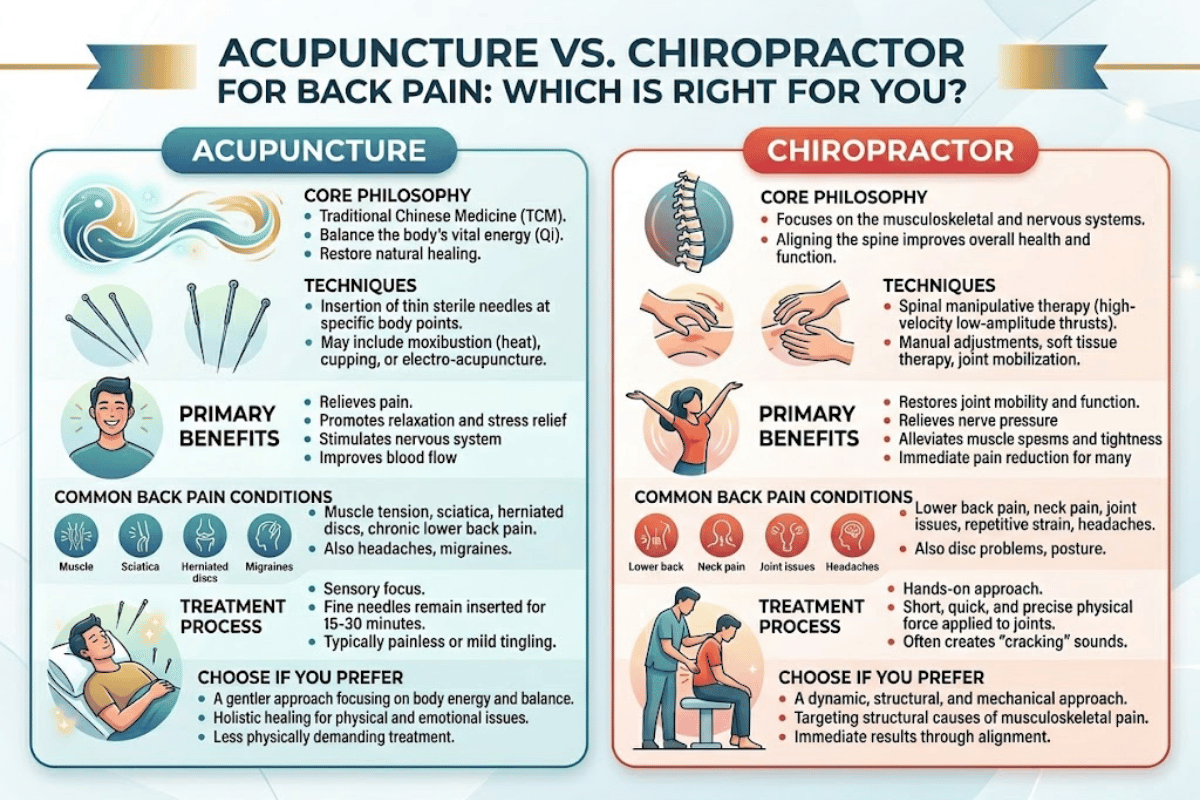
Acupuncture vs chiropractor for back pain is one of the most searched decisions for adults comparing alternative therapies to drugs or surgery. About 80 percent of adults have low back pain at some point, and both methods are now on the first-line list of treatment options in the 2017 American College of Physicians guideline. Which one fits you depends on how long your pain has lasted, where it spreads, what chronic conditions you carry, and — crucially — whether the latest 2025 body of evidence matches your scenario.
At a Glance: Acupuncture vs Chiropractic Care
| Primary mechanism | Needle stimulation of specific points on the body; neural, endorphin, and inflammatory modulation |
| Chiropractic mechanism | Manual spinal adjustment and spinal manipulation, joint manipulation, soft-tissue work |
| Best-fit conditions | Acupuncture: chronic back pain, neck pain, fibromyalgia overlap | Chiropractic: acute musculoskeletal flare, facet or SI joint pain |
| Session length | Acupuncture 20–40 min | Chiropractic 15–30 min |
| Typical course | 6–12 visits for a standard course (both) |
| ACP 2017 evidence grade (chronic) | Acupuncture: moderate-quality | Spinal manipulation: low-quality |
| Safety gatekeeper | Red-flag screening (cauda equina, fracture) matters more than modality choice |
For readers seeking a richer answer based on the actual trials rather than a textbook comparison, what follows synthesizes the NCCIH low back pain synthesis, the American College of Physicians 2017 guideline, the JAMA Network Open 2025 BackInAction trial, and patient-reported experience. If you would like a personalized review for your situation, a professional back pain assessment is the clearest way to match your symptoms to the best first-line approach.
How Acupuncture Works for Back Pain

Acupuncture, a core therapy within traditional Chinese medicine, addresses back pain by placing thin needles at specific points on the body. In the classical framework these points lie along channels through which Qi flows within the body; the practitioner reads the pulse and examines the tongue to find where that flow is obstructed before choosing needle placement. In the modern neuroscience view, stimulating specific points with those same needles triggers measurable mechanisms — they release endorphins, modulate pain signalling in the nervous system, and dampen local inflammation, which is how acupuncture may relieve pain.
Evidence for acupuncture in back pain is substantial. According to the NCCIH acupuncture fact sheet, a 2018 data review pooling 12 studies with 8,003 participants found that acupuncture can help manage back or neck pain more effectively than no treatment, with benefits holding when compared against sham. A separate 2017 systematic review of 49 studies (over 7,900 participants) concluded that acupuncture provides a modest benefit for acute back pain and a moderate benefit for chronic pain in the lower back. On that evidence, the American College of Physicians includes acupuncture among its first-line options for chronic low back pain.
An acupuncture session for back pain typically runs 20 to 40 minutes. Needles are generally 0.16 to 0.30 millimetres in diameter — finer than a hypodermic — and a regular course runs 6 to 12 visits. Your acupuncturist reassesses after three or four visits; if symptoms have not shifted by then, continuing for the full duration rarely helps.
📐 Clinical NoteBeijing Tong Ren Tang, founded in 1669 and for 188 years the sole Chinese medicine provider to eight Qing emperors, formalised a practice of combining pulse diagnosis, tongue assessment and meridian palpation before any needle is placed. That multi-input diagnostic step is what separates a structured acupuncture treatment plan from simply “needling where it hurts.”
How Chiropractic Care Works for Back Pain

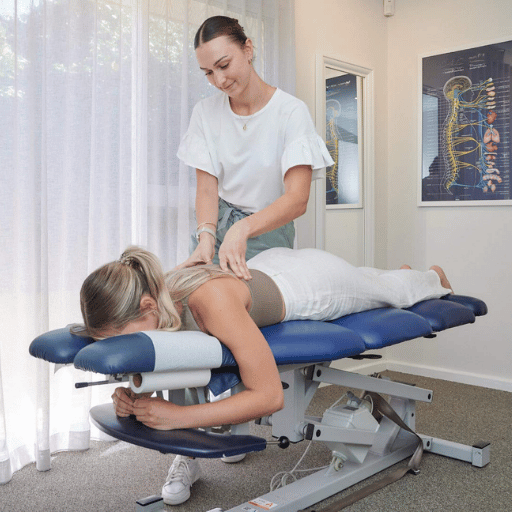
Chiropractic care centres on the spine and the musculoskeletal system. A chiropractor applies manual techniques — most commonly high-velocity, low-amplitude (HVLA) adjustments, spring-loaded activator tools, flexion-distraction tables, or diversified soft-tissue work — that restore joint motion, reduce mechanical load and modulate signalling in the nervous system. Its core premise: restricted joint movement along the spinal column amplifies pain and limits function, and a targeted spinal adjustment helps reset that pattern.
For acute back pain—when the episodes start in the last few days or weeks—the NCCIH spinal manipulation fact sheet reviews a 2017 synthesis of 15 trials (1,699 subjects) with moderate-quality evidence of modest pain benefit up to 6 weeks. A 2018 synthesis of 9 trials (1,176 subjects) reported that manipulation and mobilization have probable benefits for pain and function in chronic low back pain, with a small difference for manipulation. The Cochrane review of spinal manipulative therapy finds small pain improvement and moderate function benefit when compared to a sham control, though the evidence quality was low.
Standard chiropractic sessions last 15 to 30 minutes, and most care plans begin with two or three visits per week before tapering as pain settles. First appointments run longer because they include a spinal assessment, posture and range-of-motion testing, and — when indicated — imaging. Any competent chiropractor rules out red-flag signs before any manipulation is performed.
📐 Clinical NoteNot every adjustment is a thrust. For patients with osteoporosis, pregnancy, or recent fractures, practitioners usually switch to low-force techniques (activator tool, mobilization or flexion-distraction) instead of HVLA. Asking which technique is planned — and why — is reasonable at the first appointment.
What the 2025 Clinical Evidence Actually Shows

The contrast between acupuncture and chiropractic is more interesting than most online guides admit, because the two modalities are graded differently in the same guideline. ACP’s 2017 clinical practice guideline, published in Annals of Internal Medicine by Qaseem and colleagues, rates acupuncture evidence for chronic low back pain as moderate quality, while rating spinal manipulation as low quality for both acute and chronic low back pain. Both remain on the first-line list of nondrug therapies, but the evidence bar for acupuncture is slightly higher.
Is acupuncture better than chiropractic for back pain?
Specific to chronic low back pain, the honest answer is that 2025 evidence leans slightly toward acupuncture in terms of trial quality — not because chiropractic is ineffective, but because a well-designed new randomized trial raised the bar. In September 2025, DeBar and colleagues published the BackInAction trial in JAMA Network Open. Across four healthcare systems, 800 adults aged 65 and older with chronic low back pain were randomized into three arms: a standard 12-week acupuncture course plus usual care, an enhanced course with 4–6 maintenance sessions plus usual care, or usual care alone. At both 6-month and 12-month follow-up, the two acupuncture groups showed significantly greater reductions in pain and pain-related disability than the usual care group.
Two details from that trial are worth noting. First, the standard 12-week course matched the enhanced course — adding maintenance sessions did not improve outcomes. Second, the safety signal in older adults was favourable compared to many common drug-based treatments for back pain.
“Acupuncture offers a less invasive option that has a better safety profile than a lot of the common treatments for back pain in older adults.”
That does not mean everyone should choose acupuncture. Chiropractic care has produced reliable short-term improvements in the acute pain window across several reviews. Patients with a classic mechanical trigger — a specific movement that locked up the spine, or facet irritation after a prolonged drive — often get relief from a manual adjustment faster than a multi-week acupuncture course can deliver. The evidence grade difference matters at the population level; the right choice for you depends on the cause of your pain and your comfort with each approach.
Which Is Right for Your Specific Back Pain?

Generic comparisons treat “back pain” as one condition. It is not. A pinched nerve that sends pain into the calf is a different clinical problem from facet joint stiffness after a long flight, and the evidence supports different first-line approaches for each presentation. The matrix below maps the most common back pain presentations and related health concerns to the modality that current guidelines and trial data most support — with the honest caveat that most specific health concerns lack head-to-head trials, so the recommendations reflect evidence grade plus clinical mechanism, not proven superiority.
| Condition | Preferred first step | Why |
|---|---|---|
| Acute muscle strain (<4 weeks) | Chiropractic or acupuncture | Both are first-line in ACP 2017 for acute; manual care often faster for mechanical flare |
| Chronic nonspecific low back pain (>12 weeks) | Acupuncture (with usual care) | Moderate-quality evidence in ACP; BackInAction 2025 confirms sustained 12-month benefit |
| Sciatica / radiculopathy | Either — screen first | ACP does not differentiate; rule out disc compression needing imaging before manual therapy |
| Confirmed disc herniation (non-surgical) | Chiropractic with flexion-distraction, or acupuncture | Avoid HVLA if neurological signs are progressing; reassess in 2 weeks |
| Facet joint pain | Chiropractic adjustment | Mechanical joint irritation responds to targeted manipulation |
| Sacroiliac joint dysfunction | Chiropractic | SI manipulation is a core chiropractic skill; acupuncture adjunctive |
| Myofascial / fibromyalgia overlap | Acupuncture | Wider neural and inflammatory modulation fits the diffuse pain pattern |
What is better for sciatica: acupuncture or chiropractor?
For sciatica specifically, the candid answer is that the evidence does not clearly favour one modality. Patient reports frequently emphasise relief rather than cure — acupuncture is often described as a useful addition to the pain relief arsenal rather than a fix. Flexion-distraction chiropractic can unload compressed nerve roots for some patients but is not appropriate when neurological signs are progressing. What matters most for sciatica is not the modality — it is whether a clinician has ruled out the red-flag presentations described in the next section before any treatment begins.
The Back Pain Match Framework: 3 questions to narrow your choice
- Does the pain radiate below the knee? If yes, you need a red-flag screen before any manual therapy. Both acupuncture and chiropractic can help once the screen is clear, but imaging may be required first.
- Does stiffness ease with movement but return at rest? This pattern often has a neural and inflammatory component — the 2025 evidence for acupuncture in chronic cases is stronger here.
- Has the pain persisted more than 12 weeks despite over-the-counter care? This is chronic low back pain. ACP 2017 lists both modalities among first-line nondrug options, and a combined approach deserves a conversation with your clinician.
Safety, Risks, and When to Avoid Each

Most comparisons of acupuncture vs chiropractor safety focus on rare modality-specific risks. The honest clinical picture is different: the largest acute safety gap in back pain care is failure to recognise red-flag symptoms that require emergency evaluation, not the choice between needles and adjustments.
What’s the worst thing you can do for back pain?
Delaying an emergency evaluation when red-flag symptoms appear. Per the UK NHS cauda equina guidance and the 2019 PubMed review on cauda equina syndrome, the signs are: bilateral sciatica, numbness in the saddle area (inner thighs, genitals, around the back passage), new bladder or bowel control changes, and progressive leg weakness. These warrant an emergency department visit, not an acupuncture or chiropractic appointment.
✔ Acupuncture risks (uncommon)
- Mild bruising or soreness at needle sites
- Temporary dizziness after the first session
- Bleeding risk is higher if you take anticoagulants — disclose all medications
- Infection risk is rare with sterile single-use needles; almost always traced to nonsterile technique
⚠ Chiropractic risks (uncommon)
- Post-adjustment soreness for 24–48 hours is common, not a complication
- Avoid HVLA with severe osteoporosis — fracture risk
- Cervical HVLA has a rare association with vertebral artery injury; reputable chiropractors screen for it
- Avoid manipulation during active disc herniation with progressive nerve signs
⚠️ When to skip the clinic and go to the ER
Bilateral leg weakness, loss of sensation in the saddle area, new loss of bladder or bowel control, fever with back pain, recent major trauma, or a history of cancer with new back pain — these warrant emergency evaluation before any complementary therapy.
Cost, Sessions, and Combining Both Approaches
In the UAE, a session of acupuncture or chiropractic care commonly runs in the range of AED 300–700 depending on practitioner, clinic setting and session length. A standard 6–12 visit course therefore lands between AED 1,800 and AED 8,400. Insurance coverage varies by plan: some Dubai private policies cover chiropractic care under musculoskeletal benefits, while acupuncture coverage remains less consistent — always verify with your insurer before the first visit.
Combining chiropractic care and acupuncture comes up often, and the honest answer is that it is biologically reasonable but under-studied. No large 2024–2025 randomized trial has directly compared the combined therapy against either modality alone for back pain, overall wellness, or pain-related disability. ACP 2017 actually supports a framework of multiple first-line nondrug options chosen by patient preference and evidence grade, not a specific combination. Patients who cycle between modalities often describe broader improvement in overall health and day-to-day function — but that is individual adaptation, not proven additive benefit for overall well-being.
💡 Pro tip for a combined plan
If you decide to use both, stagger them rather than stacking on the same day. A common pattern: chiropractic early in the week to address mechanical lock-up, acupuncture mid-week for neural and inflammatory modulation. Give each modality two to three visits before judging results, and keep a simple pain diary so that you — and your practitioner — can see what is actually changing.
For UAE patients considering a structured back pain program that sits within the broader Tong Ren Tang back pain treatment program, the same evidence framework applies: value comes from a careful initial assessment, an appropriate evidence-graded first-line option, and reassessment at two to three weeks rather than a fixed-duration course regardless of response. Matching the modality to your specific health concern — and reviewing progress with a clinician who takes your wellness goals seriously — is what turns a single session into a real plan.
Making Your Decision
For most adults with back pain, acupuncture and chiropractic care are both reasonable first-line options. The 2025 evidence slightly favours acupuncture for chronic low back pain, especially in older adults; chiropractic care has a strong role for acute mechanical flares, facet joint pain and sacroiliac dysfunction. What matters most is not which modality to pick first — it is getting a careful initial assessment that rules out red flags and matches the approach to your specific pain pattern.
Book a back pain consultation →
Frequently Asked Questions
Q: Can a chiropractor fix L4 and L5?
View Answer
Chiropractors can address functional restriction and facet irritation at the L4–L5 segment, which often improves pain and mobility. However, they do not structurally repair a herniated disc at L4–L5. If neurological signs are progressing, imaging and specialist review come before any manual care.
Q: Why do some doctors remain cautious about chiropractic care?
View Answer
Most of the caution comes from two places: the evidence grade for spinal manipulation in chronic low back pain is rated low-quality in the ACP 2017 guideline, and rare serious adverse events tied to cervical HVLA have shaped hospital policies. For acute nonspecific low back pain, however, most primary care physicians now view chiropractic care as a reasonable first-line option, and referrals are routine in many integrated systems.
Q: How often and how long are acupuncture sessions for back pain?
View Answer
Typical sessions run 20 to 40 minutes, and a standard course is 6 to 12 visits — commonly once or twice a week for the first six weeks. Notably, the 2025 BackInAction trial showed that extending beyond a 12-week course did not improve outcomes.
Q: Is chiropractic adjustment painful?
View Answer
Adjustments themselves are usually brief and feel more like release than pain. Post-adjustment soreness for a day or two is common, especially after a first session.
Q: Does UAE health insurance cover acupuncture or chiropractic treatment?
View Answer
Coverage varies by insurer and plan tier in the UAE. Chiropractic care is more commonly included under musculoskeletal or physiotherapy benefits, while acupuncture coverage is inconsistent and often contingent on whether the provider is licensed within the insurer’s network. Before booking, request a pre-authorization or a written coverage statement from your insurer so there are no surprises after the first visit.
About This Analysis
This article was prepared by the Tong Ren Tang content team, drawing on the Beijing Tong Ren Tang tradition founded in 1669 and its 188-year record as a Qing-dynasty royal medicine provider. For this specific back pain comparison, we synthesised the 2025 JAMA Network Open BackInAction acupuncture trial, the NCCIH low back pain synthesis, the American College of Physicians 2017 clinical guideline, and the Cochrane spinal manipulation review. Despite the brand’s traditional Chinese medicine lineage, the chiropractic evidence was reviewed with equal weight; where the evidence favoured chiropractic care, the article says so.
References & Sources
- Low-Back Pain and Complementary Health Approaches — National Center for Complementary and Integrative Health (NIH)
- Acupuncture: Effectiveness and Safety — National Center for Complementary and Integrative Health (NIH)
- Spinal Manipulation: What You Need to Know — National Center for Complementary and Integrative Health (NIH)
- Acupuncture for Chronic Low Back Pain in Older Adults: A Randomized Clinical Trial (DeBar et al., 2025) — JAMA Network Open
- Noninvasive Treatments for Acute, Subacute, and Chronic Low Back Pain: A Clinical Practice Guideline (Qaseem et al., 2017) — American College of Physicians, Annals of Internal Medicine
- Spinal Manipulative Therapy for Adults with Chronic Low Back Pain — Cochrane Library
- Cauda Equina Syndrome Patient Advice Sheet — NHS Buckinghamshire Healthcare Trust
- BackInAction Pragmatic Trial Results (Sep 15, 2025) — NIH Pragmatic Trials Collaboratory
![Postpartum TCM Care: Safety Questions for Dubai [Guide]](https://tongrentang.ae/wp-content/uploads/2026/09/postpartum-tcm-care-blog-featured-768x512.png)