Get in Touch with Tongren Tang Gulf

Menstrual Migraine: Building a Cycle Diary for Your Doctor


Patient education · Preparing for a cycle-diary conversation
Short answer: If your migraine headaches occur just before or during your period, a cycle-linked diary may help your doctor identify if there’s a clear pattern to when they happen, and if there are any symptoms that occur at the same time. Menstrual migraine refers to a clinical pattern, and a diary can’t diagnose this by itself.
Before starting a diary: A sudden, extremely painful headache or new neurological symptoms need prompt medical help; use the emergency guidance below. Seek urgent assessment for a migraine attack lasting longer than 72 hours, or a migraine attack during pregnancy or shortly after childbirth. Do not wait to complete a diary before seeking care.
When tracking migraine headaches, period dates help you notice whether a pattern occurs around your bleeding. Menstrual migraine involves attacks that happen in the two days prior to your period or on the first three days of your bleeding. The NHS notes that these attacks can be longer and more severe than migraine attacks at other times. Read the NHS migraine guidance. The American Migraine Foundation says you should keep a journal and include the first day of bleeding, attacks, symptoms, medicines, possible triggers, and how long the attacks last so a health care professional can identify the pattern.
What your diary is trying to answer
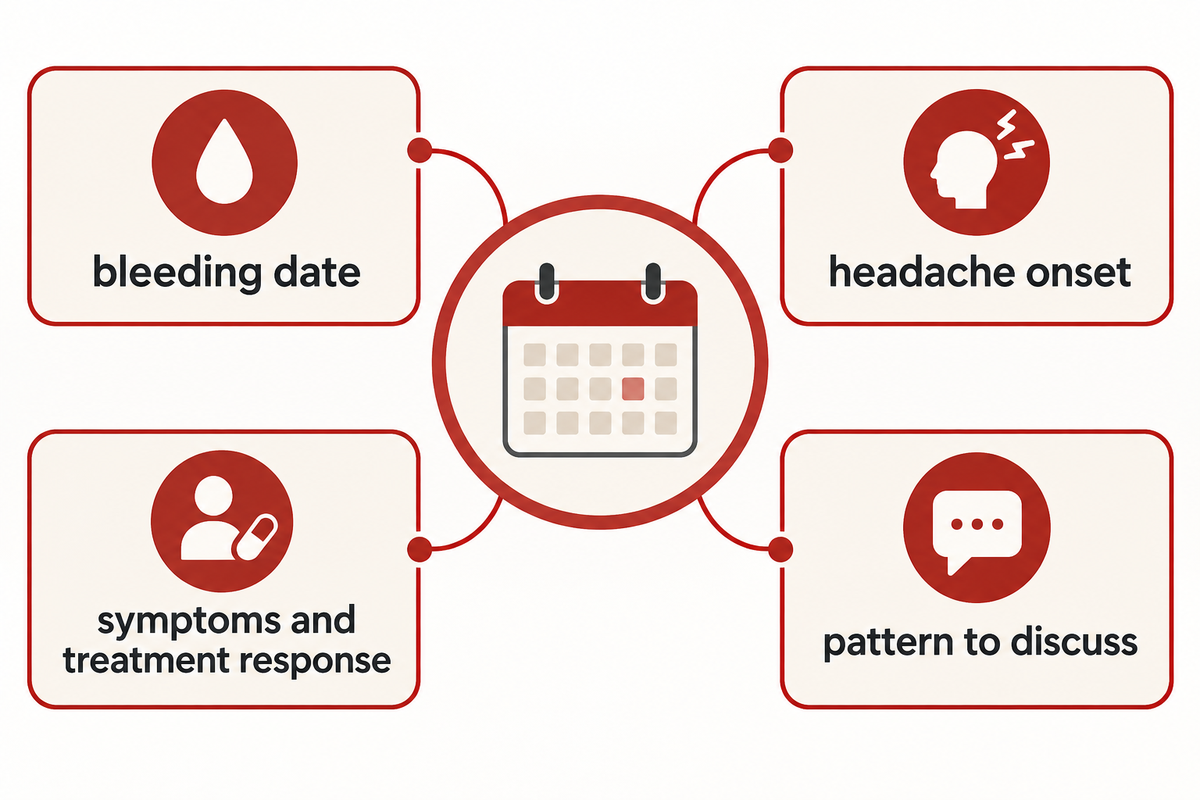
Is the timing repeatable?
Compare headache onset to the first day of your bleeding over a few cycles. A late or irregular period makes identifying a pattern harder, so write down the exact date rather than depending on an app.
Estrogen levels fall before menstruation, and this hormonal fluctuation can trigger attacks in susceptible people. It does not establish the cause of an individual headache. The Migraine Trust’s menstrual migraine guidance explains why the diary should include attacks at other times of the month too.
What does the attack feel like?
Write down the pain’s location and quality, if you’re nauseous/vomiting, how sensitive you are to light/sound, how affected you are by aura and if you’re able to engage in normal activities.
Use words that describe your own pain. Does it throb or seem to pulsate, or does it feel like steady pressure? If a clinician asks about a pulsating quality, that means a throbbing sensation; unilateral means on one side. Record what you notice rather than choosing a description because it sounds typical of migraine.
What changed the outcome?
Note the treatment given, the prescribed dose, when it was taken, any side effects, and how normal activities were affected. Don’t change or stop a treatment without consulting a doctor.
Make the medicine list specific. If you already use a triptan or nonsteroidal anti-inflammatory drugs, record the actual product name and when you took it. Include supplements such as magnesium or riboflavin if you use them. Listing a product here is not a recommendation to start it; the purpose is to show your clinician the full picture, including medicines used outside the menstrual window.
Use a simple three-cycle diary
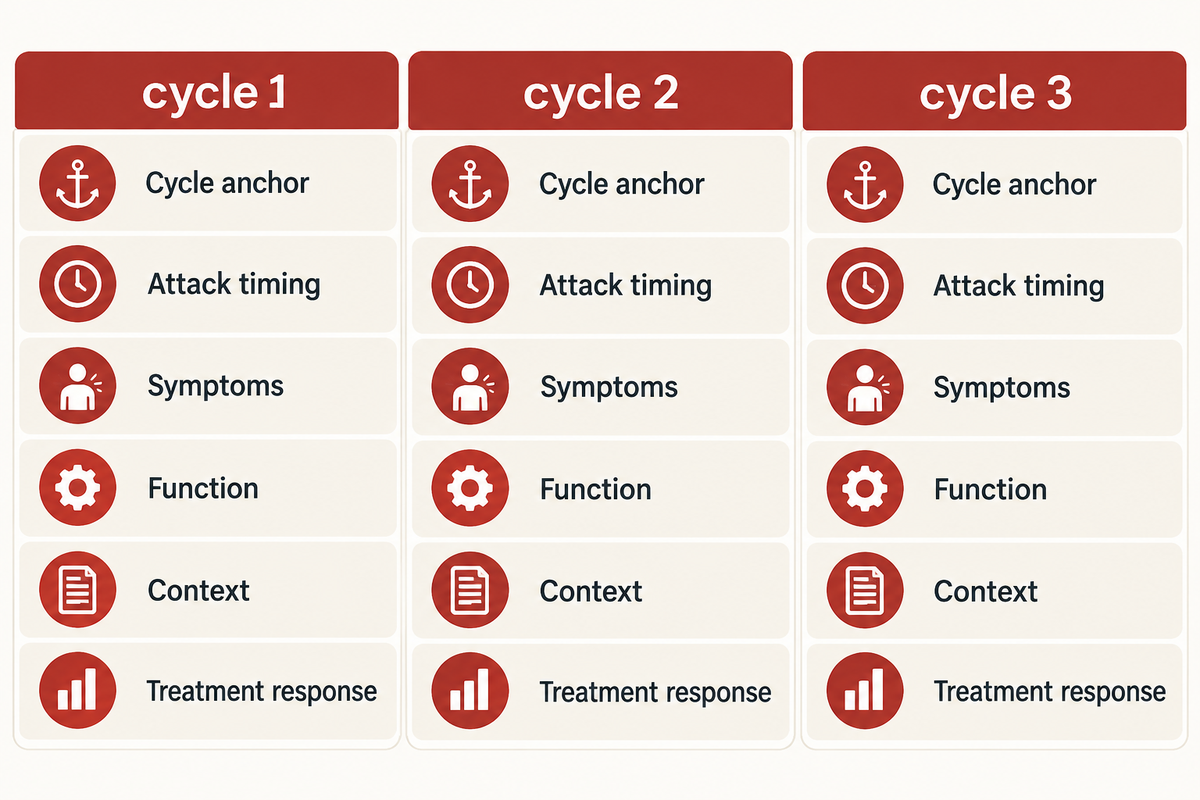
The goal isn’t to create a second job with a detailed diary. A calendar entry for a headache day plus a few consistent fields can keep the record simple to review. Use the same format for at least 3 cycles when possible and bring your raw notes to the appointment. The Migraine Trust recommends at least three months of records; irregular cycles may need a longer observation period, but the diary should never delay an appointment.
| Field | What to write | Why it matters |
|---|---|---|
| Cycle anchor | First day of bleeding; cycle day; spotting or unusual bleeding | Lets your doctor compare attack timing with the menstrual phase |
| Attack timing | Start and stop time; overnight onset; days before or after bleeding | Shows duration and whether the pattern repeats |
| Symptoms | Pain score, one/both sides, throbbing or pressure, nausea, vomiting, light/sound sensitivity, aura | Helps distinguish a familiar migraine pattern from a change needing assessment |
| Function | Missed work, exercise or childcare; able to eat, drink and sleep? | Captures disability, not only pain intensity |
| Context | Sleep, meals, hydration, caffeine, stress, illness, heat, travel and other suspected triggers | Hormonal timing can coexist with non-hormonal triggers |
| Treatment response | Medicine or non-drug measure, time used, benefit, side effects and rescue use | Gives the clinician information to review for treatment planning |
How to mark the menstrual window
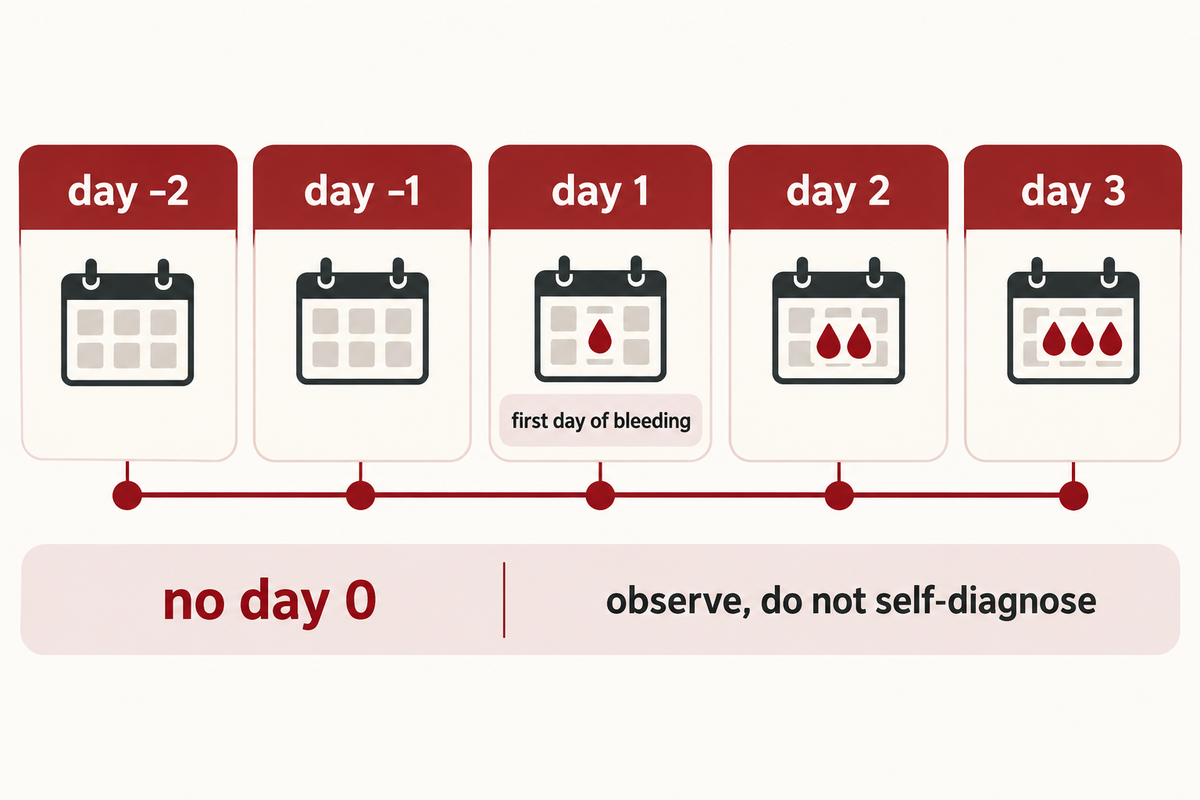
For each headache attack, state its start date and cycle-day label relative to the first day of bleeding. For example, -2 means it occurred two days before the first day of bleeding and +1 means it occurred on the first day of bleeding; the preceding day is −1 and there is no day 0.
The American Migraine Foundation explains that the so-called “menstrual window” is the two days before and the first three days of the period. You can observe the timing described here, but don’t self-diagnose based on these descriptions.
For women with migraine who menstruate, compare attacks in the days before the period with those occurring several days into the period and elsewhere in the cycle. Menses is another word for menstruation. The International Headache Society’s International Classification of Headache Disorders defines the date labels; your observations still need clinical interpretation.
| Calendar day | Cycle label | What to record |
|---|---|---|
| Tuesday | −2 | Headache or no headache; bleeding not yet started |
| Wednesday | −1 | The day immediately before bleeding |
| Thursday | 1 | Actual first day of bleeding |
| Friday | 2 | Second day from onset |
| Saturday | 3 | Third day from onset |
Example: “Cycle 1: bleeding began 6 May; migraine began 4 May (day -2), lasted 18 hours, nausea and light sensitivity, missed work, usual prescribed acute medicine helped partly.” Repeat the same level of detail for each cycle.
Turn three cycles into a doctor-ready summary
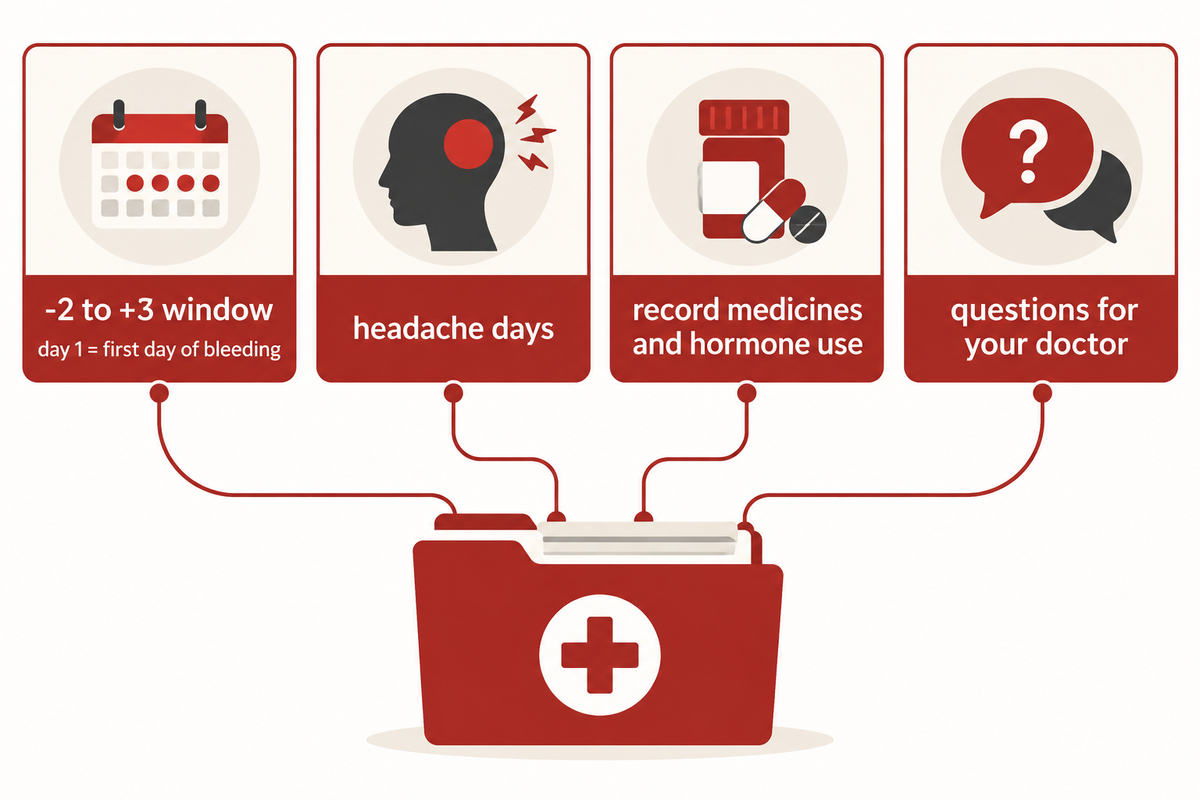
- Count the number of headache days and mark the ones that occur in the -2 to +3 window.
- Circle attacks that were longer, more disabling or less responsive than your usual attacks.
- List all current medications, supplements and hormone/contraceptive therapies and include the reason for taking, any side effects, and when you started them.
- Ask two questions: “Does this pattern fit menstrual migraine?” and “What should I do before/during the expected window?”
Bring the diary even if the pattern isn’t complete. Menstrual cycles can be irregular and migraine can have many triggers. Your doctor may use your diary along with your history and examination; no single diary entry proves a diagnosis.
A diary has limits. A prospective study comparing menstrual migraine classifications found that recalled menstrual association and diary-based classifications did not always agree. A qualitative study of headache clinicians also found different preferences about diary detail. These findings support discussing the record with your healthcare provider; they do not turn this worksheet into a validated diagnostic test.
| Record type | Example entry | Handoff action |
|---|---|---|
| Confirmed bleeding | Bleeding began Thursday; entered that evening | Patient supplies the actual date; clinician checks the cycle anchor |
| Predicted bleeding | App predicted Tuesday; bleeding began Thursday | Keep prediction separate from observation |
| Spotting | Light spotting before the usual flow | Describe it separately and ask which date to use |
| No headache | Checked this evening: no headache today | Use an explicit entry rather than a blank |
| Missing entry | No entry; cannot remember whether pain occurred | Mark unknown, not headache-free |
| Uncertain onset | Woke with pain; exact start time unknown | Preserve the uncertainty instead of inventing a time |
| Symptoms and severity | Throbbing pain, nausea; unable to finish work | Describe the experience and the effect on normal activity |
| Treatment response | Usual prescribed medicine helped partly; name and timing in notes | Bring the actual medicine details for review |
| Support person’s observation | Partner noticed I left dinner because of light sensitivity | Label who observed it; patient and clinician clarify together |
When to seek urgent medical help
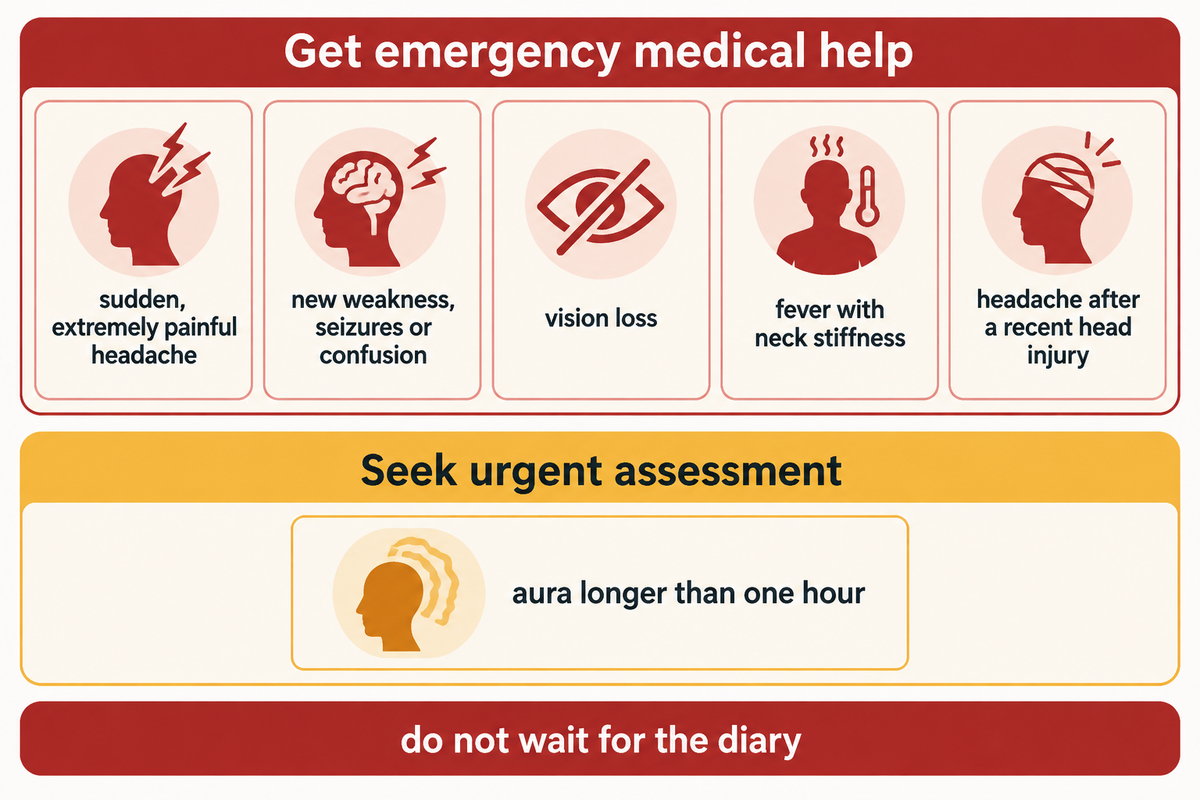
Get emergency medical help for a sudden, extremely painful headache; new weakness on one side; seizures; confusion; vision loss; a high fever with neck stiffness; or a headache after a recent head injury. Don’t explain these away as ‘just menstrual migraine’. The NHS advises urgent assessment when aura symptoms last longer than one hour.
Tell your clinician if you notice changes to your usual pattern, if attacks become more frequent or severe, or if treatment becomes less effective. If you’re pregnant, trying to conceive, breastfeeding, or considering hormonal contraception, tell your clinician before discussing treatment options.
Tell your clinician whether you have ever experienced aura, even if the attacks near your period have no aura. This matters when reviewing combined hormonal contraception, including combined oral contraceptives, because safety advice differs for migraine with aura. The CDC contraception guidance supports that distinction. Record contraceptive changes and describe whether bleeding followed a scheduled hormone break, rather than assuming every bleed reflects the same hormonal pattern.
Write down birth control pills, patches or other hormonal medicines by their actual names, including any estrogen supplements. If a product contains estrogen and progesterone, list the formulation rather than just writing “hormones.” Hormone levels can fluctuate, but a symptom diary does not measure levels of estrogen or establish which hormone caused an attack.
How a treatment conversation may fit in
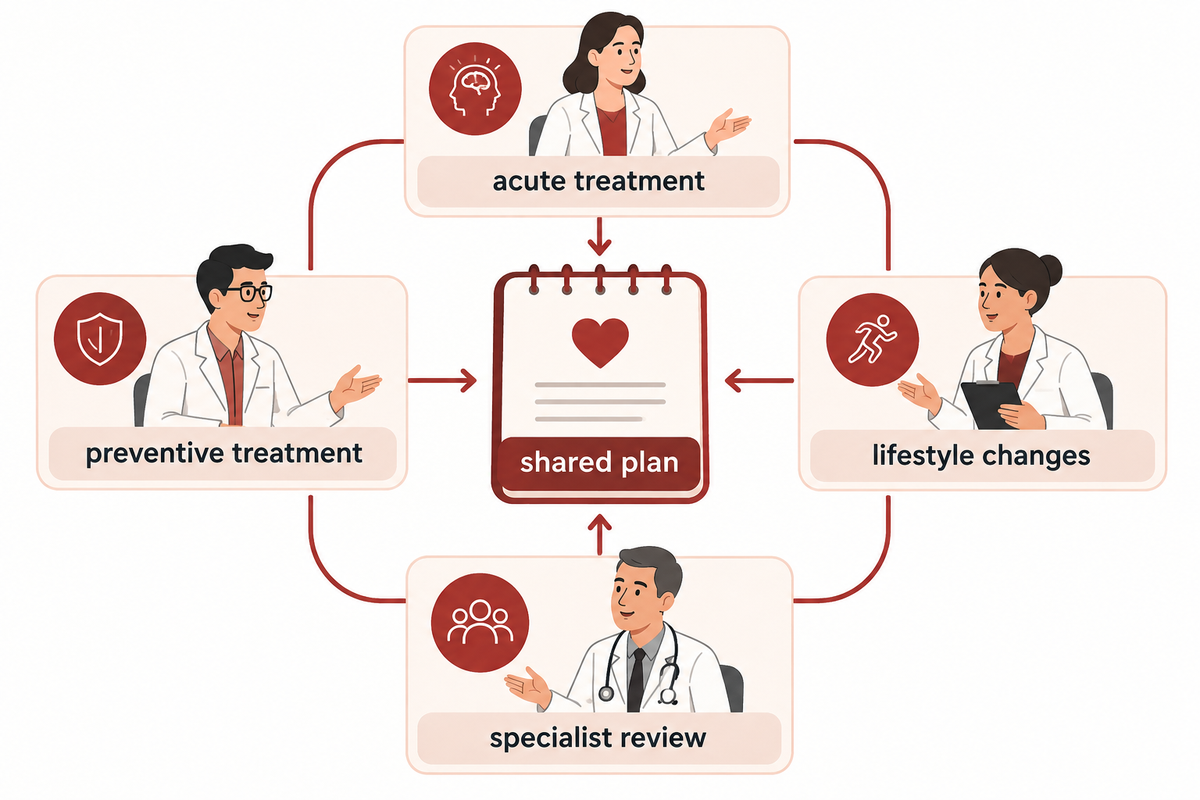
Your personal experiences with your condition can help inform your clinician about acute treatment, preventive treatment and lifestyle changes. You may also wish to ask about the appropriateness of specialist review and Traditional Chinese Medicine. The information you provide about yourself can help your clinician appreciate the complexities of your condition and inform appropriate medical and safety reviews for treatments. Review any complementary treatment with your clinician; it should not replace prescribed treatment or delay urgent care.
When discussing menstrual migraine treatment, explain what living with migraine is stopping you from doing. Ask how the diary can help manage menstrual migraine symptoms and whether you need a neurologist or gynecology review. If your clinician gives you a migraine disability assessment questionnaire, bring it alongside the diary. Your aim is a shared plan for management and treatment, not choosing medicines from a calendar alone.
For more information about the migraine service offered by the clinic, see migraine treatment. Tong Ren Tang describes its Dubai Healthcare City clinic, DHA licensed physicians and multilingual service on its About Us page. These are clinic details; they don’t guarantee the success of a certain treatment.
Before booking, read the first visit guide and review the clinic’s practitioner profiles. Use the clinic contact page for location and appointment questions. Bring your diary and ask which practitioner is appropriate for your needs; a routine clinic enquiry does not replace emergency assessment.
Frequently asked questions
How many cycles should I track?
Track as many of the cycles as you’re able to before your appointment; three cycles can help reveal repeated timing. Don’t postpone medical care if attacks are severe, changing or disabling. A short record can still describe your migraine symptoms and the dates you remember. For people with migraine and irregular periods, three calendar months may not contain three cycles; your clinician can advise how long to continue recording.
What if my periods are irregular?
Track the actual dates your period starts and the number of days in between. An irregular cycle may make a pre-period plan less predictable, so let your clinician know rather than guessing. Keep app predictions separate from actual bleeding dates, and label spotting or missing entries. This gives your doctor the uncertainty as well as the observations when you discuss a treatment plan.
Should I stop my migraine medicine during my period?
No. Keep taking medicines as prescribed. Talk to your clinician about timing and any interactions, whether the medication is safe during pregnancy, and the risk of medication over-use. The purpose of the diary is to describe what happened, not to change the medicine you’re taking.
Can a diary prove that hormones caused my migraine?
No. Stress and disrupted sleep can overlap with menstrual changes on the same days as your migraine episodes.
Bring your pattern to a consultation
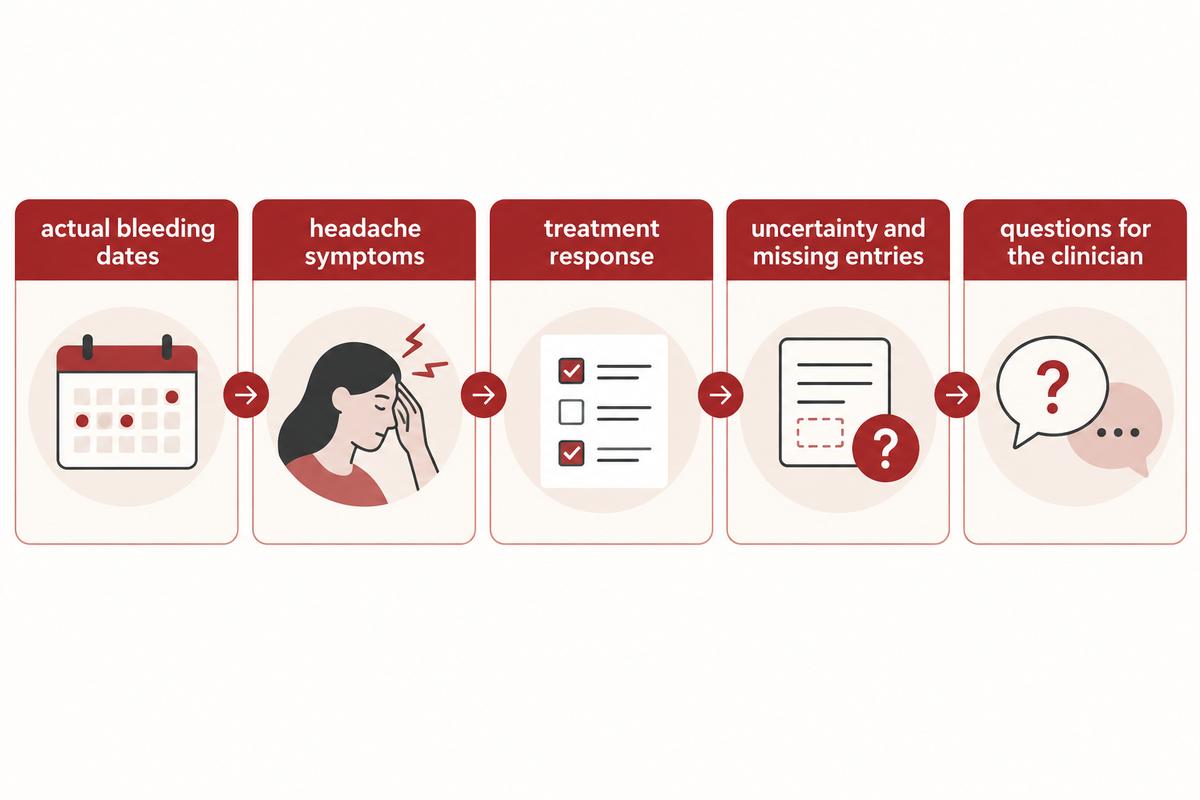
A legible diary can help your clinician assess timing and symptoms, and see your response to treatment. If you’re interested in finding out more about Tong Ren Tang’s migraine service, book a consultation and bring your diary.