Get in Touch with Tongren Tang Gulf


The search for a tension headache cause begins after an afternoon of pressure around the head. Poor sleep and stress may contribute to the headache. However, the headache label doesn’t explain every headache. The focus is on the pattern, change, and the symptoms that require medical attention.
Tension headache cause is not fully understood. Stress, sleep problems and caffeine can be associated triggers. A pressing pattern helps describe symptoms; new, severe or changed headache needs medical assessment.
Key points
- Muscle tension and a headache occurring together don’t identify a single underlying cause.
- Headache type depends on the whole pattern, including activity and accompanying symptoms.
- A diary helps an assessment; warning symptoms take priority over completing the diary.
- Acupuncture is a preventive option to discuss for chronic tension-type headache, with benefits and risks to review.
Are the headache symptoms potentially life threatening? A headache that suddenly becomes extremely severe, or headache that’s combined with new weakness or confusion, difficulty speaking, seizure, fever with neck stiffness, or loss of consciousness is an emergency. Call 998 in the UAE to get an ambulance. Other potentially dangerous situations are also described in the assessment section.
What is a tension-type headache?
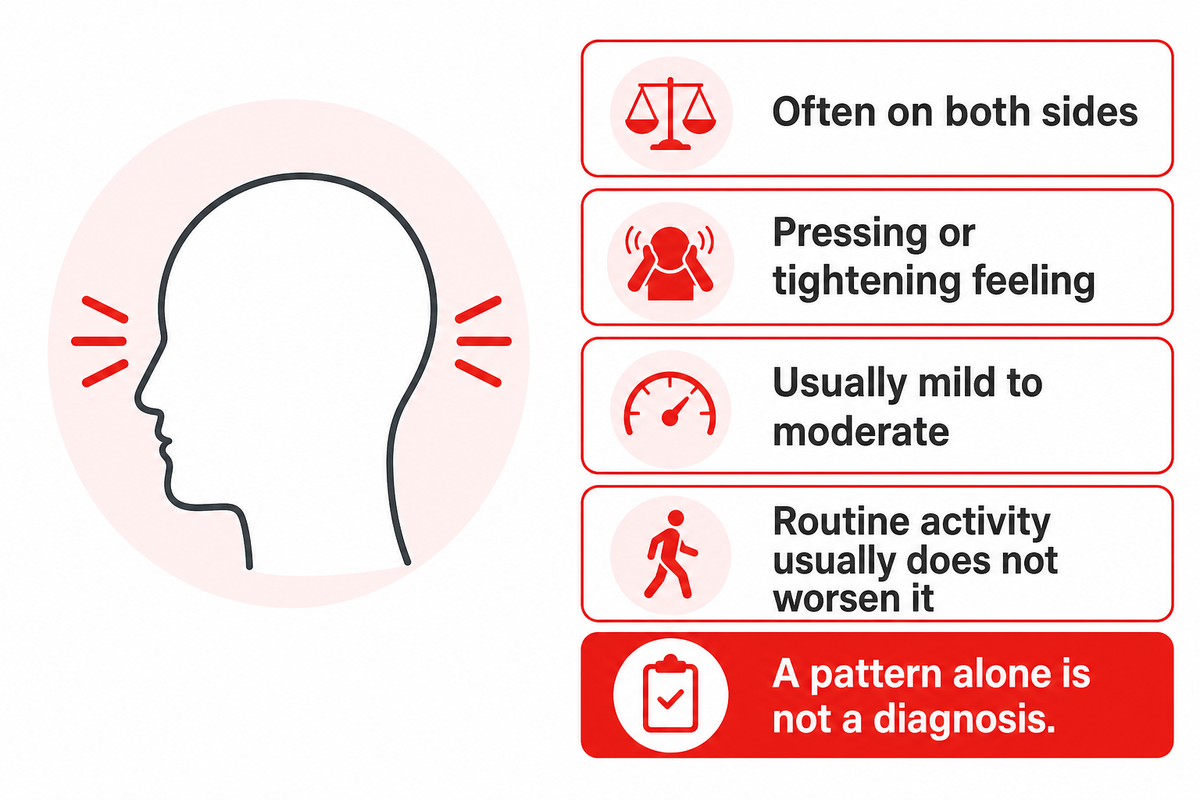
This common primary headache disorder is sometimes associated with pressure or tightness, and is usually seen on both sides of the head. Routine activities usually don’t worsen this. The pattern of the symptoms helps a clinician evaluate them, but where the symptoms are felt alone doesn’t establish the diagnosis.
Symptoms of tension headache usually include mild to moderate pain around the forehead and may be associated with tenderness or pressure on both sides. A tension headache usually feels different from a strong throb, though the distinction may be unclear. A fuller evaluation of the symptoms is included in the assessment. An established primary headache doesn’t prevent a separate illness from causing a new headache.
According to the frequent episodic classification of the International Headache Society, 10 or more episodes occur on 1-14 days a month, on average, for more than 3 months. Episodes can last between 30 minutes and 7 days. These are part of a larger complete clinical classification, which includes other features, symptoms, and exclusion of other diagnoses.
The classification for chronic tension-type headache uses 15 or more days a month on average for more than 3 months. For frequent headaches, we shouldn’t wait 3 months to assess them. Chronic headache types require a treatment plan that’s matched to the diagnosis; therefore, patients with chronic tension headache should discuss their treatment plan with their clinician.
Records of 1-14 headache days a month and records of 15 or more days a month address different classification questions in ICHD-3. Frequency becomes important when combined with duration and other symptoms. Counting days in isolation cannot distinguish tension-type headache from migraine, or anything else.
What can cause or trigger a tension headache?
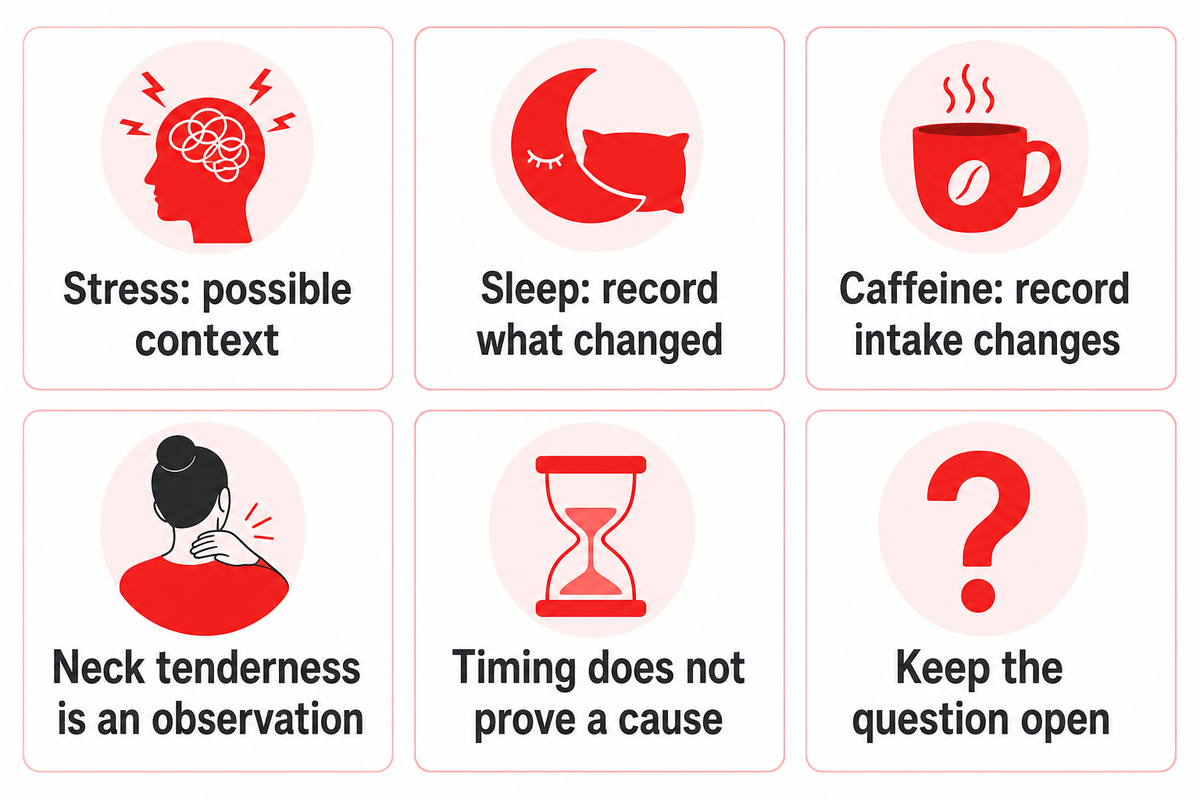
The causes of tension-type headache are still unknown. Stress and sleep problems as well as caffeine are common triggers. A trigger, however, doesn’t prove the mechanism of the headache.
According to Mayo Clinic‘s causes explanation, contemporary pain-sensitivity theories differ from the older notion that tension-type headache is caused by muscle contractions. Muscle contraction headache implies that old idea. Tension in the neck and tenderness in the head and neck can be documented, but shouldn’t be considered proof of the cause of tension headache.
To separate what happened from your explanation, use the Observation-Trigger-Uncertainty Table. Its entries are prompts to start a conversation, not a diagnostic checklist. Examples of triggers are from NHS guidance on tension headache; other record fields help a clinician consider the timing.
| Record an observation | Possible context | Keep the question open |
|---|---|---|
| Headache after a demanding day | Emotional stress | Did similar days occur without pain? |
| Short or disrupted sleep | Sleep problems | Did the headache begin before or after the sleep change? |
| Different coffee intake | Caffeine use or a change in routine | Record what changed rather than declaring a cause. |
| Neck feels tight | Muscle tenderness or neck discomfort | Does neck movement affect symptoms? |
| Pressure after desk work | Work timing and breaks | Timing alone does not establish a posture diagnosis. |
| More painkiller days | Medicine-use pattern | Could medication overuse be contributing? |
| Pain on a low-stress day | No obvious headache trigger | Headaches can occur without an identifiable trigger. |
| New nausea or activity sensitivity | A changing symptom pattern | Does the original headache label still fit? |
| Headache on a day off | Different sleep, meals or caffeine | Compare several entries, including headache-free days. |
Let’s say a worker at an office gets pressure around the head after working two straight late shifts. She notes six hours of sleep, an extra coffee and a tense neck. Calling this a headache triggered by stress would answer the question too quickly. Several things changed during the same period. The next headache free day, she notes the same things. At her appointment, the account that’s most helpful is the series of events, the symptoms and how often they occur. She doesn’t have to determine which of the events was the cause of the pain, to seek help. For example, if a new, or worsening, symptom occurs, and the work schedule is similar to before, the next step is to seek help.
Practical distinction: While it’s important to pay attention to chronic stress, decreasing stress levels isn’t a substitute for looking into headaches that keep coming back or change character.
How do tension headache symptoms differ from migraine?
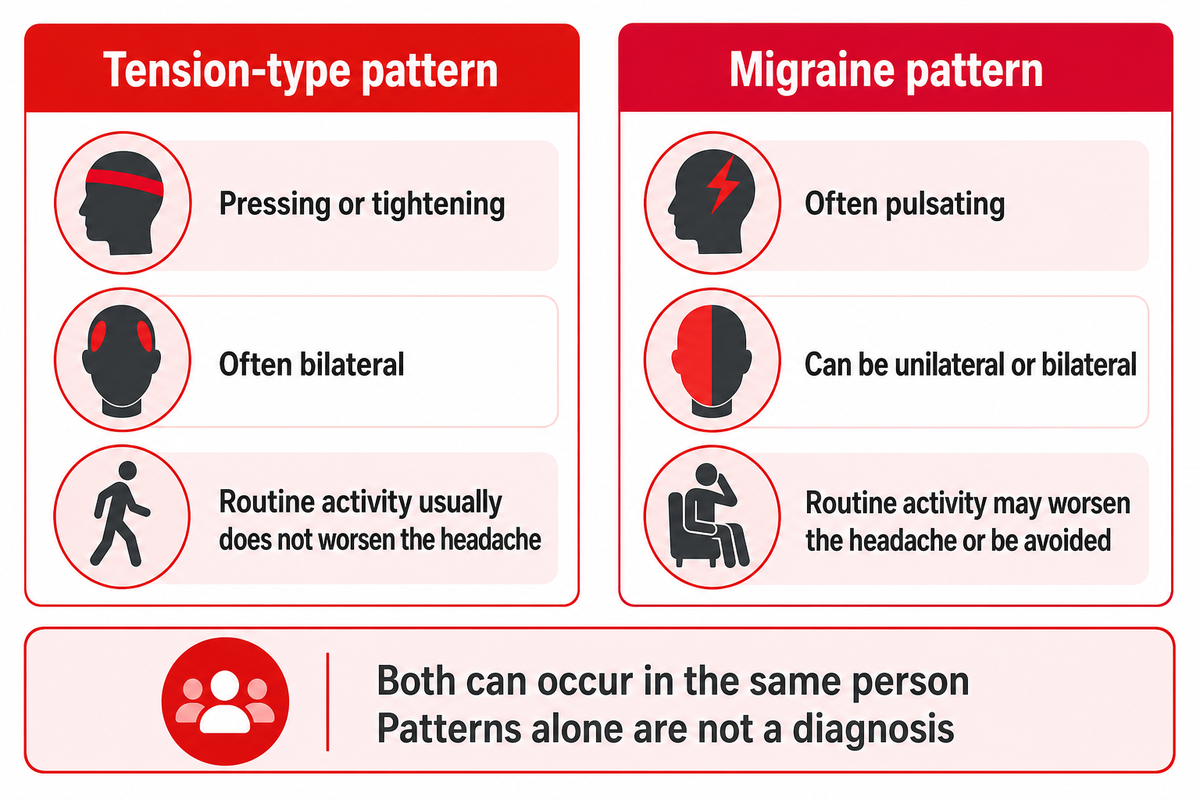
Tension Headaches may also involve pressing. Migraine may involve a pulsating pain, nausea or sensitivity to light and sound. The entire picture may include other symptoms. Headache pain at the back of the head doesn’t reliably distinguish the two types of headaches.
The comparison which follows is based on ICHD-3, and on NICE’s headache assessment guidance. It describes patterns of assessment, not a symptom test for diagnosis. Migraine headaches and tension-type episodes can occur in the same person. Tension-type episodes can occur in the same person as Migraine headaches.
| Feature | Tension-type pattern | Migraine pattern | What to discuss |
|---|---|---|---|
| Location | Often bilateral | Can be unilateral or bilateral | Location alone is insufficient. |
| Quality | Pressing or tightening | Often pulsating | Describe the sensation in your own words. |
| Intensity | Usually mild to moderate | Often moderate to severe | Explain what you stop doing. |
| Routine activity | Usually not aggravated | Often aggravated or avoided | Record stairs, walking and ordinary tasks. |
| Nausea | Absent in episodic criteria; mild nausea can occur in chronic criteria | Nausea can accompany an episode | Frequency and accompanying symptoms matter. |
| Vomiting | Excluded by the stated tension-type criteria | Can occur | Report it rather than dismissing it. |
| Light and sound | Criteria permit a limited associated-symptom pattern | Both sensitivities can occur | Record each separately. |
| Visual or sensory changes | Not explained by a simple pressure label | Aura can occur, but new symptoms need assessment | Do not self-label new neurological symptoms as aura. |
| Pattern over time | Can be episodic or chronic | Can also be episodic or chronic | A diary helps separate different episode types. |
In another example, a reader states that episodes are called stress headache because the pain starts around the head. Sometimes he works in the afternoons, and other days the pain is so bad from the stairs that he needs to go to a dark room. At first he recorded both as the same headache pattern, but later on he started separating them. Separating the episodes gave the assessing clinician more useful information, as the clinician could determine if more than one headache type is present and also ask about other symptoms the patient hadn’t related to the pain. He doesn’t refer to the comparison table in order to rule out a diagnosis or assume that every visual change is migraine.
Our migraine assessment and treatment guide covers that separate topic. Persistent mixed symptoms may also prompt a clinician to consider neurology review.
The chronic criteria in ICHD-3 allow at most one of sensitivity to light, sensitivity to sound or mild nausea, while excluding moderate or severe nausea and vomiting. A history of at least 15 headache days a month still requires clinical judgment. A simple claim that tension headaches never involve nausea also misses this distinction.
When do headache symptoms need medical assessment?
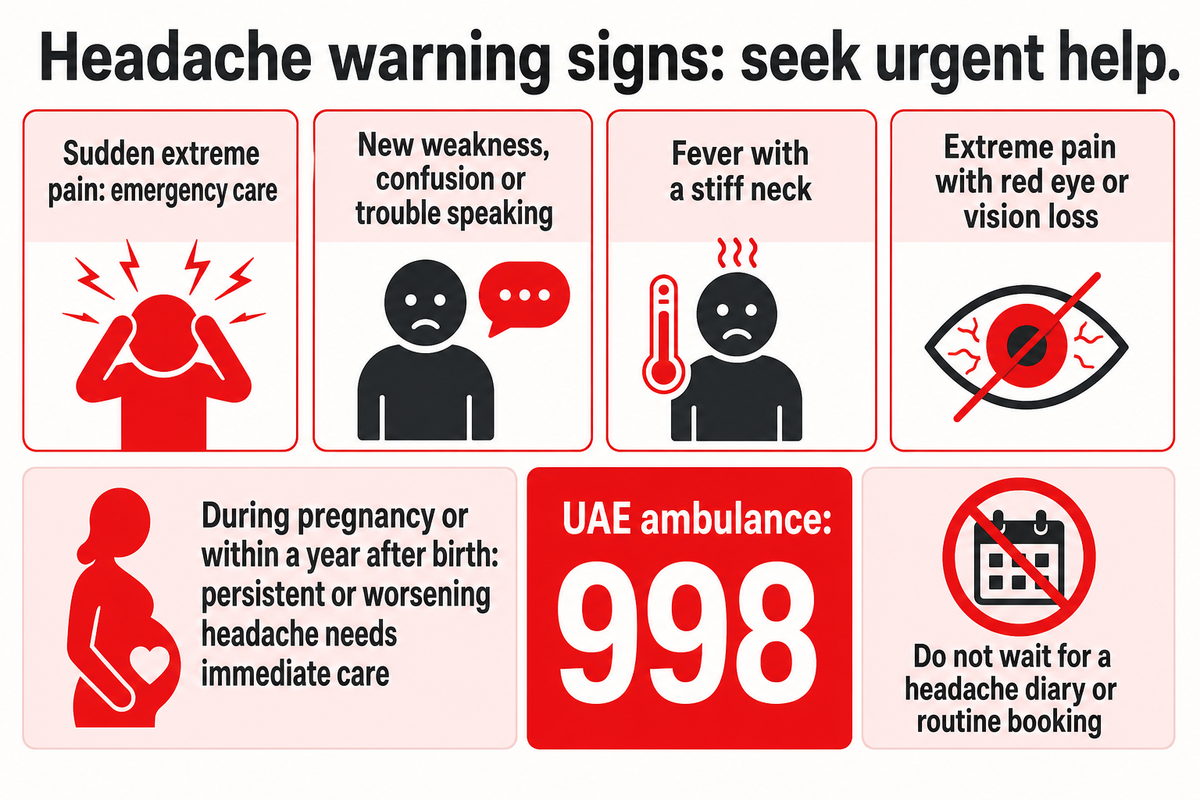
An extremely severe and sudden headache or a headache with new neurological symptoms requires emergency assessment. Likewise, frequent, severe, changing or persistent headache symptoms require medical assessment, even if they resemble earlier symptoms. Urgency also depends on recent pregnancy and childbirth, injuries and other medical conditions; the presence of a familiar pressure sensation doesn’t eliminate the need for evaluation.
Get emergency help now
Seek emergency care for sudden extreme pain, new weakness, trouble speaking, confusion, seizure, or headache with fever and a stiff neck. A severe headache following a head injury also needs urgent assessment. In the UAE, call 998 for an ambulance if emergency help is needed.
UAE official emergency information confirms the ambulance number. Don’t wait for a diary, a routine appointment or a complementary treatment session.
Pregnant or up to a year postpartum? A headache that won’t go away or gets worse is an urgent maternal warning sign and requires immediate medical attention. The clinician needs to be made aware about your pregnancy or recent delivery. Other guidance from the CDC includes headache that persists despite medication and fluids, sudden severe pain and headache that’s coupled with blurred vision or dizziness.
You should seek prompt medical care for the following: A headache that occurs frequently (several times a week); If there’s a major change in the person’s symptoms; if a headache is severe; If a relief measure that’s working for the person is no longer helping; if a person has new symptoms, for example, a person has a fever, a painful and red eye, new problems with a person’s eyes and/or vision, jaw pain when the person chews, a headache that’s caused by a person coughing or by a person exercising, and/or if the person has a related health concern (for example, if the person has a history of cancer or has a lowered immunity). This list isn’t all of the things that require medical attention. An extremely painful headache with a red eye or loss of vision needs emergency care.
In the beginning, a Headache diagnosis and treatment should include a person’s complete history and physical examination. NICE advises against using imaging only for reassurance after a primary-headache diagnosis. Just because an individual doesn’t have all the warning signs, doesn’t mean that some other features of a headache should be ignored.
Takeaway: A change in symptoms can matter more than the familiar headache label. Use emergency care for emergency features and arrange assessment for recurring problems before choosing supportive treatment.
What should a headache diary record before your appointment?
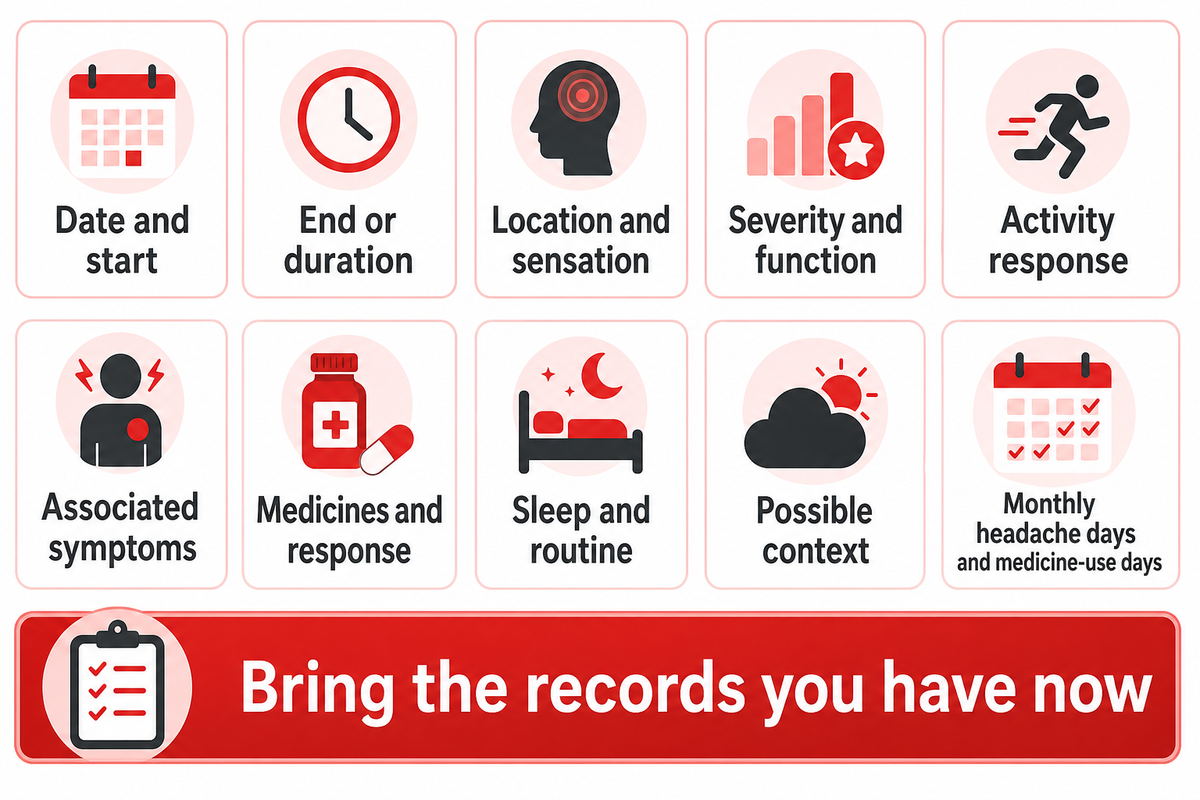
A headache diary is a way to document the pain a person is experiencing. You should include the time and the duration of the pain, the location of the pain, the severity of the pain, and other symptoms the person is experiencing. A person should include all medicines they’ve taken. A person should include possible headache triggers without declaring them causes of the pain. A brief and consistent record is usually better and easier to talk about with the medical provider. Bringing a record of the notes to a medical appointment is better than guessing what to talk about.
NICE suggests a minimum of 8 weeks when a diary is used to help diagnose headache. Don’t wait eight weeks to seek an assessment. Use the information you have now and keep a record if your clinician advises you to do so. A headache journal may include headache-free days and episodes.
“For at least a month, just note down when you have a headache, how you treated it, how long it lasted.”
Oshinsky’s practical starting advice and NICE’s diagnostic-diary recommendation serve different purposes. Bring the record that you have available now. For logistics of your next appointment, see our first-visit preparation guide.
| Field | Example entry, not a patient case |
|---|---|
| Date and start | Example Monday, 14:00 |
| End or duration | Ended 16:00; 2 hours |
| Location and sensation | Pressure around both temples |
| Severity and function | 4/10; continued work with a break |
| Activity response | Ordinary walking did not change pain |
| Associated symptoms | No nausea, vomiting or light/sound sensitivity recorded |
| Medicines and response | No medicine taken; record exact product and response if used |
| Sleep and routine | 6 hours of sleep; usual morning coffee |
| Possible context | Busy afternoon; cause not assigned |
| Monthly counts | 3 headache days so far; 0 pain-medicine days so far |
A fictitious entry from the record demonstrates the reason a useful record includes details beyond the intensity of pain. A reader who remembers only “three headaches” may mean three attacks on one day or pain on three different days. The patient brings the dates, the two-hour duration and the effect on her walking to her appointment. The field for the medicine taken is left as “none.” Later entries also include the same fields. This allows the patient and her clinician to compare the changes. The focused questions then asked by the clinician help the patient gain insight into the reason for the changes and the patterns that may help direct her treatment. The example doesn’t identify the patient’s diagnosis, predict treatment response or tell her to wait a complete month.
The number of ‘medicine days’ and ‘headache days’ should be recorded. NICE flags possible medication-overuse headache when headache develops or worsens while relevant medicines have been used for 3 months or more: triptans, opioids, ergots or combination analgesics on at least 10 days a month; paracetamol, aspirin or NSAIDs on at least 15 days a month. These are the assessment thresholds; they aren’t the safe-use thresholds. Talk with a doctor or pharmacist about the medicines you’re using; don’t discontinue prescription medicines based on a table.
NICE suggests keeping a headache diary for at least 8 weeks when it helps diagnosis, not as a waiting period before care. Headache frequency and medicine-use days refer to different aspects. If symptoms are changing or treatment is becoming more frequent, bring the diary now, even if the entries are short.
Which daily changes may support headache relief?
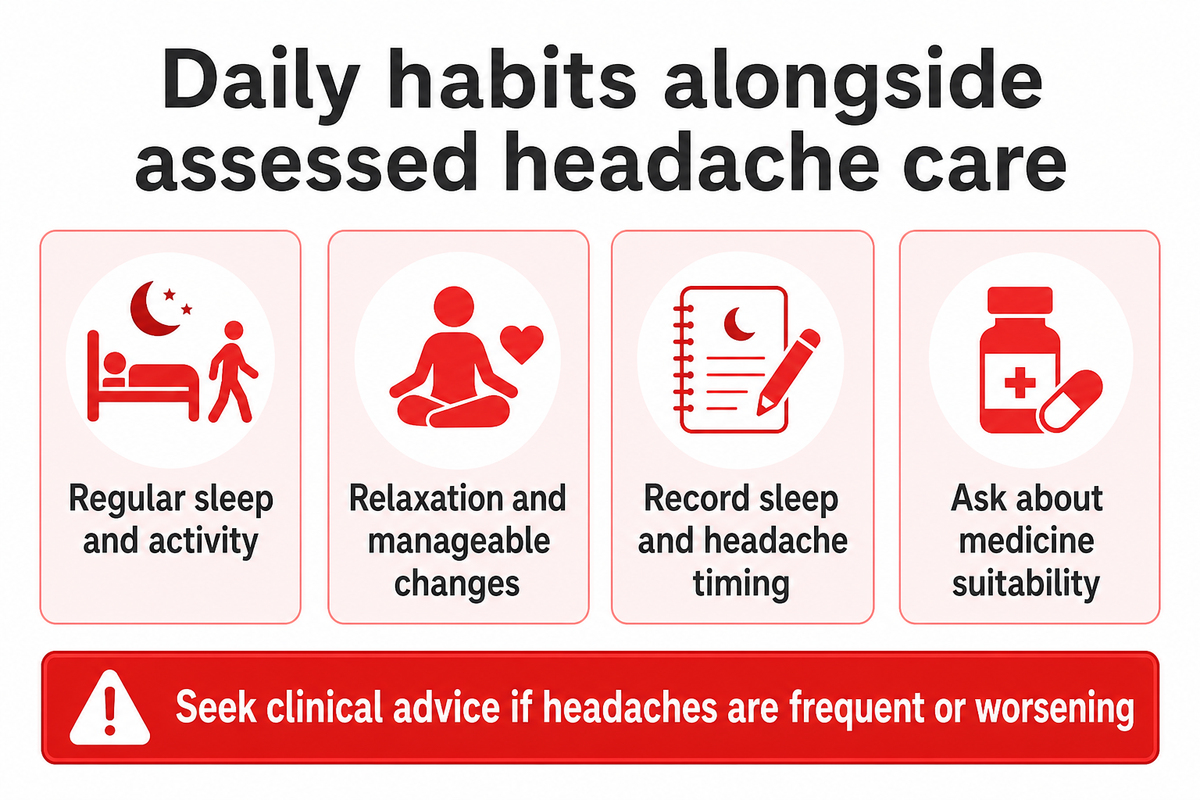
Establishing good habits for regular sleep and activity, as well as relaxation, may provide headache prevention and relief when tension-type headache has been assessed. Notice caffeine use and any changes in routines, rather than assuming every episode has the same trigger. Daily changes may accompany a plan of care, but if symptoms become frequent or worsen, medical advice is still needed.
NHS advice includes relaxation activities and strategies to tackle sleep problems. Gentle exercise or taking a break may help you manage stress. A sleep diary can help show if disrupted nights and headaches occur together. Avoid turning the diary into a demand to control every aspect of the day. An association doesn’t mean blame or that a particular thing will definitely prevent headaches.
Over-the-counter pain relievers aren’t suitable for everyone. A pharmacist can advise on an over-the-counter pain medicine in light of pregnancy, other medicines and overall health. Using pain medicines frequently can lead to rebound headaches, also known as medication overuse headaches. Seeking quick relief repeatedly is a reason to review the plan, not to increase use.
Choose one manageable habit to discuss and record what happens, without assigning it a treatment success rate. If, for example, sleep becomes more regular and headache days don’t fall, that’s useful information for the clinician. The goal of a care plan may be to reduce the frequency of episodes or reduce headache disruption; a new symptom still requires attention.
Where does acupuncture fit among treatment options?
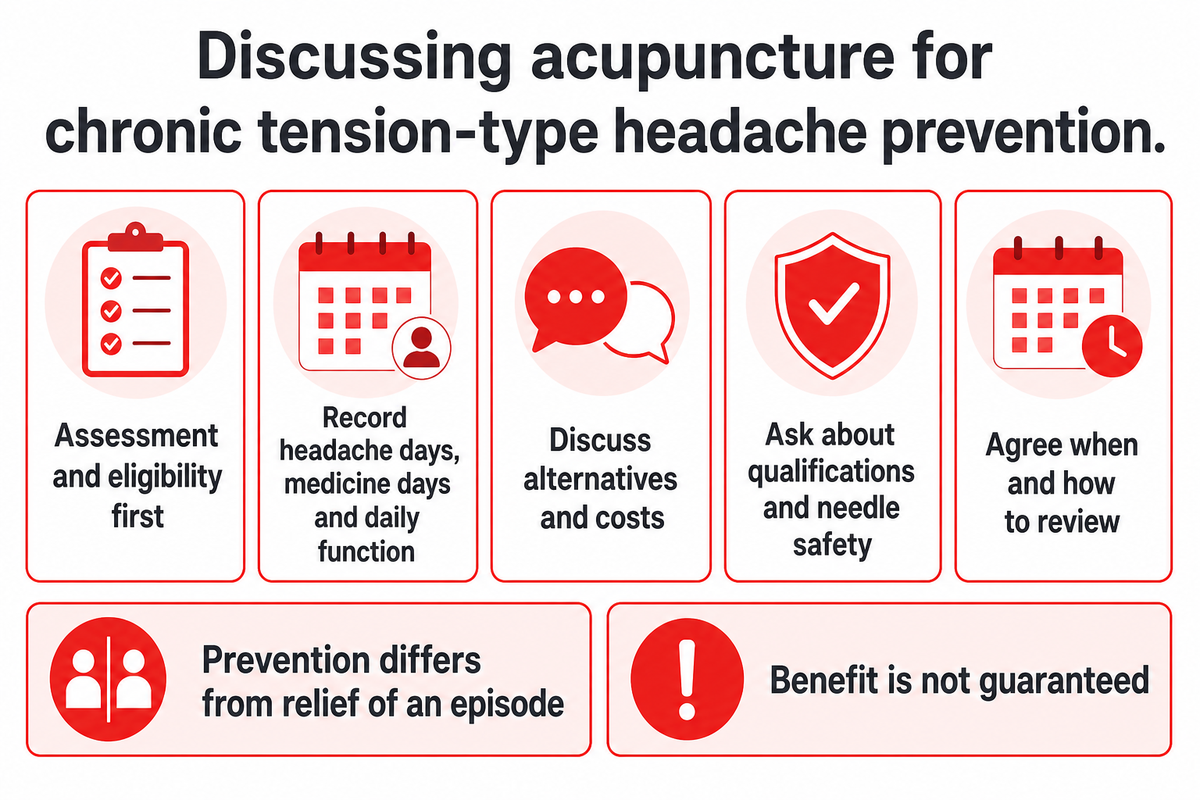
Acupuncture for prevention of chronic tension-type headache may be discussed following an appropriate assessment. Acupuncture doesn’t replace emergency care or provide an explanation for a headache. Preventive care and relieving an episode should be clearly distinguished. Before starting care, discuss reasonable alternatives and agree how benefit and adverse effects will be reviewed.
The UK guideline from NICE recommends considering up to 10 sessions over 5–8 weeks for prophylactic treatment of chronic tension-type headache. This recommendation is dated 2012 and subject to change. The recommendation is marked 2012 within the currently published guidance; the page’s 2025 update isn’t a newly conducted acupuncture trial. This source-specific recommendation isn’t a prescription for every individual with occasional tension headache.
Other headache treatment options may include clinician-selected prescription prevention and structured stress management. A 2001 randomized trial by Holroyd and colleagues evaluated tricyclic medication, structured stress-management therapy and their combination in selected adults with chronic tension-type headache. This study didn’t include acupuncture and doesn’t provide a prescription for you. Structured therapy isn’t the same as telling you to relax.
Acupuncture findings vary by comparison and follow-up. The 2023 systematic review by Kang and colleagues found substantial uncertainty in many outcomes. Comparing acupuncture with sham acupuncture, a 2025 review by Lin, Su and Shih reported a favorable headache-frequency result six weeks after treatment ended, while its pooled comparison within 12 weeks after treatment wasn’t significant. These findings do not indicate the best session count or provide a clinic response.
According to NCCIH’s effectiveness and safety summary, improper delivery or nonsterile needles can cause serious harm. Discuss practitioner qualifications, sterile single-use needles, medicines and relevant health conditions. Tong Ren Tang’s acupuncture service in Dubai is a place to ask about its assessment process and suitability for your circumstances.
| Agree on | Bring or ask | Who helps decide |
|---|---|---|
| Diagnosis and eligibility | What is the working diagnosis, and what needs assessment first? | Assessing clinician |
| Baseline | Current headache days, medicine days and interrupted activities | Patient and clinician |
| Options | Reasonable alternatives, expected costs and treatment burden | Patient and care team |
| Delivery and risks | Practitioner qualifications, needle safety and relevant health conditions | Acupuncture practitioner |
| Review | When progress is reviewed, how adverse effects are reported and when the plan changes | Patient and care team |
NICE’s option of up to 10 sessions in 5 to 8 weeks applies to prevention in chronic tension-type headache. Headache days, medicine usage and function should be reviewed against the same baseline, rather than assessing a course by one good afternoon. A cost discussion and review does not require a promised response or a prepaid package.
What should you ask before booking care in Dubai?
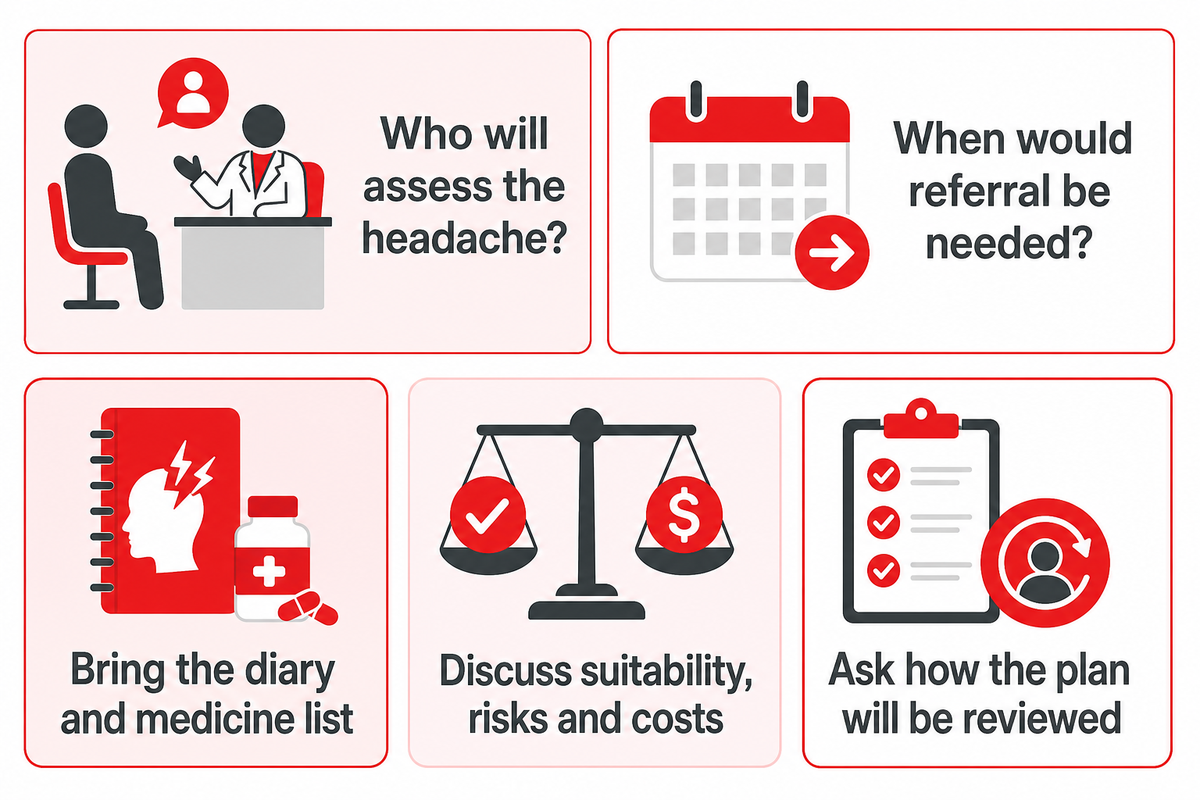
Before arranging non-urgent treatment, inquire as to who will assess the headache and upon what symptoms a referral would be made. Bring your symptom diary and medicine list. Discussing suitability, risks, costs, and review helps you decide if care is warranted.
Find out how a diagnosis of tension headache is distinguished from another type of headache and what happens if the pattern changes. Patients with tension-type headache may require a more complete medical plan. The treatment of tension-type headache should be based on that assessment rather than begin with a fixed explanation about stress or an automatic series of appointments.
For more information about the practical steps to take before a first traditional Chinese medicine consultation, please refer to our guideline. Use the Care Discussion Agreement to keep the focus on your daily function and how you’ll review the plan.
Frequently asked questions
Can stress cause a headache without anxiety?
Stress can be a trigger; record when it occurs and whether you feel anxious.
Emotional stress is only one part of the history. Sleep changes, caffeine, medicine use and the headache pattern also matter. Record what was happening before the episode, including headache-free days with similar demands. Calling pain a stress headache doesn’t establish a diagnosis or exclude other causes, particularly when symptoms are new or changing.
How long can an episodic tension headache last?
ICHD-3 describes episodes lasting 30 minutes to 7 days.
Duration is one element of the episodic tension-type headache criteria, alongside frequency, pain features and accompanying symptoms. A long episode isn’t automatically safe because it fits that range. Seek assessment for severe, persistent or changing pain, and use emergency care for warning symptoms rather than waiting for an episode to reach a time limit.
Can tension headaches include nausea?
The chronic classification permits mild nausea under specific conditions.
Episodic tension-type criteria exclude nausea and vomiting. Chronic tension-type criteria allow at most one of light sensitivity, sound sensitivity or mild nausea, with neither moderate or severe nausea nor vomiting. These distinctions are for clinical assessment. Report nausea honestly rather than deciding it rules a headache type in or out by itself.
Does a tension headache require a brain scan?
A clinician decides whether investigation is needed from the history and examination.
NICE advises against imaging solely for reassurance after a primary-headache diagnosis. New neurological symptoms, a substantial change or other warning features can alter the assessment. A normal-looking symptom checklist can’t decide whether a scan is appropriate.
Can taking painkillers make headaches more frequent?
Frequent use of some headache medicines can contribute to medication-overuse headache.
Keep a record of exact products and the days you take them, including combination medicines and prescriptions. The relevant thresholds differ by medicine class and require a pattern over time; they aren’t permission to take a product up to that limit. A clinician or pharmacist can review suitability, interactions and the next step. Don’t change prescribed treatment solely because of an online threshold.
Will acupuncture prevent tension headaches?
Acupuncture may help prevent tension headaches in some people, but benefit is not guaranteed.
NICE considers it for prevention of chronic tension-type headache. Evidence depends on the population, comparison and follow-up. Discuss whether the option fits your diagnosis and how you’ll review headache days, function, adverse effects and cost.
What should I bring to a headache appointment?
Bring the symptom record you have and a complete medicine list.
Include onset, duration, location, severity, activity response, nausea or vomiting, and any visual or sensory changes. Add prescription and non-prescription products, relevant health conditions, and pregnancy or recent childbirth. If your notes are incomplete, attend anyway. Keeping a headache diary should help the consultation rather than postpone it; urgent symptoms require care immediately.
Your next step
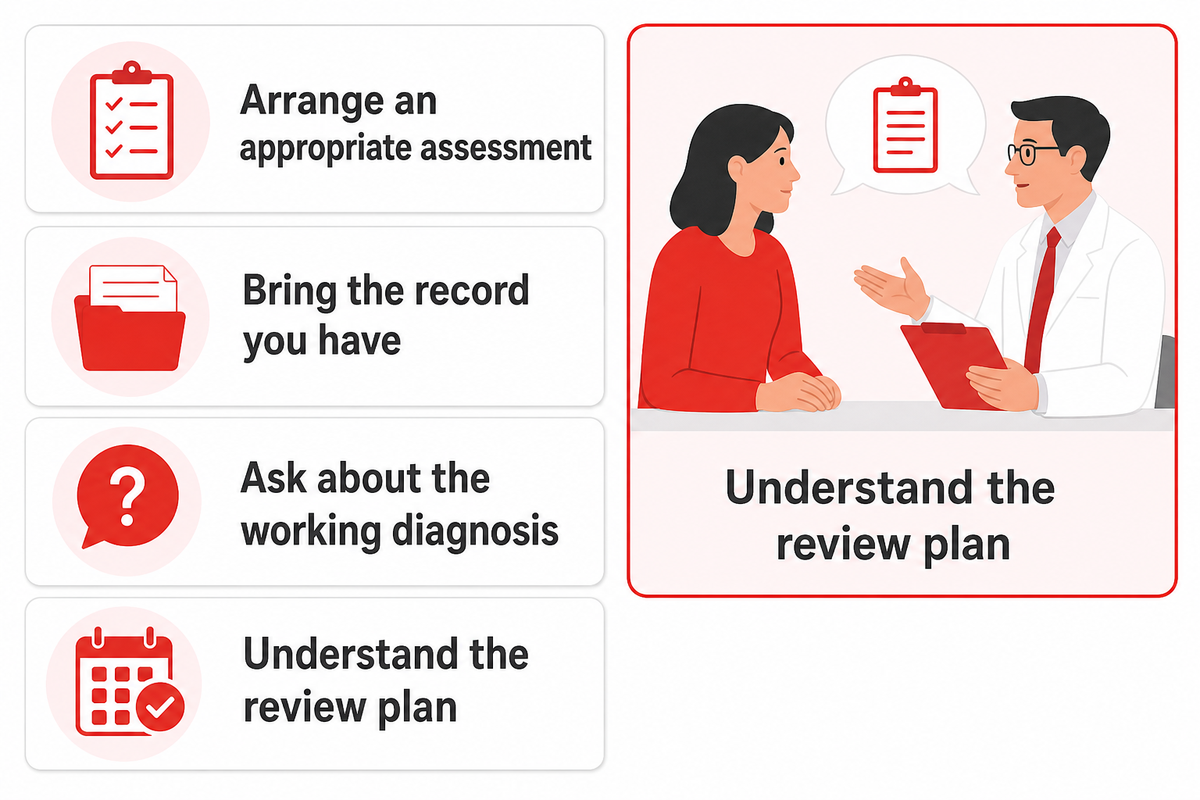
For repeat headaches without emergency features, an appropriate assessment should be arranged, and your record brought. If supportive care is being considered, seek to understand the working diagnosis and review plan, as well as other considerations, before committing to treatment.
Discuss a non-urgent appointment
Use the enquiry form for appointment questions. It isn’t an emergency service.
This provides basic information about Adult Health with sample records. Examples are fictitious. Clinical judgment is required for diagnosis and treatment. Read about Tong Ren Tang and services.
References & Sources
- Tension-type headache, ICHD-3, International Headache Society.
- Frequent episodic tension-type headache, ICHD-3, International Headache Society.
- Chronic tension-type headache, ICHD-3, International Headache Society.
- Tension headache: Symptoms and causes, Mayo Clinic, May 2026.
- Tension headaches, NHS.
- Headaches in over 12s: diagnosis and management, recommendations, NICE CG150.
- Handling emergencies, Official Portal of the UAE Government.
- Urgent Maternal Warning Signs and Symptoms, CDC HEAR HER.
- Tension Headaches, Migraine, and More, NIH News in Health, September 2025.
- Management of Chronic Tension-Type Headache With Tricyclic Antidepressant Medication, Stress Management Therapy, and Their Combination, Holroyd and colleagues, JAMA, 2001.
- Acupuncture for tension-type headache: a systematic review and meta-analysis of randomized controlled trials, Kang and colleagues, Frontiers in Neurology, 2023.
- The efficacy of acupuncture for tension-type headache: a systematic review and meta-analysis of randomized controlled trials, Lin, Su and Shih, Journal of Oral & Facial Pain and Headache, 2025.
- Acupuncture: Effectiveness and Safety, National Center for Complementary and Integrative Health.