Get in Touch with Tongren Tang Gulf

Updated October 2026
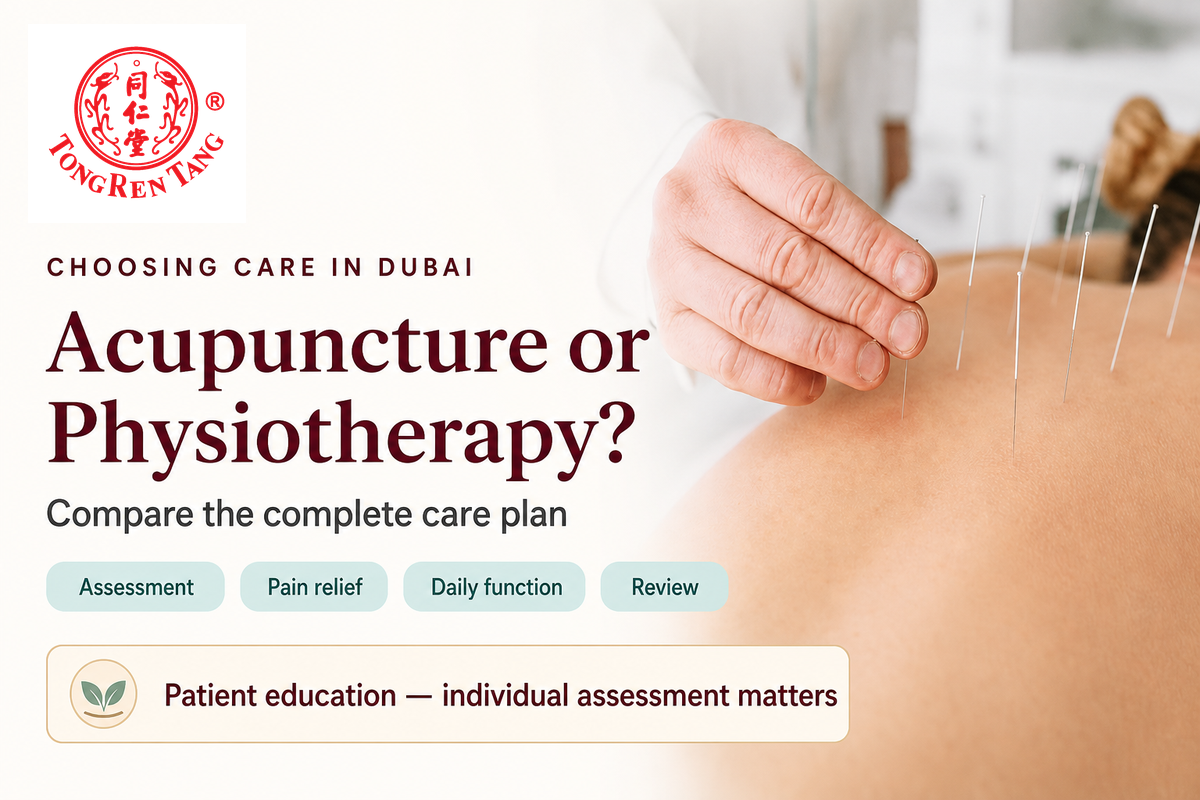
Choosing acupuncture or physiotherapy depends on the problem being assessed and the activity being restored. Acupuncture may help some pain conditions. Physiotherapy can help with pain and assess and address movement and function and rehabilitation. Neither option provides an indication whether a treatment plan suits your case, and a needling session isn’t the same as a complete physiotherapy program.
For the person who needs to sit through work or walk comfortably, a better question is, what will this appointment assess? What will improve? How will it be reviewed? The focus is to improve mobility and comfort. Acupuncture consultations are offered at Tong Ren Tang. This resource compares broader health care choices in Dubai. It offers education and not an individual treatment prescription or diagnosis.
Get urgent symptoms assessed first. Back pain with new loss of bladder or bowel control, loss of feeling around the genitals or anus, or pain, weakness or numbness in both legs needs emergency assessment. Do not wait for a routine treatment appointment. The NHS back-pain guidance explains these warning signs.
Acupuncture vs physiotherapy at a glance
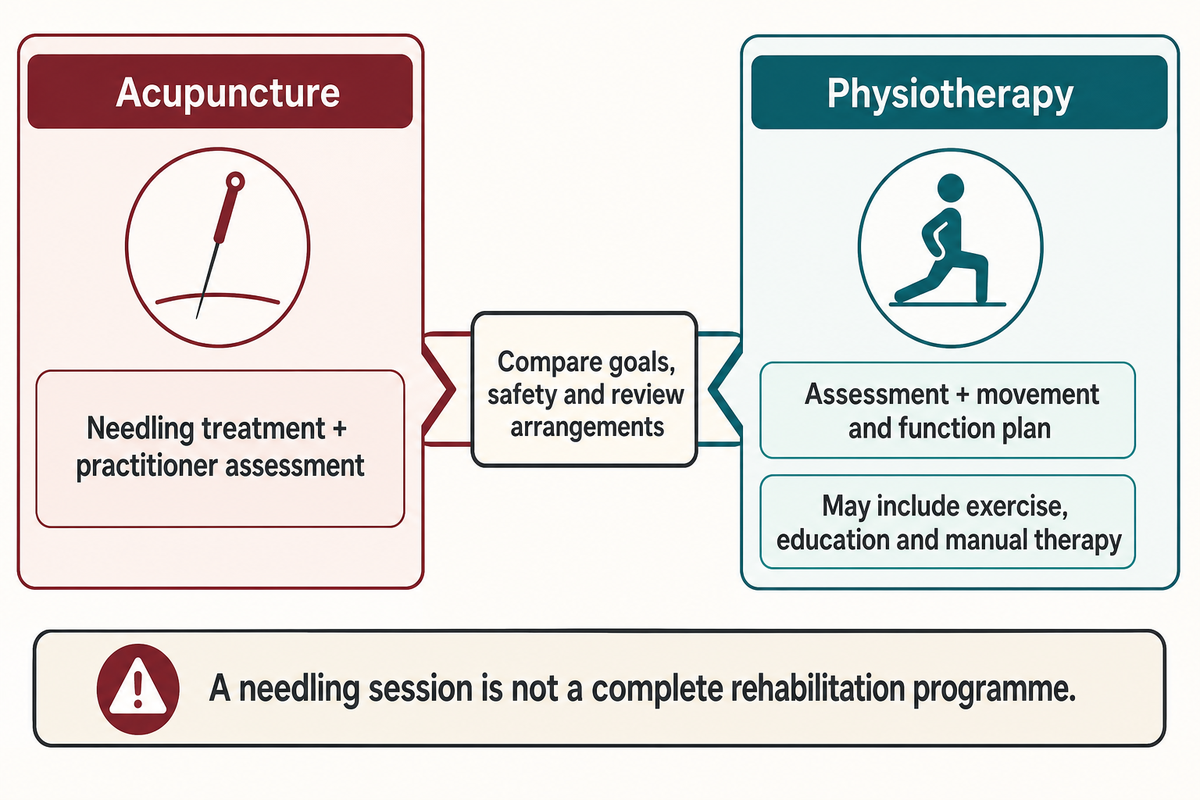
Acupuncture and physiotherapy overlap in some instances, but describe different things. Needling is a component of Acupuncture. Physiotherapy is a healthcare profession that assesses movement and function. Compare the complete proposed plan (assessment and follow-up) to understand what it includes; the conditions treated, clinician and goals may differ between providers.
| What to compare | Acupuncture consultation | Physiotherapy programme |
|---|---|---|
| Scope | A needling treatment, with the practitioner’s assessment. | Assessment and a plan for movement, function and relevant symptoms. |
| Treatment options | Needling methods vary; clarify the proposed approach. | May include exercise, education, manual therapy and other techniques. |
| Main goal | Ask which symptom or limitation the treatment targets. | Agree on relevant activities and rehabilitation goals. |
| Your participation | Report sensations, symptoms and any adverse effects. | Discuss what exercises and activity changes are feasible between visits. |
| Evidence | Depends on the condition, method and comparison used in research. | Depends on the condition and the actual intervention, not the profession’s name alone. |
| Needling | Central to acupuncture treatment. | May be one technique for an appropriately trained and authorised practitioner. |
| Progress | Review symptoms and meaningful daily activities. | Review symptoms, physical function and the agreed goals. |
| Safety | Discuss needle-related risks and your medical history. | Discuss suitability, exercise tolerance and symptoms that require reassessment. |
| Booking | Clarify what the consultation and treatment include. | Clarify assessment, supervised work, home guidance and review arrangements. |
Scope summaries: NHS physiotherapy guidance and NCCIH acupuncture evidence and safety. The questions are an editorial comparison aid, not a clinical selection rule. Using acupuncture alongside rehabilitation calls for an agreed purpose; combining names doesn’t make an effective treatment plan.
Is acupuncture part of physiotherapy?
Acupuncture in physiotherapy may be part of a wider programme but on its own, isn’t a complete programme. Dry needling, as part of the Dubai Health Authority’s physiotherapist scope, is allowed only if the practitioner is competent and has the granted privileges. Allowing dry needling in the physiotherapist scope doesn’t make it identical to traditional Chinese acupuncture or mean that every physiotherapist is allowed to perform it.
Ask the practitioner what technique they’re offering and why, especially if discussion of trigger points leaves you unsure whether the provider is offering a needling technique or a wider programme within physiotherapy. The DHA scope document, sections 7.3.1 and 7.9.5, explains the local boundaries. Our separate article on acupuncture and dry needling covers the rest.
What can acupuncture realistically do for pain?
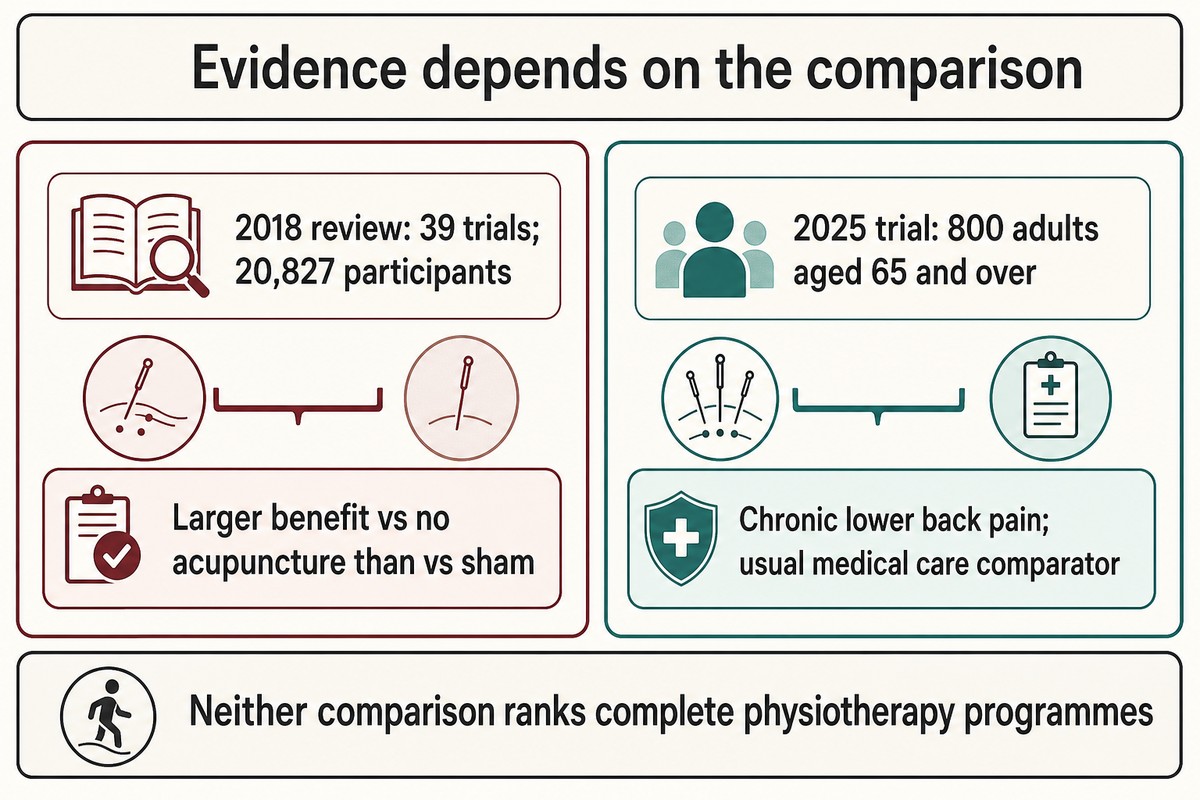
For people with some chronic pain conditions, acupuncture may reduce pain, but the size of the benefit depends on the condition and the comparator. Evidence against no acupuncture isn’t the same as evidence against sham needling. Neither, by itself, suggests acupuncture is better than a complete physiotherapy programme for the condition in question.
A 2018 individual-patient-data meta-analysis integrated 39 trials with 20,827 participants who had chronic pain. The benefits against no-acupuncture controls were greater than against sham controls. The results support a qualified discussion of pain relief, not an absolute promise that the patient will respond and/or that one session will restore normal function.
Newer research has added a specific population. The 2025 BackInAction trial included 800 adults aged 65 years and over with chronic lower back pain. Adding acupuncture to usual medical care showed some improvement in disability compared to usual care alone. It didn’t include a direct comparison of acupuncture to a complete physio program. The participants’ age, the condition, and the treatment setting are to be considered when interpreting the results.
How does acupuncture work?
Acupuncture uses fine needles to stimulate specific points, but the mechanisms by which it alleviates pain are not fully understood. Researchers examine how acupuncture stimulates responses in the nervous system and how those responses may relieve pain. Traditional Chinese medicine describes acupuncture treatment through concepts such as qi and meridians. Those concepts should be differentiated from known anatomy and from clinical evidence that a treatment improves an outcome.
Research into endorphin release, blood flow or whether acupuncture can reduce inflammation doesn’t prove that it repairs an injury, and a proposed mechanism of pain reduction can’t prove that a patient will recover strength or return to work sooner. The NCCIH separates possible mechanisms of action from effects that have been documented. A convincing explanation isn’t a prediction of your outcome. Discussing key acupuncture points with a practitioner can clarify the hypothesized approach, but the location of the needle doesn’t establish effectiveness of acupuncture for your diagnosis.
A useful consultation question: “What evidence applies to my case, and what would constitute adequate benefit to reconsider the plan?” The BackInAction 800 person study evaluated chronic back pain in older adults, and the results of this study can’t be generalized to a recent sports injury, to a different diagnosis, to a different age group, etc.
How physiotherapy addresses movement and function
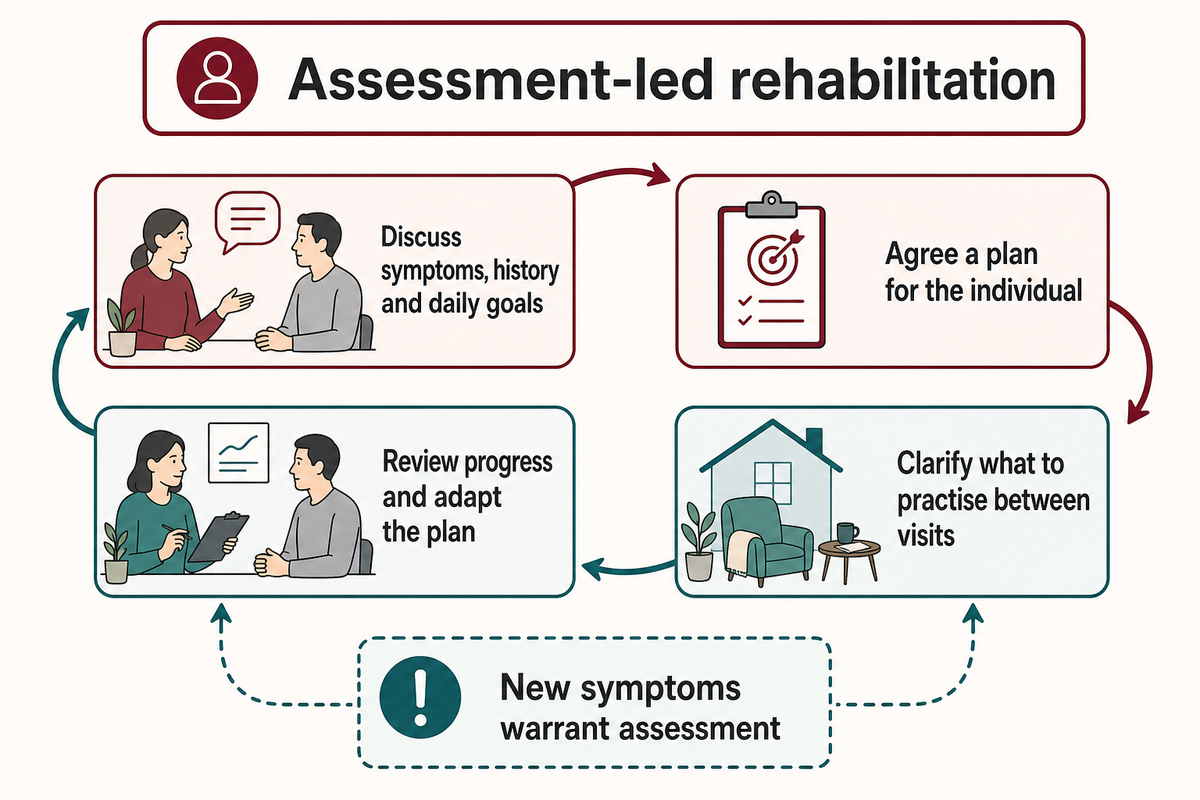
Physiotherapy uses assessment to connect the symptoms to the activity limitations and to the personal goals. Depending on the case, treatment may include exercises, education or hands-on therapy; joint range of motion, strength and activity tolerance can be discussed as goals without assuming that every patient needs the same measurements or exercises. Understanding the proposed rehabilitation work is more important for the patient than names of different treatments.
What should a detailed physiotherapy assessment cover?
A physiotherapy assessment should review your symptoms and medical history, examine your daily activities and goals, and include an appropriate physical exam. The clinician should then be able to provide examples of findings and how they impact the treatment plan. Ask the clinician to explain what you should be practicing between appointments, and how the program can be adapted to your specific situation. Also ask how long it will be before progress is reviewed.
The NHS description of physiotherapy includes advice, exercise and manual therapy. Services include different conditions, musculoskeletal conditions, and sports injuries. However, the treatment of musculoskeletal conditions still requires an assessment of the individual rather than selection from a list of therapy techniques.
For chronic nonspecific low back pain, a 2021 Cochrane review of 249 trials and 24,486 participants, found that exercise probably improves pain compared with no treatment, usual care or placebo. Average disability improvement didn’t reach the review’s prespecified threshold for clinical importance. Exercise programmes are of benefit. This evidence shouldn’t be generalized to other physiotherapy services.
Let’s say the treatment has allowed the patient to sit more comfortably, but he is still unable to make the walk to work. Differences like those belong in the review discussion. Chronic pain doesn’t always mean chronic damage, as South Tees’ pain management guidance outlines. New symptoms warrant assessment. The activity plan must adapt to the individual, and shouldn’t demand a person push through every pain signal. Feeling Muscle pain, or muscle tension or muscle tightness is something to describe rather than something to diagnose and settle before the assessment.
Safety: when to get medical advice first
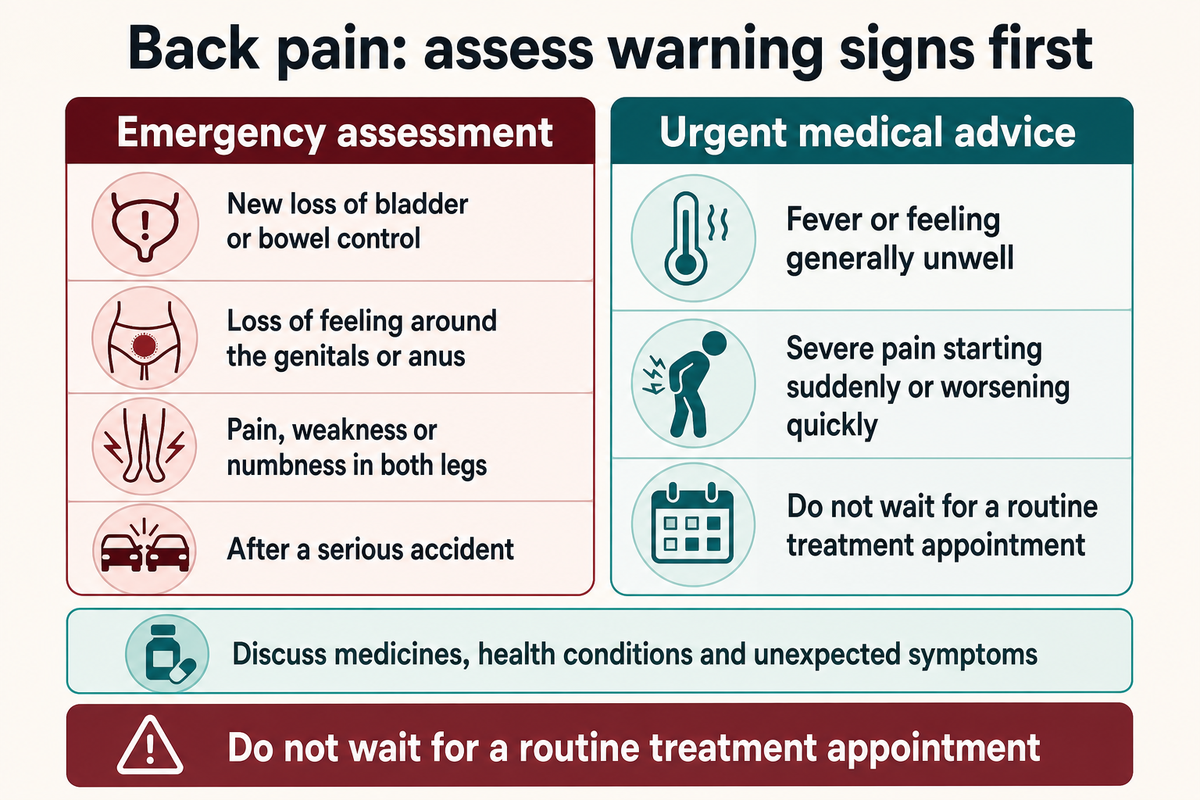
Safety is related to the pattern of your symptoms, your medical history and the treatment proposed. Both acupuncture and physiotherapy shouldn’t delay assessment of new and troubling symptoms. It’s important to discuss your medicines and pertinent health conditions prior to Needling. Before exercise or manual treatment, explain to the therapist what makes your symptoms worse and ask what to do if the planned activity aggravates them.
Alongside the emergency symptoms noted above, back pain with a fever or feeling generally unwell, or severe pain that starts suddenly or worsens quickly, requires urgent medical advice. Back pain after a serious accident also needs emergency care. These urgency distinctions are explained in the NHS back pain guidance; they shouldn’t be reduced to “try a different therapist”.
Needling may cause soreness, minor bleeding, bruising or dizziness. Rare serious complications are also possible, including organ injury and infection. NCCIH safety guidance stresses the importance of proper technique and the use of sterile, single-use acupuncture needles.
Anticoagulants or bleeding problems, pregnancy, immune suppression and any implanted electrical devices should be discussed with the practitioner, particularly if electrical stimulation is proposed. These are safety considerations for the appropriate acupuncture approach and not an indication that the person can’t receive any acupuncture, or that a clinic can determine suitability from a booking form. For more details on acupuncture and associated side effects, refer to Guy’s and St Thomas’ acupuncture information.
The use of acupuncture should have a clear purpose and a tolerable plan. Worsening pain doesn’t prove the treatment is working. Unanticipated symptoms warrant reassessment. More information regarding anticipated and unanticipated side effects of acupuncture and questions to discuss at appointments can be found in our guide to acupuncture side effects.
Combining acupuncture and physiotherapy: track two outcomes
Acupuncture as an adjunct to physiotherapy requires a clear purpose and a coordinated plan. In chronic pain management, this should be related to the personal goals set for physical wellbeing. Additional appointments don’t automatically increase benefit. Studies vary based on the diagnosis, treatment and follow-up period. Symptoms and daily functioning should be discussed with the treating clinician.
As mentioned in the 2007 BMJ knee-osteoarthritis trial, adding a specific acupuncture regimen to the usual advice and exercise didn’t show any benefit on the primary outcome for pain at 6 months. This is for a specific program and not a generalization to all possible programs.
A Small 2024 Knee Osteoarthritis Trial reported short-term benefits from the combination of acupuncture and exercise rehabilitation. The trial has an inconsistent percentage calculation. Participants weren’t blinded. Follow-up after treatment was only 8 weeks. The study provides a rationale to evaluate potential benefit, but doesn’t demonstrate reliable superiority or synergistic effect in general.
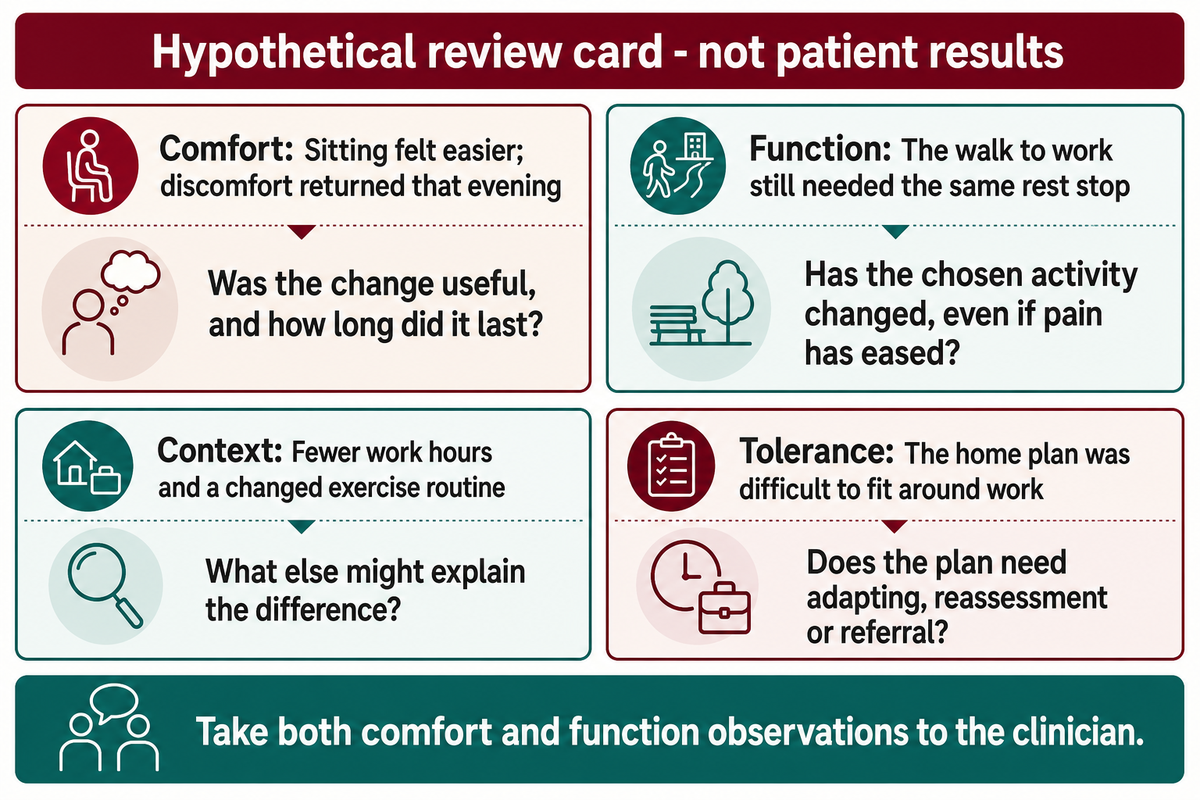
The 2-Track Pain-and-Function Review Card
Use this record to prepare for your review, not for self diagnosis. Decide on an activity, with your clinician, and be consistent in describing your symptoms. Note other changes that might also affect the activity or your symptoms. A caregiver can make practical observations. The clinician interprets the observations and other data in light of assessment findings. No score on this record determines the activity or treatment you receive. For chronic pain problems, discuss the management of pain to appreciate the burden of extra appointments with the potential benefit you may experience.
| Record | Hypothetical entry | Question for review |
|---|---|---|
| Symptoms | “Sitting felt easier after the visit; discomfort returned that evening.” | Was the change useful, and how long did it last? |
| Daily function | “The walk to work still needed the same rest stop.” | Has the chosen activity changed, even if pain has eased? |
| Other changes | “I worked fewer hours and changed my usual exercise routine.” | What else might explain the difference? |
| Tolerance and next step | “The home plan was difficult to fit around work.” | Does the plan need adapting, reassessment or referral? |
Source basis: NHS physiotherapy guidance and the condition-specific studies above. They aren’t patient cases.
“most patients with acute or subacute low back pain improve over time regardless of treatment”
physio and acupuncture before-and-after records can’t distinguish treatment effects from natural recovery. Therefore, to avoid making an error in attributing improvement to either treatment or natural recovery, the history and the actual treatments received should be reviewed. Over 2 tracks, improvement in comfort and function may occur together or separately. Take both observations to your appointment; don’t use an encouraging diary entry to stop rehabilitation or buy an additional course.
Choosing care in Dubai: clinician, costs and insurance
Choose a provider based on the assessment and service you need, then verify the practitioner’s status and proposed costs. Advertising by a clinic doesn’t establish a clinician’s licence or every treatment privilege. Ask about acupuncture and physiotherapy separately, including who provides the service and how referrals and shared care would be done.
The Dubai Medical Registry has some licence categories and “Registered Only” entries. Familiarize yourself with professional and facility details relevant to your appointment. The DHA physiotherapist scope also requires practitioners to work only within granted privileges and competence.
The advertisement of acupuncture consultations in Dubai by Tong Ren Tang doesn’t indicate that the clinic provides physiotherapy. You should ask about the service and the practitioner that you’re planning to see, particularly for a rehabilitation assessment.
What belongs in a like-for-like treatment quote?
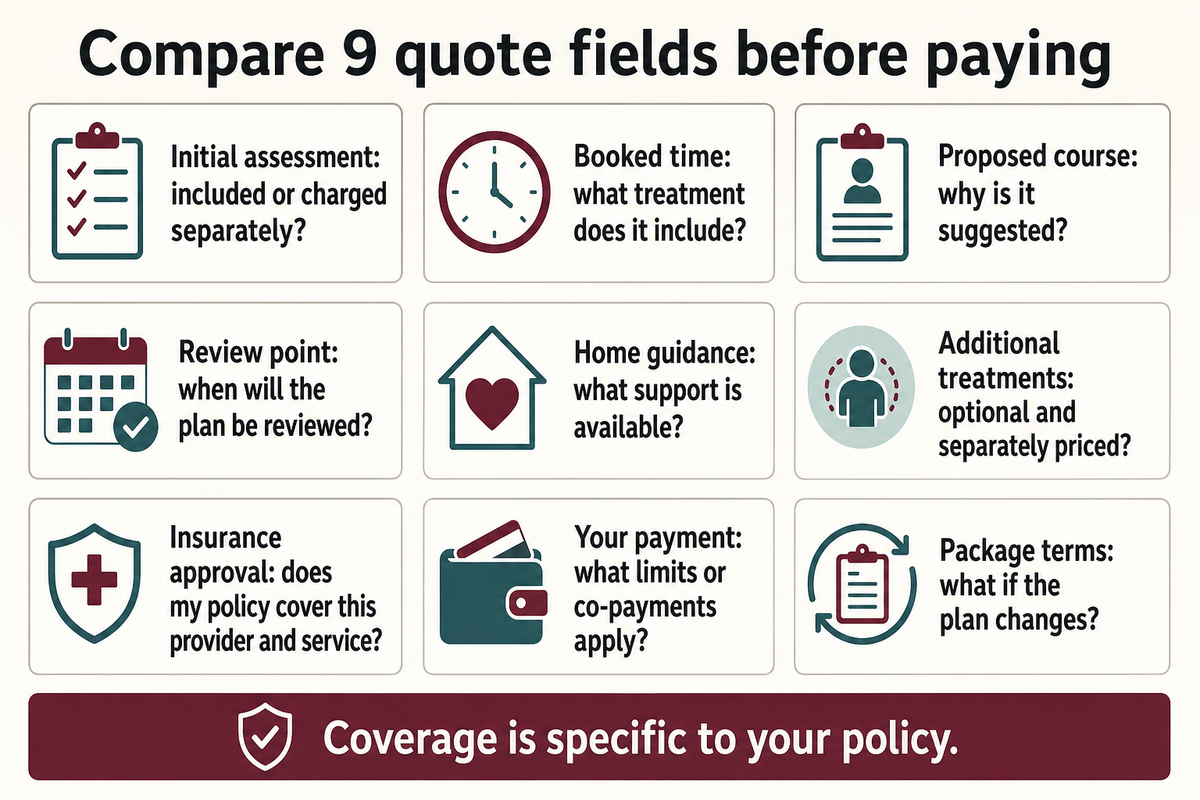
Treatment quotes should include the assessment, appointment time, proposed review and additional costs. Insurance questions should be placed with these, as the clinic’s price and your payment may differ. Compare the same information from each provider, and ask for unresolved items in writing before making a payment.
| Quote field | Ask both providers | Resolve before paying |
|---|---|---|
| Initial assessment | Is assessment included or charged separately? | Get the first-visit total. |
| Booked time | How much treatment time is booked, and what does it include? | Distinguish consultation, treatment and supervised work. |
| Proposed course | Why is this course suggested? | Clarify the rationale rather than assuming more visits are better than a single treatment followed by review. |
| Review point | When will the plan be reviewed? | Agree how benefit and tolerance will be discussed. |
| Home guidance | What help is available between visits? | Check whether follow-up support costs extra. |
| Additional treatments | Are add-ons optional and separately priced? | Separate each service on the quote. |
| Insurance approval | Does my policy cover this service and provider? | Confirm referrals and prior approval with the insurer. |
| Your payment | What limits, co-payments or reimbursement rules apply? | Ask for your expected payment, not just the headline fee. |
| Package terms | What happens if the plan changes? | Read cancellation and unused-visit terms. |
Dubai’s health-insurance law, article 16, identifies policy benefits, financial limits, and provider networks. This doesn’t establish coverage for either treatment under your particular insurance policy. Self-paying patients and family members arranging treatment can use the same quote fields to request information without assuming that the package offered is good value.
For the specific questions related to booking, see acupuncture costs in Dubai and insurance questions before acupuncture. Confirm the information directly.
What pain guidelines mean for your next appointment
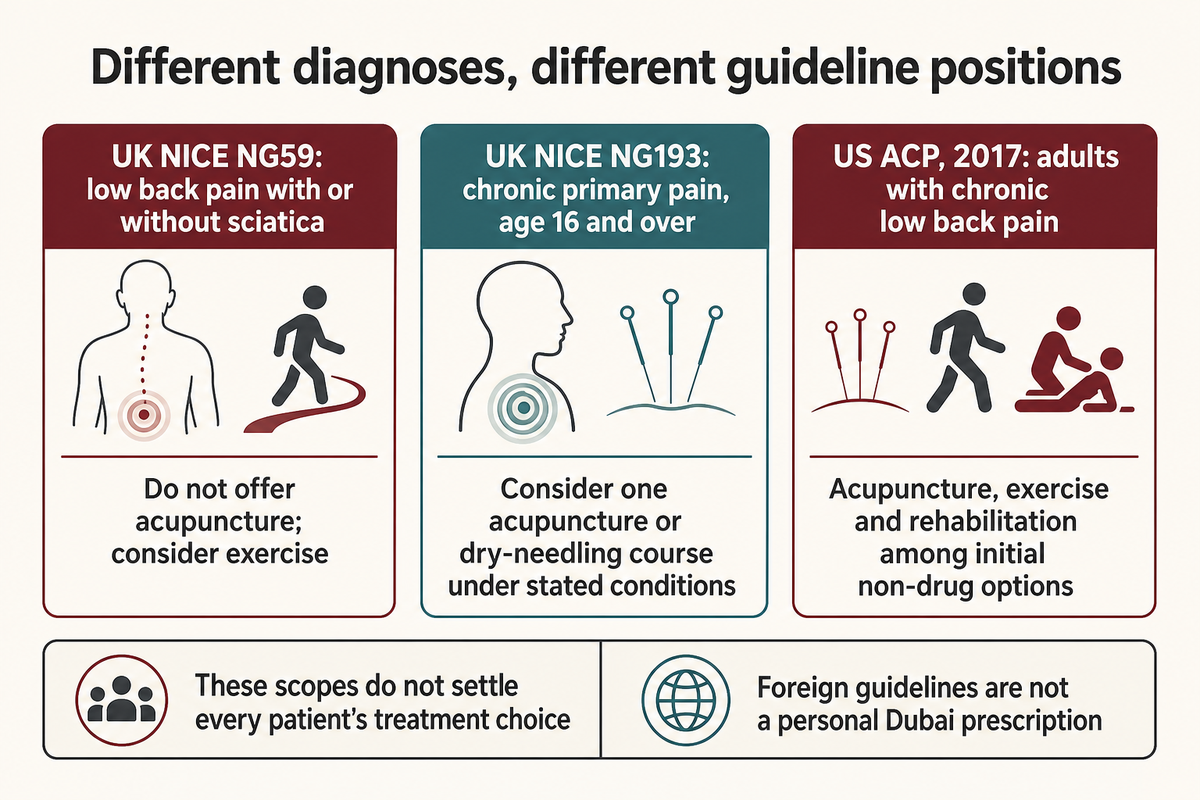
Guideline recommendations do not give one universal answer to questions about acupuncture or physiotherapy. Also, recommendations for physiotherapy and acupuncture depend on the care each provider proposes. Recommendations are context specific and vary based on the condition being treated, the population and the organization that published the guideline. Chronic primary pain isn’t interchangeable with every cause of back pain. Even when similar conditions are being treated, the recommendations and the guidelines may be different. It’s important to understand what evidence the health care provider considers relevant in your case and why.
| Guideline | Scope | Relevant position and boundary |
|---|---|---|
| UK NICE NG59 | Low back pain with or without sciatica. | Do not offer acupuncture. Consider exercise; manual therapy is considered only within a package including exercise. |
| UK NICE NG193 | Chronic primary pain, age 16 and over. | Consider one acupuncture or dry-needling course under stated training, setting and resource conditions. |
| US ACP, 2017 | Adults with chronic low back pain. | Lists acupuncture, exercise and multidisciplinary rehabilitation among initial non-drug options. This is an explicitly dated guideline, not a direct comparison. |
Sources: NG59 sections 1.2.2, 1.2.7, and 1.2.8; NG193 section 1.2.5; ACP 2017 recommendation 2.
NG193 places a limit on 5 hours of health-care professional time within one delivery route, and allows an alternative provider or setting at equivalent or lower cost. It isn’t a personal treatment duration or a Dubai prescription. NICE’s July 2026 NG59 update didn’t alter its recommendation for acupuncture.
State the task for which you need assistance, outline your symptom history and provide relevant medical documentation. A clinician can discuss your suitability for treatment options and recommend reassessment, including whether an assessment of the cause has identified a condition requiring a different pathway, before a pain-management appointment is booked. The 3 guidelines illustrate why a single recommendation, taken outside its scope, can’t settle every patient’s treatment choice.
Frequently asked questions
Is acupuncture better than physiotherapy?
Neither acupuncture nor physiotherapy is universally better; the relevant comparison depends on the condition and the actual care proposed.
Acupuncture alone and an assessment-led rehabilitation programme may address different needs. Ask what outcome matters most to you and what evidence applies to that diagnosis. Research comparing acupuncture with sham or usual care does not automatically compare it with complete physiotherapy. If several clinicians are involved, clarify their roles and how they will review your symptoms and daily function. Avoid choosing solely on a promise of faster pain relief.
Is acupressure better than physiotherapy?
Acupressure uses pressure rather than needles, and evidence about acupuncture cannot establish that acupressure is better than physiotherapy.
Physiotherapy can include assessment, exercise, education and other interventions selected for the person. Those services cannot be ranked against a single technique without identifying the condition and the proposed treatment. If movement, weakness or an injury is affecting daily activities, ask a qualified clinician what assessment and rehabilitation are appropriate. A preference for a needle-free approach is worth discussing, but it does not determine the evidence for that approach.
When is acupuncture not recommended?
Acupuncture may be inappropriate for a particular condition or need modification because of individual risks; concerning symptoms require medical assessment first.
For example, NICE NG59 advises against acupuncture for low back pain with or without sciatica, while other guidelines take different positions within their own scope. Tell the practitioner about medicines, bleeding problems, pregnancy, immune suppression and implanted devices. These details call for an individual discussion rather than a blanket assumption that every form of needling is forbidden. Acupuncture should not delay diagnosis or urgent treatment, and neither advertising nor a past positive experience establishes that it is suitable for a new problem.
Does acupuncture hurt?
Acupuncture may cause a brief prick, aching or other sensations, and experiences vary.
Tell the practitioner about sharp or persistent pain, dizziness or unexpected symptoms. Ask about likely sensations before consenting; enduring severe discomfort is not a treatment goal.
Are acupuncture and physiotherapy covered by insurance?
Coverage must be checked separately for each service under your own policy.
Confirm the practitioner, clinic network, referrals, prior approval, visit limits and your payment with the insurer. A clinic accepting insurance does not establish your individual benefits or guarantee reimbursement for every treatment it offers.
Prior to your first TCM consultation, make a note of the things you want help with and the questions you need answers to. To talk about Tong Ren Tang’s advertised acupuncture service, make an appointment. If you need physiotherapy, confirm the appropriate provider and rehabilitation assessment separately.
References & Sources
- NHS: Physiotherapy.
- NCCIH: Acupuncture effectiveness and safety.
- Vickers et al., 2018: Acupuncture for chronic pain, updated individual-patient-data meta-analysis.
- DeBar et al., 2025: BackInAction randomized clinical trial.
- Cochrane, 2021: Exercise treatment for chronic low back pain
- NHS: Back pain and warning signs.
- Guy’s and St Thomas’: Acupuncture patient information.
- South Tees Hospitals: Physiotherapy for pain management.
- Nadine Foster et al., 2007: Acupuncture as an adjunct to exercise-based physiotherapy for knee osteoarthritis.
- Liu et al., 2024: Acupuncture, exercise rehabilitation and their combination for knee osteoarthritis.
- Qaseem et al., 2017: ACP guideline for noninvasive low-back-pain treatments.
- DHA, 2023: Scope of Practice for Physiotherapist.
- DHA: Dubai Medical Registry.
- Dubai Law No. 11 of 2013, concerning health insurance.
- NICE NG59: Low back pain and sciatica recommendations; update information.
- NICE NG193: Chronic pain recommendations.
![Postpartum TCM Care: Safety Questions for Dubai [Guide]](https://tongrentang.ae/wp-content/uploads/2026/09/postpartum-tcm-care-blog-featured-768x512.png)