Get in Touch with Tongren Tang Gulf

Acupuncture vs dry needling is not a simple “which one is better” question. Both use thin solid needles, both may be discussed for pain relief, and both require qualified clinical judgment. Start with a safer question: what is causing the pain, what outcome matters, and which authorized provider pathway fits your condition and risk profile?
Medical note: This guide is educational. This guide does not diagnose pain, replace medical assessment, or promise that either treatment will work. Seek medical care first for new, worsening, unexplained, traumatic, fever-related, pregnancy-related, neurological, chest, breathing, cancer-related, infection-related, or inflammatory symptoms.
Quick Answer: How They Differ
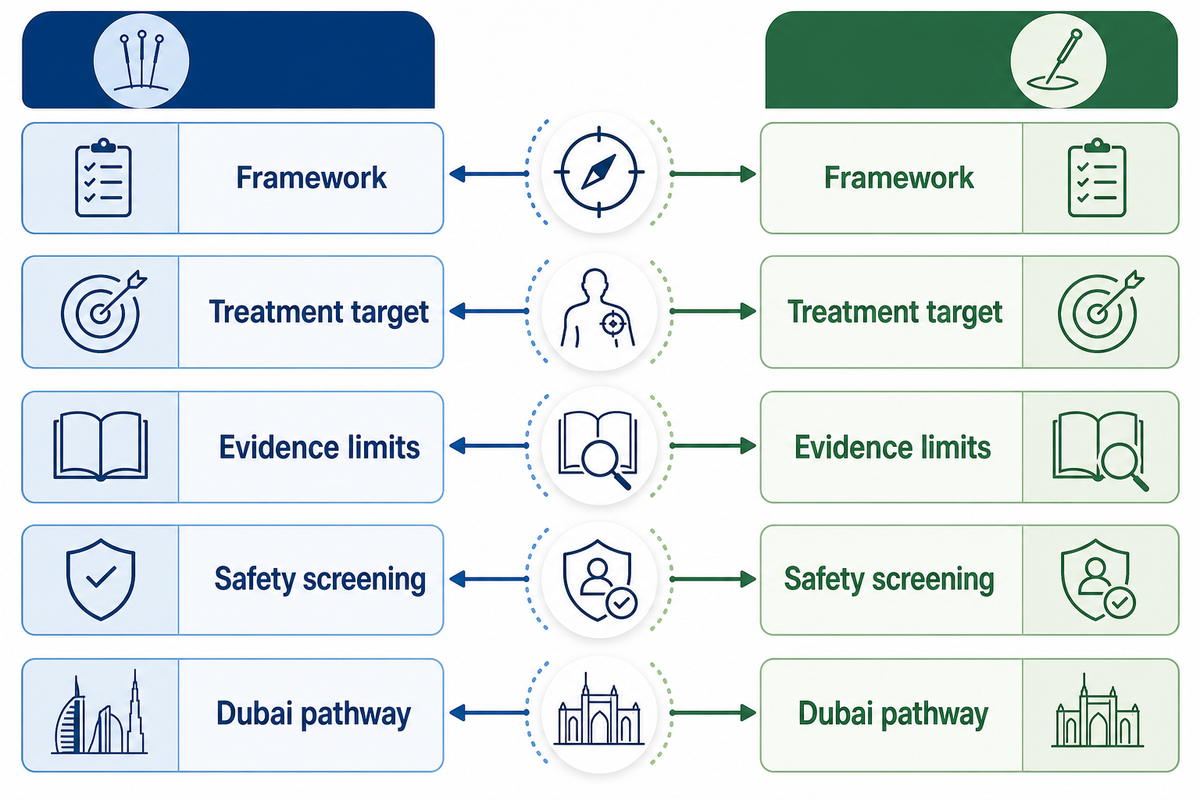
Acupuncture is usually explained through Traditional Chinese Medicine and related medical acupuncture frameworks, with points chosen according to a broader pattern assessment. Dry needling is usually explained through musculoskeletal assessment, trigger points, muscle pain, and movement impairment. That difference matters, but it does not make the evidence base cleanly split into two perfect categories.
| Question | Acupuncture | Dry Needling | What to Ask Before Booking |
|---|---|---|---|
| Main framework | Traditional Chinese Medicine or medical acupuncture point selection. | Musculoskeletal and trigger-point style assessment. | Ask how the provider explains your pain pattern and treatment target. |
| Common goal | Pain relief, function, whole-pattern regulation, or symptom support. | Trigger-point pain, muscle tightness, soreness, and movement limits. | Define the target: pain score, function, range of motion, sleep, medication use, or durability. |
| Evidence shape | Condition-specific pain evidence, with sham-control and nonspecific-effect limits. | Short-term musculoskeletal pain signals, with protocol and adverse-event reporting limits. | Ask whether evidence applies to your diagnosis, body region, and expected follow-up period. |
| Dubai pathway | TCIM, TCAM, or acupuncture-practitioner pathway, plus facility authorization. | Usually discussed through physiotherapy or allied-health pathway materials when dry needling is named. | Verify current license, facility link, privilege or procedure permission, competence, consent, and regulator. |
Main takeaway: neither label alone tells you what will work for your pain. Useful comparison needs diagnosis, outcome, protocol, provider pathway, body region, and safety screening.
What Acupuncture Means in a Pain-Relief Decision
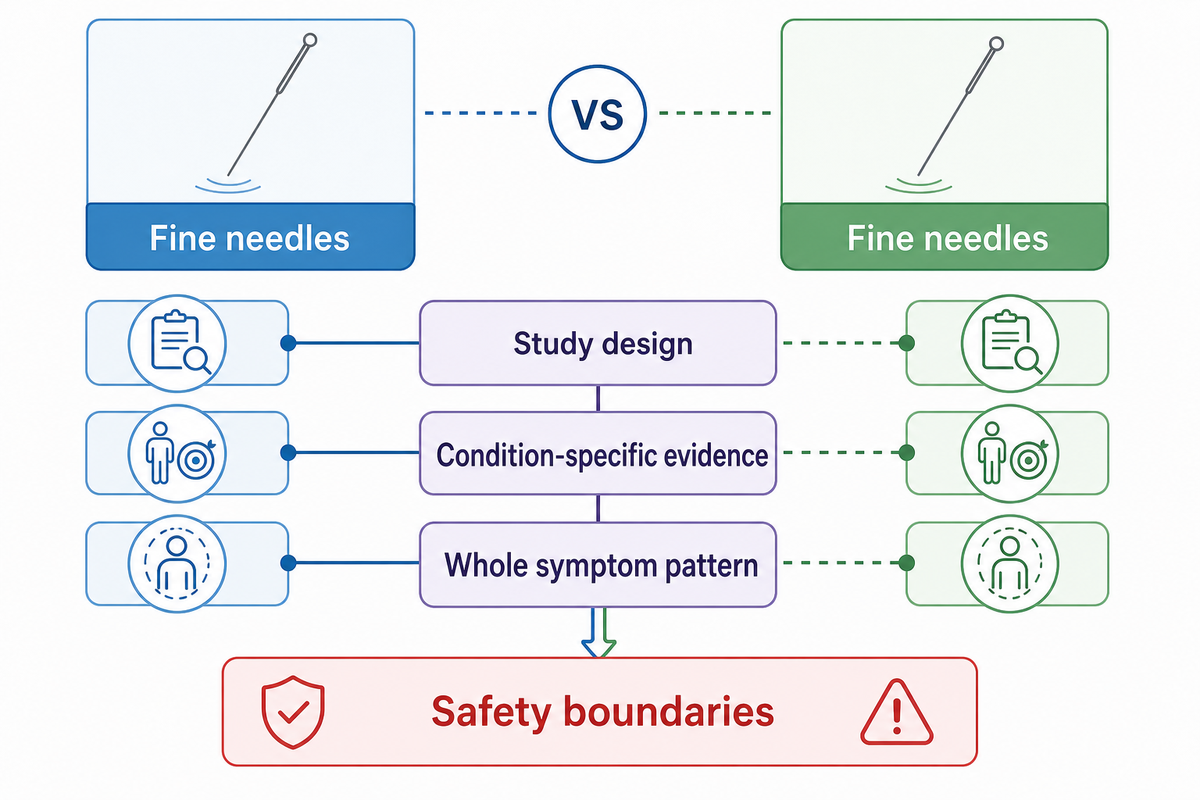
The U.S. National Center for Complementary and Integrative Health describes acupuncture as insertion of fine needles into the skin, with possible manual or electrical stimulation. NCCIH also says acupuncture research for pain varies by condition, comparator, and study design. That matters because “acupuncture helps pain” is too broad to guide one patient’s next step.
In some studied pain conditions, acupuncture has evidence of benefit compared with no acupuncture or sham procedures. One individual-patient-data meta-analysis across chronic pain trials found acupuncture better than sham and no-acupuncture controls in studied contexts. That is a real acupuncture signal, but not proof that acupuncture is superior to dry needling, safer than dry needling, or suitable for every type of pain.
In a Traditional Chinese Medicine setting, the consultation may also assess sleep, stress, digestion, menstrual history, general health, and the pattern of symptoms rather than only a painful point. That broader assessment can be useful when a reader wants care that considers the whole symptom pattern. Ordinary medical safety boundaries still apply: do not delay evaluation for serious or changing symptoms, and do not treat a needle appointment as a diagnosis.
What Dry Needling Means in a Pain-Relief Decision
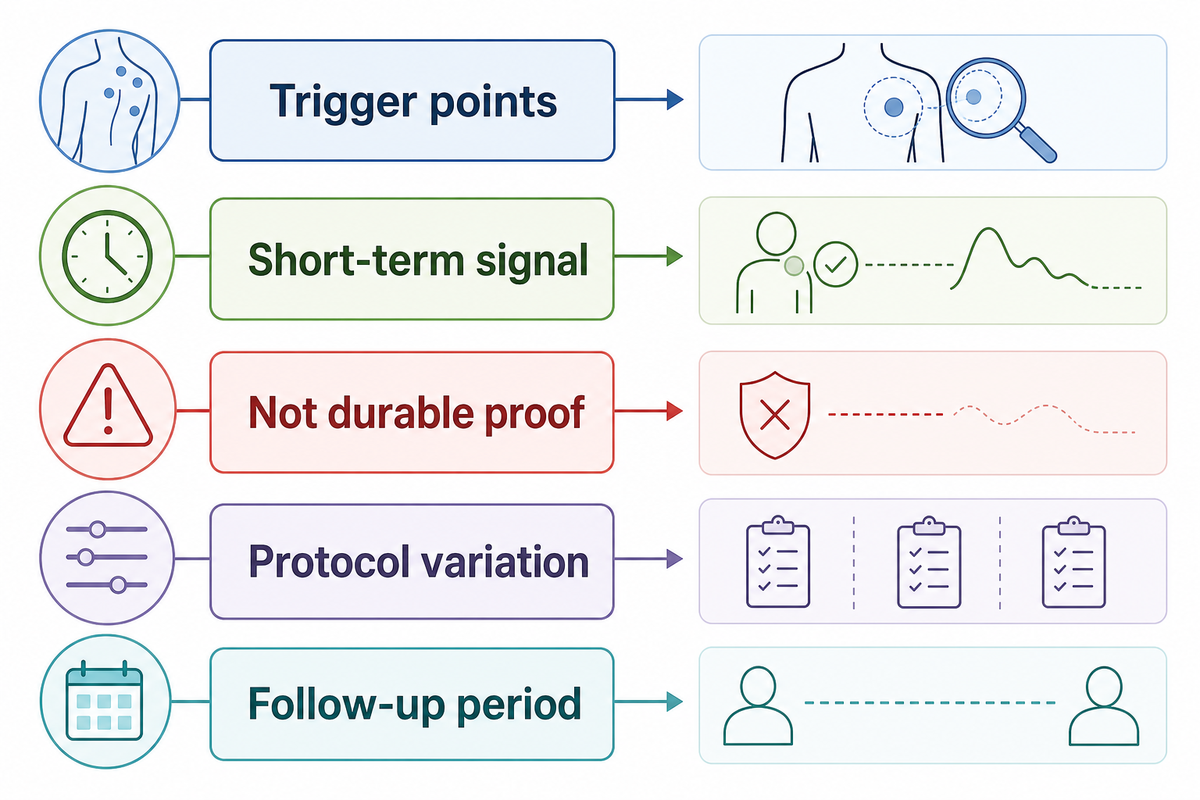
Dry needling is commonly framed around myofascial trigger points, muscle pain, soreness, and movement problems. Providers may insert a thin needle into a tight or painful muscle area to provoke a local response or reduce sensitivity. Clinics often link it to physiotherapy or musculoskeletal care, though exact scope depends on jurisdiction and facility rules.
One dry-needling umbrella review reported short-term pain-reduction signals for musculoskeletal pain, but it also described low-to-moderate evidence and heterogeneity. That means a dry-needling discussion should be condition-specific and time-specific. Short-term pain signal is not the same as durable function change, long-term relief, or a general advantage over acupuncture.
Dry needling also is not one standardized protocol. Trials and clinics can differ by target tissue, depth, stimulation, retention time, dose, session count, co-interventions, and adverse-event reporting. If a provider says “dry needling is good for this,” the follow-up question is: which diagnosis, which protocol, which body region, which outcome, and what follow-up period?
Evidence Map: Where the Comparison Gets Tricky
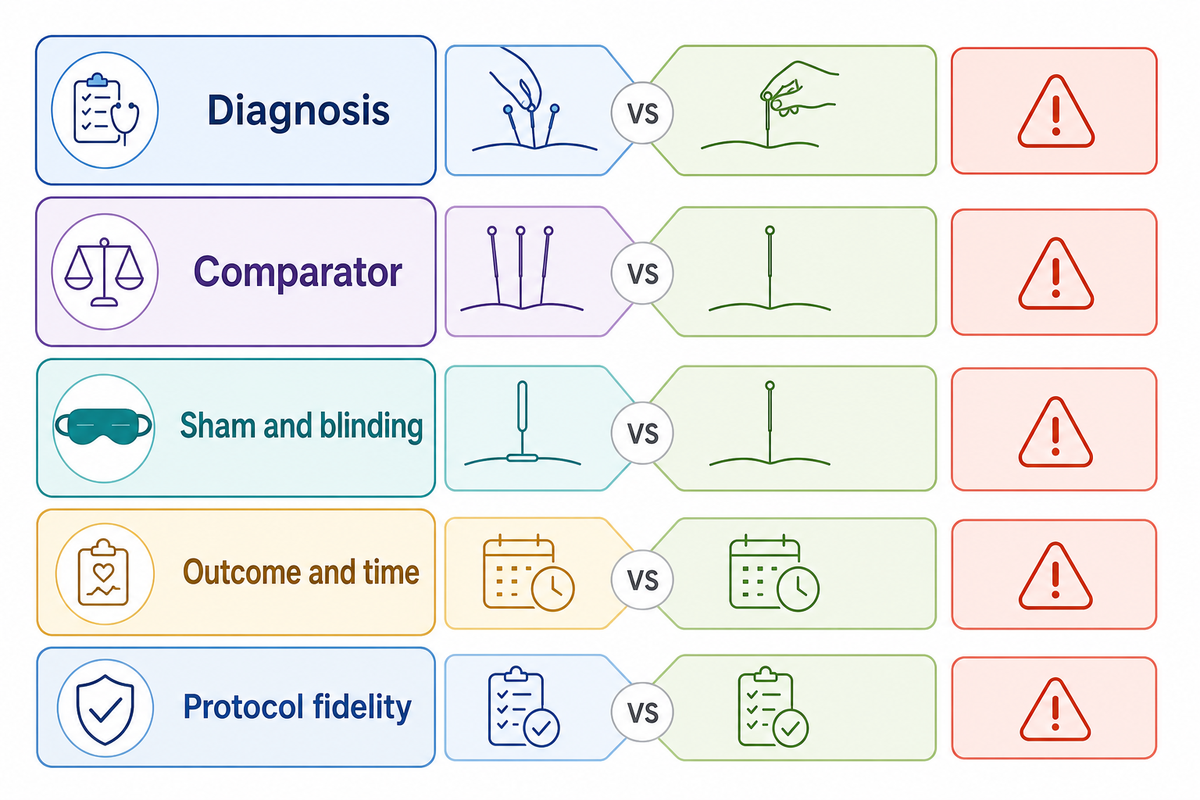
One common mistake is to compare two names instead of comparing actual evidence rows. Pain-relief evidence maps should include diagnosis, protocol, comparator, blinding, outcome, time horizon, and certainty. Without those fields, a comparison table may look tidy while hiding the real uncertainty.
| Evidence Field | Why It Changes the Answer | Practical Reading Rule |
|---|---|---|
| Diagnosis | Back pain, neck pain, masticatory muscle pain, TMD, shoulder pain, and sciatica are not one condition. | Do not transfer a result from one condition to another without a clinician’s reason. |
| Comparator | No treatment, usual care, sham acupuncture, sham dry needling, active placebo, and active therapy answer different questions. | Larger effect versus no treatment does not equal a strong needling-specific effect. |
| Sham and blinding | Sham acupuncture may not be inert. Dry-needling sham evidence has separate dated limits, including lack of a widely accepted sham protocol in a 2019 review and no therapist blinding in included trials. | Treat blinding limits as modality-specific, not as equal or interchangeable caveats. |
| Outcome and time | Immediate pain, follow-up pain, disability, function, mouth opening, quality of life, and medication use can move differently. | Ask whether the result lasted and whether it changed function, not only pain score. |
| Protocol fidelity | Needle site, depth, manipulation, dose, session count, and co-interventions can matter more than the label. | Ask the provider to describe the planned protocol and why it fits your case. |
Dry-needling sham research needs careful wording. In 2019, a blinding review searched trials from inception through February 2016 and reported heterogeneous sham strategies, no widely accepted dry-needling sham protocol in that evidence base, and no attempted therapist blinding in the included trials. In 2025, an illustrative review identified sham dry-needling or acupuncture device forms with blinding-effectiveness validation, while also noting lack of clear selection guidance and lack of standardization. One small sham dry-needle validation study tested participant belief about skin penetration and pain response in 42 healthy asymptomatic subjects at one gluteal site; that is not proof of physiological inertness, therapist blinding, allocation concealment, or validity across body sites, patients, experience levels, and clinicians.
Acupuncture evidence also has sham and placebo limits. Sham acupuncture can create nonspecific effects and may not be physiologically inert. A fair conclusion is not “both evidence problems are equal.” A fair conclusion is: evidence-map rows must state exactly what was compared, how blinding was tested, and what the comparator can and cannot prove.
Safety: Shared Risks Do Not Mean Equal Risks
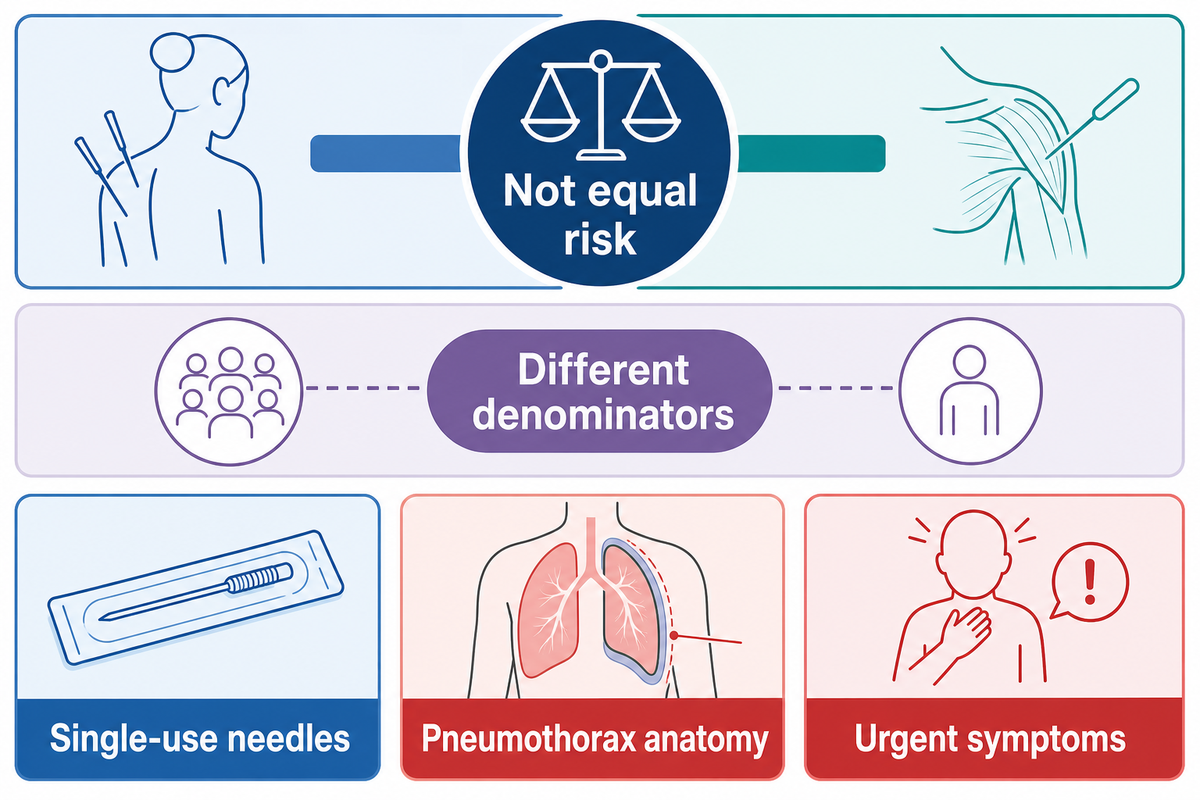
Both acupuncture and dry needling can involve bleeding, bruising, soreness, infection risk, and rare serious injury if performed improperly or in a high-risk anatomical area. But writing “both have pneumothorax risk” must not become “both have equal pneumothorax risk.” Safety evidence for the two fields uses different sources, denominators, event definitions, severity grading, surveillance methods, and reporting completeness.
The Needle Safety Pause List
- Tell the provider about blood thinners, antithrombotic medicine, bleeding disorders, easy bruising, immune compromise, diabetes, skin infection, poor skin condition, pregnancy, implants, pacemakers, epilepsy, recent surgery, and severe needle reactions.
- Ask about sterile single-use needles, skin preparation, infection-control process, adverse-event plan, and informed consent.
- When needling neck, shoulder, chest, thoracic, trapezius, upper-back, or periscapular areas, ask how the provider manages anatomy-related pneumothorax risk.
- Seek urgent medical assessment after needling if chest pain, shortness of breath, breathing difficulty, faintness, fever, neurological symptoms, or severe worsening pain develops, including delayed symptoms later the same day or the next day.
Dry-needling safety reviews may report minor and major adverse events using separate per-treatment and clinician-career survey units. Separately, a scoping review found inconsistent dry-needling dose and adverse-event documentation in randomized trials. Acupuncture safety summaries may use per-patient treatment-series or per-treatment estimates and still report substantial heterogeneity. Those denominators cannot be merged into a clean “safer” or “riskier” ranking.
Pneumothorax needs body-region language. Dry-needling case reports and safety literature highlight concern after neck, shoulder, trapezius, chest, thoracic, and upper-back region needling. Acupuncture can also involve pneumothorax risk when needling occurs near the thorax or lung field. Shared anatomy hazard means consent and urgent-symptom advice should be visible for both. Shared anatomy does not mean the same incidence, the same severity distribution, or the same reporting quality.
Which Pain Conditions Have the Clearest Signals?
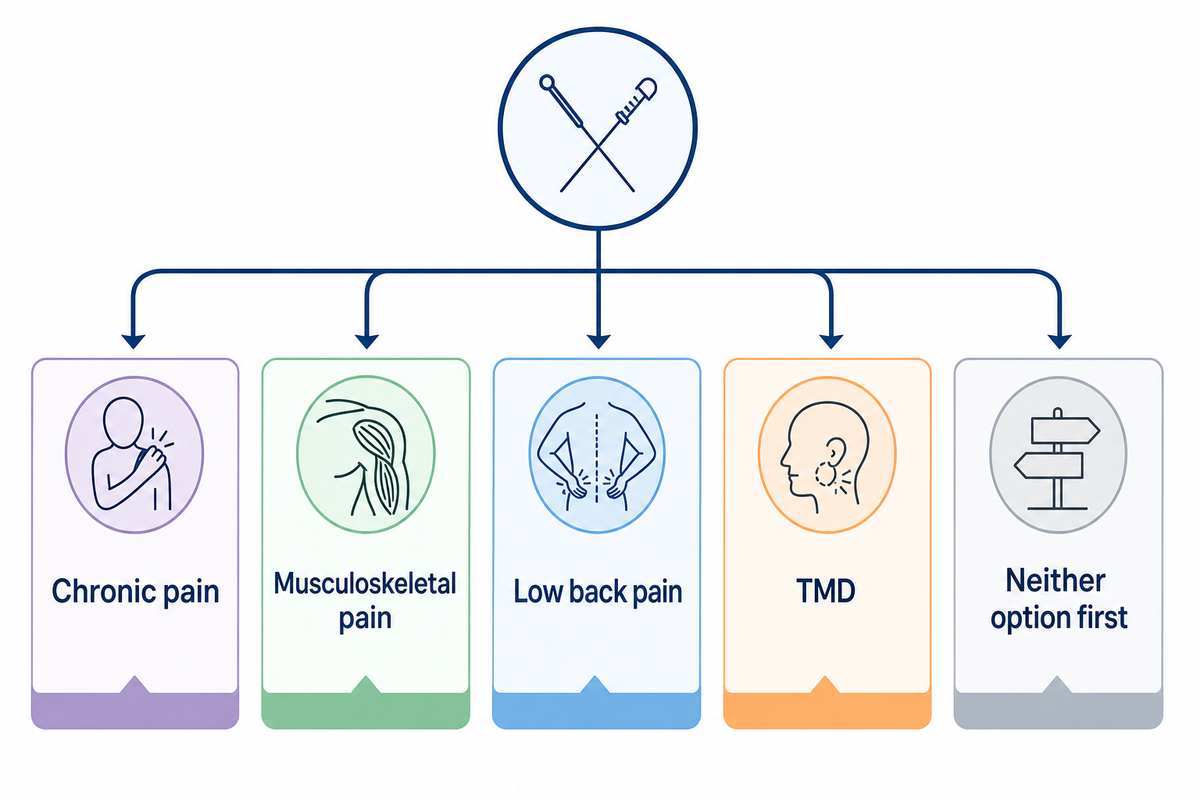
Patient-facing writing cannot rank acupuncture and dry needling as stable classes. Instead, it can show where evidence is more or less direct.
| Pain Context | What the Evidence Suggests | What It Does Not Prove |
|---|---|---|
| General chronic pain studied in acupuncture trials | Acupuncture has condition-limited evidence versus sham and no-acupuncture controls in studied chronic pain settings. | No proof of superiority over dry needling or suitability for undiagnosed pain. |
| Musculoskeletal pain and trigger-point style complaints | Dry needling has short-term pain signals in some musculoskeletal evidence, with protocol heterogeneity. | No proof of durable benefit or a general advantage over acupuncture. |
| Low back pain | One low-back review reported dry needling better immediately after treatment, but follow-up results were similar and many risk-of-bias judgments were high or unclear. | No lasting dry-needling advantage or diagnosis-general ranking is established. |
| TMD and masticatory muscle pain | Evidence is source-sensitive. One masticatory-muscle-pain network meta-analysis found no pain-intensity or pressure-pain-threshold advantage for acupuncture or dry needling over active or inactive placebo, with only very-low-quality mouth-opening evidence favoring dry needling. | No simple “choose acupuncture” or “choose dry needling” rule follows for jaw pain. |
| Chronic TMD pain care | A chronic TMD guideline gives strong support to several non-needling or broader-care options, while acupuncture is conditional. | No default dry-needling workaround or always-first acupuncture rule follows. |
Many readers may need neither needling option first. Next care may be diagnostic assessment, exercise-based care, manual therapy, behavioral support, medical treatment, imaging or referral when appropriate, or a combined plan. Needling can sit inside broader care; it should not erase the broader care question.
Dubai and UAE Licensing: The Checks Are Layered
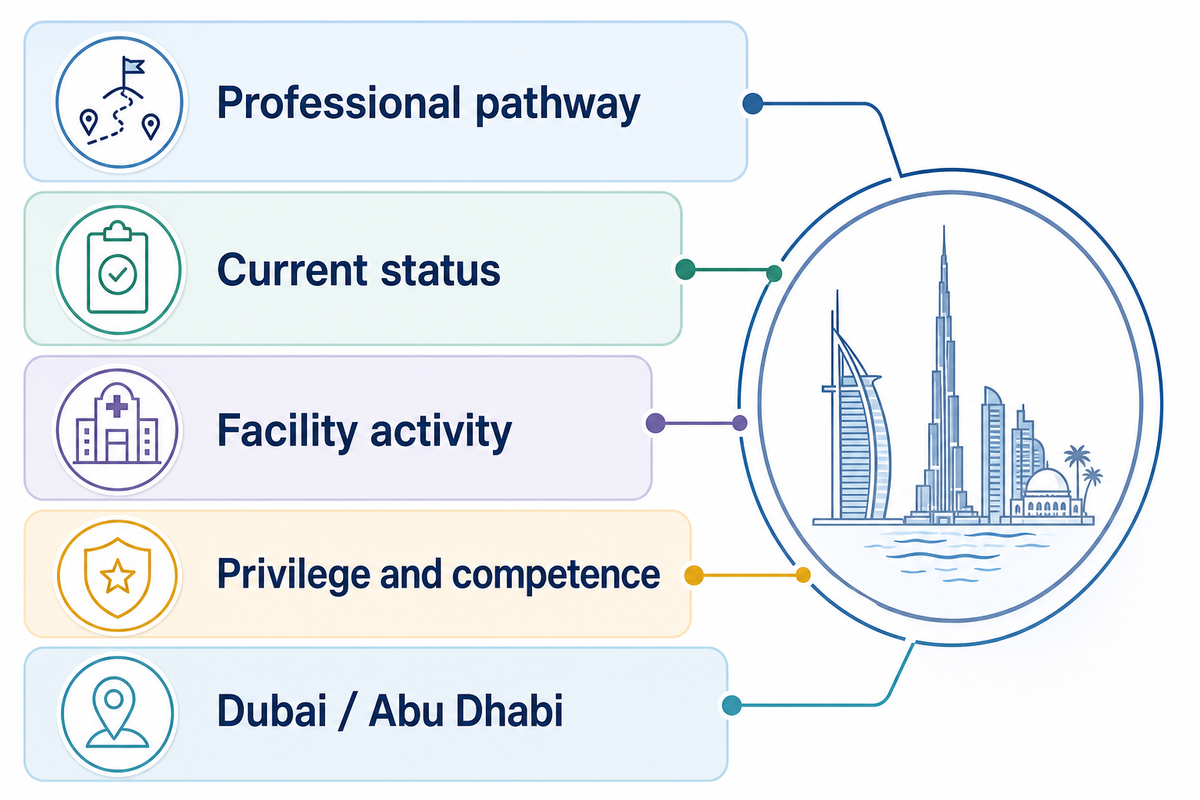
Dubai licensing is not one checkbox. Licensing is a layered authorization state: professional pathway, current registration or licence status, facility link, licensed and authorized facility activity, clinical privilege or procedure permission, competence, infection-control infrastructure, and consent.
| Layer | Acupuncture Pathway | Dry-Needling Pathway | Jurisdiction Note |
|---|---|---|---|
| Professional category | TCIM, TCAM, or acupuncture-practitioner route where applicable. | Usually physiotherapy or allied-health route when DHA materials name dry needling. | Do not treat research-category overlap as a legal taxonomy. |
| Current professional status | Verify active professional status, not only past training. | Verify the physiotherapy or allied-health status that applies to the provider. | Registration and active licence are not the same thing. |
| Facility and activity | The provider must be linked to an authorized facility and activity. | Relevant facility rules must allow the treatment activity and procedure. | DHA oversight covers Dubai facilities and professionals, including free zones. |
| Privilege and competence | Ask whether the procedure is within current facility privilege or permission. | Ask about dry-needling competence, body-region training, and privilege. | Privileges at one facility do not prove privilege at another. |
| Dubai vs Abu Dhabi | Dubai evidence should not be generalized to every emirate. | Abu Dhabi DoH and other regulators may use different scope materials. | Check the regulator for the emirate and facility where care will occur. |
Dubai Health Authority’s Sheryan page describes the health-regulation sector as overseeing healthcare facilities and professionals in Dubai, including free zones, with functions that include licensing, supervision, inspection, and complaints. In Dubai Healthcare City, the current DHCC professional license services page says healthcare professional licensing in the free zone is managed by DHA. That does not erase DHCA’s institutional role over DHCC establishments, permits, audit, inspection, and supervision under Dubai Law No. 16 of 2024. Correct patient wording is layered, not “DHA only” and not “DHCC separately licenses the professional.”
The 5-Point Pain Relief Decision Grid
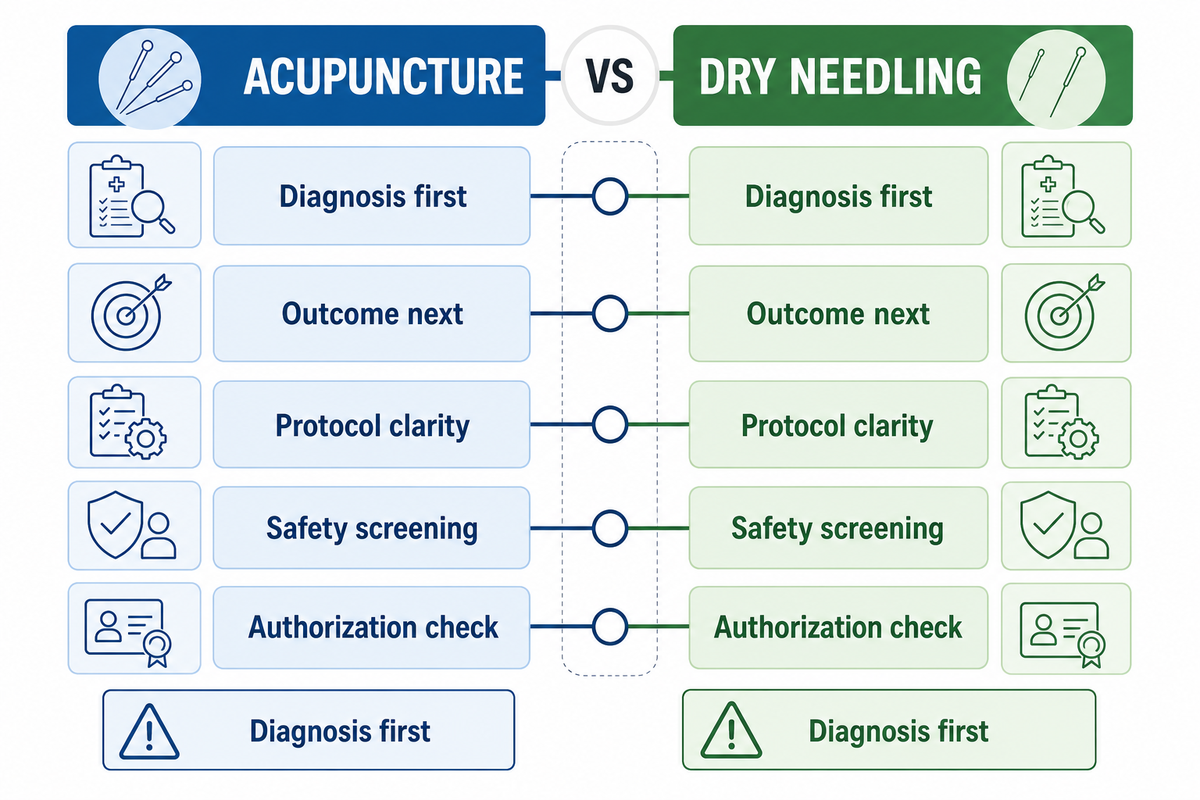
Use this grid before booking either treatment. This grid does not predict response; use it to ask better questions.
- Diagnosis first: What is the likely pain generator, and what conditions must be ruled out before needling?
- Outcome next: Are you trying to reduce pain intensity, improve function, improve range of motion, sleep better, lower medication use, or test short-term symptom relief?
- Protocol clarity: What points or muscles will be targeted, how deep may the needles go, how many sessions are planned, and what changes the plan if symptoms worsen?
- Safety screening: What medicine, anatomy, pregnancy, infection, skin, immune, implant, or medical-history factors change the plan?
- Authorization check: Which professional pathway, facility licence, facility-linked authorization, procedure privilege, competence record, and consent process applies where you are receiving care?
If the answers are vague, pause. With acupuncture, ask how the practitioner links the point selection and treatment plan to your symptoms and safety screen. With dry needling, ask how the provider links the muscle or trigger-point target to your diagnosis, function goal, and body-region risk. In both cases, the provider should be comfortable explaining limits and alternatives.
When Acupuncture May Be the Better Conversation
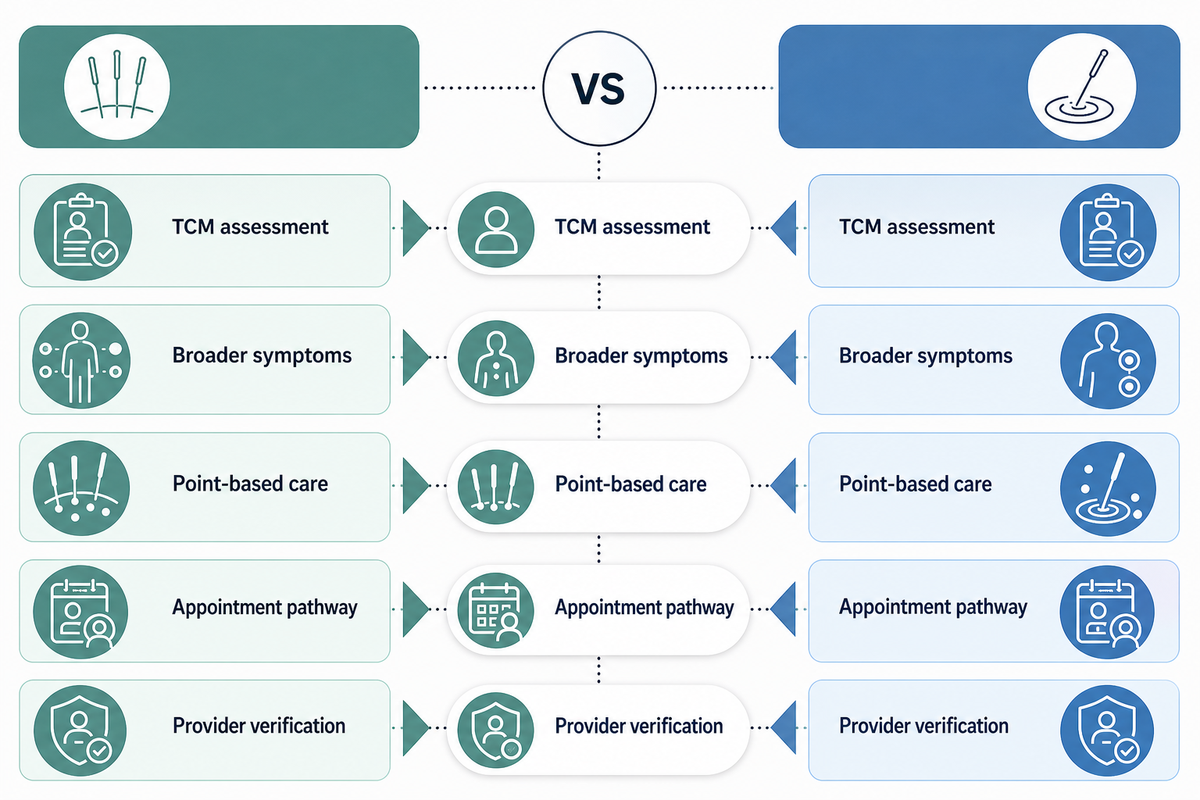
Acupuncture may be the more natural conversation when you want a Traditional Chinese Medicine assessment, when your pain is part of a broader symptom pattern, when you prefer a point-based care model, or when your local clinic has a clear acupuncture pathway and no verified dry-needling service. Acupuncture can also be reasonable when the condition under discussion has acupuncture evidence and your clinician believes the risk profile is suitable.
This still does not mean “choose acupuncture” from the article alone. Rather, acupuncture is worth discussing with a qualified practitioner when the diagnosis, safety screen, and expected outcome fit. If you are in Dubai and specifically want to discuss Chinese medicine acupuncture, Tong Ren Tang provides an acupuncture information and booking path here: qualified acupuncture consultation in Dubai.
That internal link is an appointment pathway, not proof that acupuncture is clinically better than dry needling. If you are considering dry needling, use the same standard: verify the provider’s current professional pathway, facility authorization, procedure privilege, competence, informed consent, and body-region risk management.
When Dry Needling May Be the Better Conversation
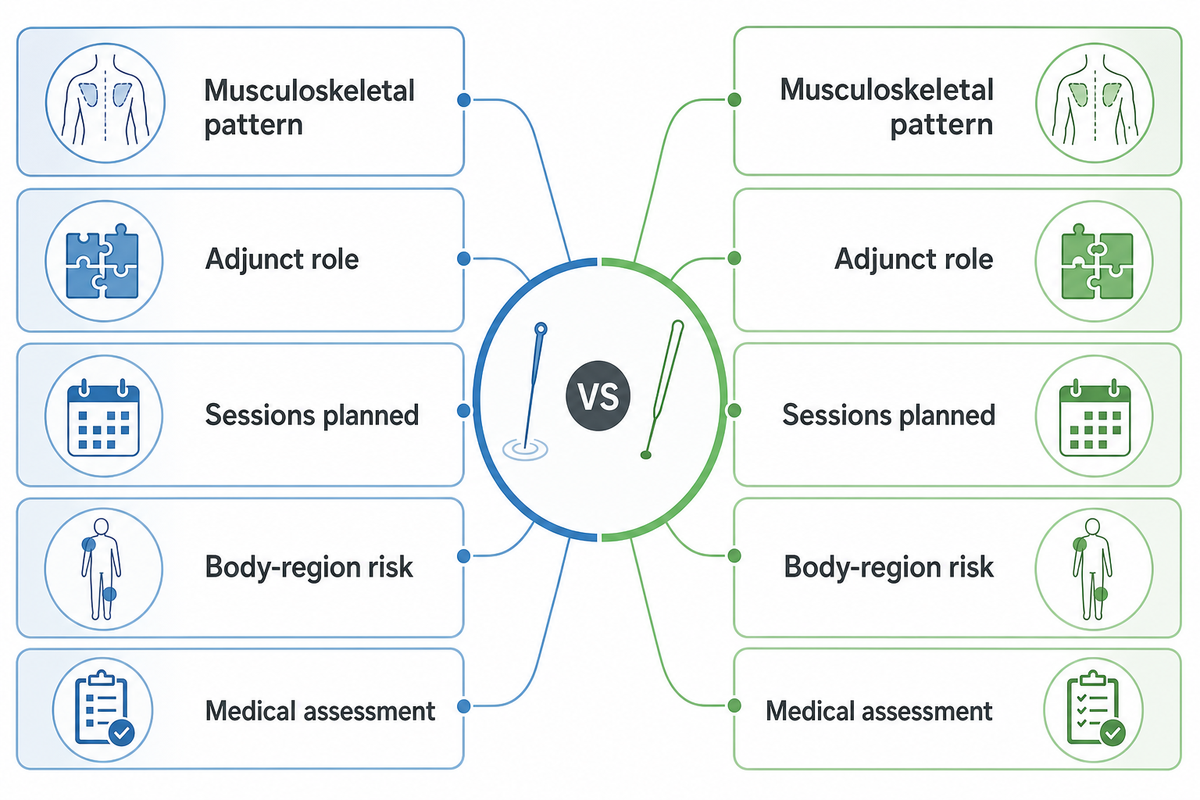
Dry needling may be the more natural conversation when the pain is clearly musculoskeletal, when a physiotherapist or qualified musculoskeletal clinician has assessed a trigger-point or muscle-related pattern, and when the goal is short-term pain change, soreness reduction, or movement improvement inside a broader rehabilitation plan.
Protocol and safety specificity matter. Ask whether dry needling is the main intervention or an adjunct to exercise, manual therapy, posture work, or load management. Ask how many sessions are planned, what adverse events are discussed, and how the provider handles neck, shoulder, chest, thoracic, or upper-back needling. Also ask what happens if the short-term response is poor.
Dry-needling care should never be used as a workaround when a reader actually needs medical assessment, non-needling care, or a specialist referral. Some pain conditions may have stronger advice outside either needle option.
Neutral Dubai Booking Path
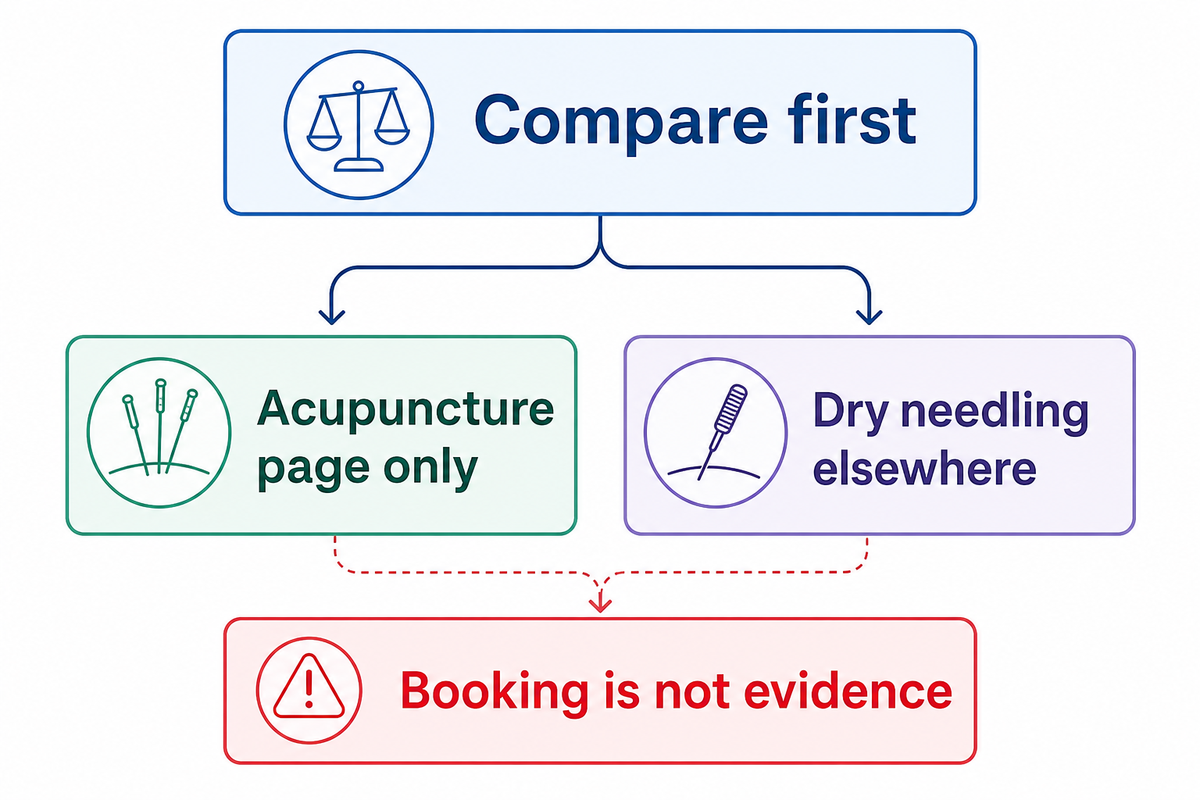
Because Tong Ren Tang’s verified service path is acupuncture, this article should not pretend to offer both bookings. Neutral handling separates the evidence comparison from the local handoff:
- Use the article to compare care models, evidence limits, safety screening, and authorization checks.
- Use Tong Ren Tang’s page only if you want to discuss acupuncture in Dubai.
- Use a separate provider-verification checklist if you are considering dry needling elsewhere.
- Do not treat the presence of a booking button as medical evidence.
Dubai reader note
If your goal is to discuss acupuncture with a DHA-linked clinic team, review the acupuncture service page and prepare your diagnosis, medication list, symptom history, and safety questions before the visit. If your goal is dry needling, verify that provider separately.
FAQs
Is dry needling just acupuncture by another name?
No. These practices can overlap because both may use solid filiform needles, both may sometimes target tender areas, and some research categories group needling methods in ways that are not tidy for patients. The clinical framework still differs. Acupuncture often sits inside Traditional Chinese Medicine or medical acupuncture reasoning, with points selected from a broader pattern assessment. Dry needling is usually framed through musculoskeletal and trigger-point reasoning. Clinically, the question is which protocol, provider pathway, body region, consent process, and safety screen fits your case.
Which is more effective for pain relief?
No reliable all-purpose winner follows from the treatment label alone. Acupuncture has condition-limited evidence for some pain settings; dry needling has short-term musculoskeletal pain signals in some reviews. Results depend on diagnosis, comparator, protocol, provider, outcome, and follow-up time.
Does dry needling go deeper than acupuncture?
Sometimes, but depth alone does not define the treatment. Dry needling may target muscle or trigger-point tissue, while acupuncture depth varies by point, body region, technique, and practitioner plan. Depth alone is not automatically better, stronger, or riskier in every setting. What matters is anatomical site, training, indication, consent, sterile technique, and whether the planned depth is appropriate for your body region. In risk-sensitive areas such as the neck, shoulder, chest, thoracic region, trapezius, or upper back, a depth discussion should include anatomy-related pneumothorax risk and delayed symptom instructions.
Is there a downside to dry needling?
Yes. Common issues can include soreness, bruising, bleeding, and temporary symptom flare. Rare serious events can occur near risk-sensitive anatomy or when screening is weak. Reporting limits in dry-needling trials also make safety interpretation harder. Ask about consent, body-region risk, sterile technique, and post-treatment warning symptoms.
Can acupuncture release muscle knots?
Acupuncture may be applied to tender or trigger-point areas in some care models, and some evidence summaries discuss myofascial pain. But “muscle knot” is a casual phrase, not a diagnosis. Better questions come before the needle: is the painful area local muscle sensitivity, nerve irritation, joint referral, inflammatory disease, stress-related guarding, postural load, sleep-related sensitization, or another cause? Has the pain changed? Is there weakness, numbness, fever, trauma, unexplained weight loss, cancer history, pregnancy-related concern, chest pain, or breathing difficulty? Qualified clinician assessment should come before a needle-based plan, especially when symptoms are new, worsening, or unclear.
Bottom Line
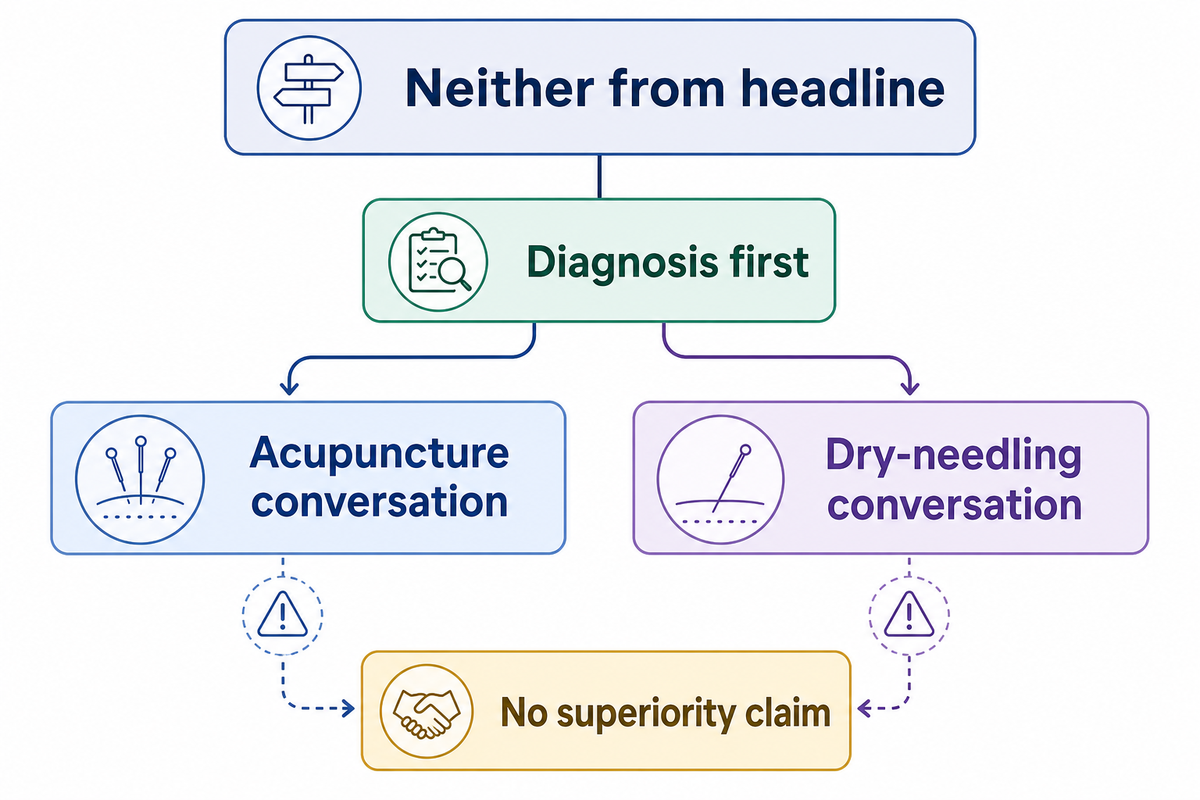
Choose neither treatment from a headline. In acupuncture vs dry needling decisions, the right next step is a diagnosis-first discussion that separates evidence, safety, and authorization. Acupuncture may be a better conversation when you want Traditional Chinese Medicine assessment or a verified acupuncture clinic pathway. Dry needling may be a better conversation when a qualified musculoskeletal provider identifies a trigger-point or muscle-related pattern inside broader care. Both require screening, consent, and current provider verification.
About This Comparison
Tong Ren Tang is a Traditional Chinese Medicine brand with a stated history dating to 1669 and local Dubai clinic context. This article uses that background only to explain the acupuncture consultation handoff. Evidence sections are not written to prove that acupuncture is better than dry needling, and they do not claim that Tong Ren Tang provides dry needling.
References & Sources
- Acupuncture: Effectiveness and Safety – National Center for Complementary and Integrative Health.
- What Is Dry Needling? – Cleveland Clinic.
- Dry Needling for Musculoskeletal Pain: Umbrella Review – PubMed Central.
- Acupuncture for Chronic Pain: Individual Patient Data Meta-analysis – PubMed Central.
- Dry Needling Protocol and Adverse-Event Reporting Review – PubMed.
- Dry Needling Safety Review – PubMed.
- Adverse Events of Acupuncture: Systematic Review – PubMed.
- Pneumothorax After Dry Needling Case Series – PubMed Central.
- Blinding and Sham-Control Evidence in Dry Needling Trials – PubMed.
- Sham Dry-Needling and Acupuncture Device Review – PubMed Central.
- Dubai Health Licensing System – Dubai Health Authority.
- Professional License Services – Dubai Healthcare City.
- Law No. 16 of 2024 Concerning Dubai Healthcare City – Dubai Legislation Portal.