Get in Touch with Tongren Tang Gulf



A TCM-reviewed guide to the five ear acupressure points used for weight management, what the peer-reviewed trials on auricular acupressure really found, and how to place, press and replace ear seeds without guesswork.
Quick Specs: Ear Seeds for Weight Loss
- What they are: vaccaria plant seeds or 24K gold / stainless pellets taped onto specific points on the outer ear
- Primary weight-loss points: Shen Men, Hunger, Stomach, Mouth, Endocrine
- Wear time: 3-5 days per application, then replace and alternate ears
- Stimulation dose: press each seed for 15-20 seconds, 3-5 times per day (ideally 15-20 minutes before meals)
- Evidence grade: low-to-moderate; a 2024 meta-analysis reports statistically significant BMI reduction but notes the effect size is below conventional clinical-relevance thresholds
- What they are NOT: a standalone replacement for diet, exercise, or GLP-1 therapy – ear seeds work as an adjunct, not a primary weight-loss tool
If you have searched for ear seeds for weight loss, you have probably seen wildly different claims – from just a trend to lost 10 pounds in a month. Both extremes are wrong. Auricular acupressure (the formal name for what ear seed kits do) has a respectable body of peer-reviewed research behind it, and a plausible mechanism rooted in traditional Chinese medicine. What it does not have is a large effect size. This guide walks through the five ear points used for weight management, where to place ear seeds anatomically, what the trials actually report, and when you should reach for a different tool entirely.
What Are Ear Seeds, and Why Are People Using Them for Weight Loss?
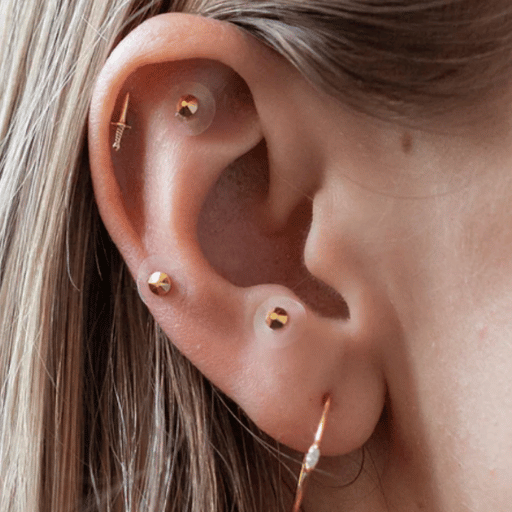
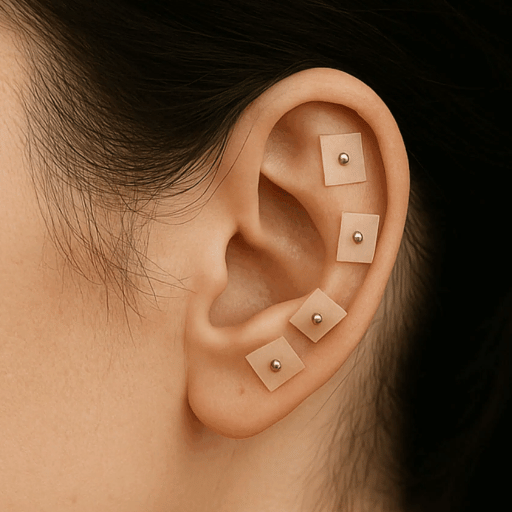
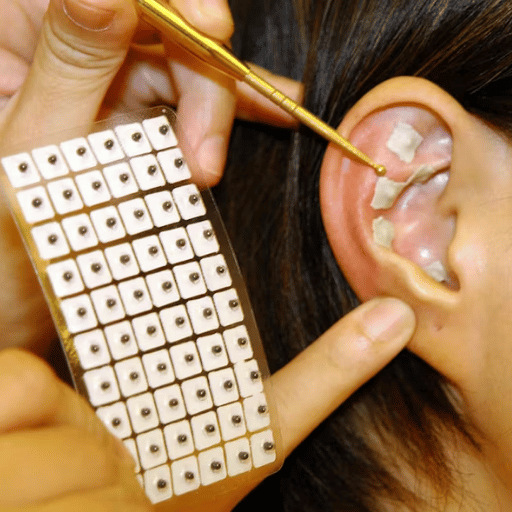
Ear seeds are tiny adhesive pellets – historically harvested from the Vaccaria plant, now often replaced with hypoallergenic 24K gold ear seeds or stainless-steel beads – taped onto specific acupressure points on the outer ear. Press the seed, and you stimulate that point in the same way an acupuncture needle would, except non-invasively and for days at a time. This practice is part of auriculotherapy, a branch of acupuncture that treats the ear as a microsystem reflecting the whole body.
Auriculotherapy was formalised in 1950s France by Dr. Paul Nogier, but ear maps used to guide placement trace back to classical Chinese medical texts. Why ear seeds have found a second life in the weight-loss conversation is practical: they cost $15-$35 for a kit of 40-60 pellets, they do not involve needles, and users can reapply them at home between acupuncture visits. For anyone already exploring TCM obesity treatment in Dubai or elsewhere, ear seeds are usually the lowest-friction entry point.
The mechanism worth understanding up front: stimulating auricular acupressure points is thought to influence vagal tone and hypothalamic signalling, which may in turn modulate appetite, satiety, and stress-driven eating. “May” is doing real work in that sentence – more on that in the next section.
Do Ear Seeds Really Work for Weight Loss? What the Research Shows
Are Ear Seeds Effective for Weight Loss?
Short answer: yes, with an asterisk. Multiple randomized trials and meta-analyses report that auricular acupressure produces small but statistically significant reductions in body mass index (BMI) and body weight. An honest answer is where most consumer articles stop reading.
A 2019 systematic review and meta-analysis of 10 RCTs with 923 participants determined that auricular acupressure is effective for weight reduction in overweight and obese individuals, with significant decreases observed in body weight, BMI, body fat, and waist circumference. Protocols of 12 weeks or more outperformed 2–8 week protocols, which suggests a dose–duration relationship rather than an immediate effect.
In 2019, Cha et al. ran a clinical trial in which 58 adolescents with obesity received auricular acupressure versus sham placement over 8 weeks. Active-group participants saw significant reductions in total cholesterol and low-density lipoprotein — an outcome the authors flagged as more interesting than pure BMI change, because lipid shifts hint at a metabolic rather than purely appetite-driven mechanism. Healthline’s medically-reviewed overview of ear seeds archives this trial alongside two other peer-reviewed studies.
Then the correction arrives. A 2024 meta-analysis published on PubMed Central, Effects of auricular stimulation on weight- and obesity-related parameters, concluded that although the weight and BMI reductions were statistically real, “the size of the effect does not appear to be of clinical relevance.” In plain terms: a trial can detect a 0.6 BMI-point difference between treatment and placebo over eight weeks and still leave a reader unable to spot the change on the bathroom scale. Most consumer guides on ear seeds for weight loss cite the first study and quietly ignore the second.
“Auricular acupressure is a suitable adjunct to a diet-and-activity program, but avoid having patients see it as a stand-alone weight-loss therapy. Sham-controlled studies demonstrate a genuine, albeit modest, effect, and trials over 12 weeks generally demonstrate the largest effect.”
An earlier 2017 meta-analysis of auricular acupoint stimulation corroborates the direction of the effect across 16 trials. Sham-acupressure control arms repeatedly fail to reproduce the weight-loss effect, which is itself meaningful: it tells us point specificity matters — which is why where you place ear seeds is the substance of this guide rather than an afterthought.
The 5 Ear Acupressure Points Used for Weight Management

What Are the Ear Acupressure Points for Weight Loss?
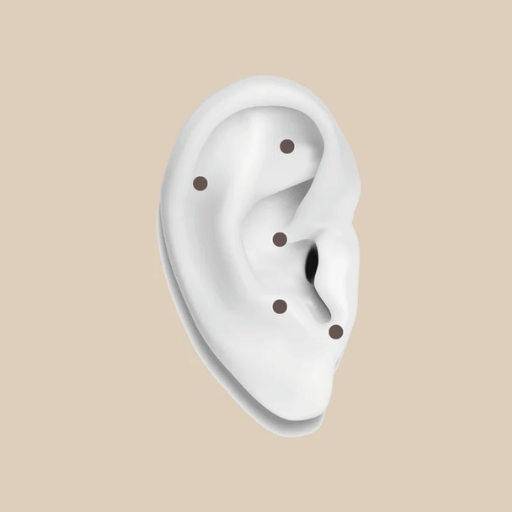
Five specific points on the ear show up repeatedly across the auricular acupressure weight loss literature. Anatomical locations are consistent between authorities; what varies is how many practitioners choose to use at once. Landmarks below come from classical auriculotherapy maps and will not replace a hands-on session with a licensed practitioner, but they are enough to read an ear chart with confidence.
Before reading the list, orient yourself to three regions of the outer ear: the triangular fossa (the small triangular depression near the top), the tragus (the small flap in front of the ear canal) and the concha (the deep bowl-shaped area around the ear canal). Every weight-management point sits in one of these three regions.
- Shen Men (神门 — “Spirit Gate”). Found in the upper third of the triangular fossa. In traditional Chinese medicine, Shen Men is the calming-the-mind point and the headline point for stress-driven eating. Bonus: it is also the most-studied ear point for TCM insomnia and sleep treatment. If disrupted sleep is what drives your late-night snacking, this one point addresses both halves of the loop.
- Hunger Point (饥点). Sits on the tragus, roughly halfway down its outer face. This is the appetite-signalling point, and it is the single point every weight-loss protocol includes.
- Stomach Point (胃). In the concha, near the root of the helix where it meets the ear canal opening. TCM links this point to digestion and satiety; Yeh’s 2010 vaccaria trial used it as one of the primary points.
- Mouth Point (口). Lower concha, near the front of the ear canal. Targeted for compulsive eating and oral-fixation habits.
- Endocrine Point (内分泌). Intertragic notch — the small dip between the tragus and antitragus. Used for hormonal and metabolic balance; relevant if your weight gain has a PCOS or hormonal component.
One reason competitor guides disagree on the exact list is that TCM practitioners individualise placements — a practitioner treating stress eating will weight Shen Men heavily; one treating a hormonally-driven weight gain pattern will prioritise the Endocrine point. These five are the consensus menu — not a mandatory prescription.
Although ear seed placement for weight loss is not technically difficult, three things go wrong for first-time users: the adhesive loosens within a day, the seed is placed a few millimetres off the actual point, or the user forgets to stimulate it after application. Our procedure below addresses all three.
Where to Place Ear Seeds for Weight Loss: Step-by-Step

Thoroughly wipe the outer ear with an alcohol wipe: sebum, sweat, and sunscreen all degrade the latex-free medical-grade adhesive. Let the skin dry fully for 30 seconds before moving to the next step.
- Locate each point using an ear chart or mirror, with the triangular fossa / tragus / concha landmarks from the previous section as your map. If you feel a small tender dip under finger pressure at the approximate location, that is usually the active point.
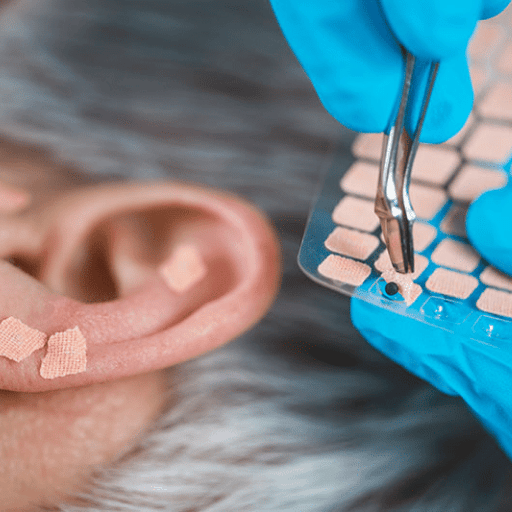
- Peel the seed from the backing strip with tweezers. Avoid finger contact with the adhesive side — skin oil reduces stickiness from the start.
- Press the seed firmly onto the point and seal the adhesive edges with a gentle massage for 3–5 seconds to secure the contact.
- Once attached, stimulate each seed for 15–20 seconds per session, 3–5 times per day. Press straight in rather than rubbing aggressively — aggressive rotation can cause small skin abrasions.
- Press until you feel a mild warmth or dull soreness — that sensation is the signal the point is engaged. Sharp pain means you are pressing too hard.
- Replace every 3–5 days and alternate ears each cycle. Let the skin rest for 24 hours before reapplying to the same location.
📐 Engineering Note — stimulation dose.
Apply pressure for 15–20 seconds per seed, 3–5 times per day, with the key stimulations timed 15–20 minutes before main meals so the appetite signal lands in the pre-prandial window. Vaccaria seeds typically loosen between 72–120 hours of continuous tape contact; shower water accelerates adhesive fatigue, so the third-day check is non-negotiable. If a seed falls off before day three, the medical-grade adhesive tape is the failure point — not the point selection.
All points on the ear should be stimulated individually – pressing one point will not stimulate the others. Experienced users commonly keep a reminder in their phone “3 check-ins: morning, pre-lunch, pre-dinner” until the pattern becomes well established.
The Hunger–Shen Men–Stomach Triangle: A 3-Point Starter Protocol

If you are unfamiliar with ear seeds and no practitioner is locatings points for you, test three points in place of five. This is the Hunger-Shen Men-Stomach Triangle. This is the pattern that appeared in every study we reviewed – if you include Yeh’s 2010 vaccaria RCT, and the 2019 meta-analysis – whereas the Mouth and Endocrine points appeared inconsistently.
Visualise the triangle on your own ear: Hunger on the tragus (front), Shen Men in the upper triangular fossa (back/top) and Stomach in the concha (middle). Join them and you get a narrow triangle pointed towards the ear canal. Three seeds, one pressure point at each corner and that is the starter protocol.
When do you use the3-point Triangle 3pT and 5-point protocol—the full protocol(5pP)8?
- First 4 weeks/first-time user/DIY kit at home: Triangle- Hunger + Shen Men + Stomach. Quicker to find, less chance of mis-placing and includes the three most attended points.
- Begin with a significant pattern of stress-eating or snack after midnight and later incorporate Mouth point at week 3.
- Hormonal or Metabolic weight gain (including PCOS, perimenopause, thyroid issues): Complete 5-point protocol with a licensed TCM practitioner–the Endocrine point requires cut work.
- Additional to professional GLP-1 treatment: Triangle only, as adjunct to stress-and-craving-trusting that support method; refrain from recommending the endocrine point for self-administration while in other treatment.
The concept of naming a system is so you can tell a practitioner or friend in a sentence: I am practicing the Hunger Shen Men-Stomach handle triangle. It also prevents that week one failure mode I see so often of your tried to set five accurately-aimed seeds down your own ear with a hand mirror.
Ear Seeds Wear Schedule + Appetite Log Template
A schedule turns ear seeds from a novelty into a protocol. Our table below lays out the five-day rhythm used by most practitioners who hand-off a kit for home use, including the Tong Ren Tang clinic’s clinical weight management pathway.
| Day | Morning (after waking) | 15 min pre-lunch | 15 min pre-dinner | Evening / pre-sleep |
|---|---|---|---|---|
| Day 1 | Apply seeds both ears | 15 sec × 3 points | 15 sec × 3 points | 15 sec × 3 points |
| Day 2 | 20 sec × 3 points | 20 sec × 3 points | 20 sec × 3 points | Optional |
| Day 3 | Check adherence + 20 sec | 20 sec × 3 points | 20 sec × 3 points | Optional |
| Day 4 | 20 sec × 3 points | 20 sec × 3 points | 20 sec × 3 points | Optional |
| Day 5 | 20 sec × 3 points | 20 sec × 3 points | Remove seeds; skin rest 24 h | Reapply day 7 on opposite ear |
Pair the schedule with a one-number appetite log: right before each meal, rate hunger from 1 (famished) to 10 (uncomfortably full). After three weeks you will see whether the pre-meal stimulation moves the number down by a point or two. That is the signal a protocol is working — not the scale, which will lag.
The data shows that anything lasting fifteen weeks has better than double the effect of everything shorter than that. Your five-day cycle repeats for a minimum of twelve weeks before you can really know if ear seeds work for you, and you can add in a twenty-minute moxibustion session for damp-phlegm constitution or a modest course of Chinese herbal support to tie in with your existing schedule if your TCM practitioner recognizes a pattern.
Side Effects, Safety, and Who Should Not Use Ear Seeds
What Are the Side Effects of Ear Seeds?
Auriculotherapy is a low-risk, non-invasive treatment — the 2020 Oxford Pain Medicine review of extended auricular therapy classified reported adverse events as minor and self-limiting. “Minor” is not the same as “none.” The following can happen:
- Redness, itch, or mild inflammation of the skin of the outer ear (most common; due to adhesive sensitivities)
- Tenderness beneath the stimulated point (normal; no honking pain)
- Small skin wounds -usually from periodical overstimulation or reapplication before an interval between treatments expires
- Transient dizziness, drowsiness or light nausea – infrequent, but not unheard of, to the extent that Healthline suggests not to get behind the wheel right after your first session
- Adhesive or metal allergy sensitivities – if you already know you’re latex sensitive, opt for a transparent, hypoallergenic medical grade tape; for metal sensitivities, ceramic or vaccaria seed kits are safer than stainless
⚠️ Who should consult a practitioner before applying ear seeds: people who are pregnant (some points can stimulate early labour), anyone with open wounds on the outer ear or a recent ear surgery, children (supervised by a TCM practitioner only), and anyone with a known latex or adhesive allergy.
One misconception worth clearing up: ear seeds do not “melt” fat. Their mechanism is appetite and stress signalling, not lipolysis. Articles that promise visible fat loss from ear seeds alone are overstating the research.
Ear Seeds vs Acupuncture vs GLP-1: An Honest Scenario Comparison
Ear seeds are at the low-end of the cost-effective, gentle-weight-loss-treatment spectrum. They are not a substitute for an acupuncture session with every other product that claims to help you lose weight; become acquainted with the decision chart below indicating how we really ration treatment at our clinic.
| Your situation | Start with | Typical monthly cost | Why |
|---|---|---|---|
| Mild cravings, want a low-friction at-home tool | Ear seeds — 3-point Triangle | $15–35 per kit | Lowest cost, non-invasive, evidence shows modest benefit over 12 weeks |
| Strong emotional-eating or high stress load | Full-body acupuncture + ear seeds as between-visit support | $200–500 | Body channels + ear channels address the stress–appetite loop together |
| BMI ≥ 30 or metabolic syndrome diagnosis | Clinically supervised program (GLP-1 + nutrition + TCM support) | Varies by provider | Ear seeds alone cannot move the needle at this BMI range — they are an adjunct |
| PCOS or hormonal weight gain | TCM PCOS treatment protocol + ear seeds (5-point) | Clinic-dependent | Endocrine point benefits from professional placement |
Transparency declaration. Research on auricular acupressure for obesity is consistent in direction but modest in magnitude. Our 2024 meta-analysis cited earlier is explicit: the effect is real but below the threshold most clinicians would call clinically meaningful. Ear seeds are a supportive self-care tool, not a replacement for clinically supervised weight-loss care. If someone tells you otherwise, check whether they are selling the kit.
Frequently Asked Questions
How quickly can I see results from ear seeds?
View Answer
Most studies that showed significant weight or BMI change ran for 8 to 12 weeks; protocols shorter than 4 weeks usually showed no measurable effect. Expect appetite and craving shifts (easier to read) in weeks 2–3 if the protocol is going to work for you, and body-weight changes — if they come at all — after week 6. If nothing has shifted by week 8, a consultation with a practitioner is a better next step than more seeds.
Are ear seeds reusable?
View Answer
No. Ear seeds are designed for a single application cycle of 3–5 days. Once the adhesive has contacted skin, it degrades quickly, and reusing a loose seed also carries a skin-infection risk. Most kits include 40–60 pellets precisely because a single kit covers several wear cycles.
Can I sleep, swim, or exercise with ear seeds on?
View Answer
Sleep — yes, with no special precautions. Exercise and sweating — yes, but expect adhesive to degrade faster; check adherence after every workout. Swimming and long hot showers — avoid if possible, because chlorine and sustained water contact loosen the medical-grade tape within one session. If you swim daily, plan to reapply every 2–3 days instead of every 3–5.
Can ear seeds interfere with GLP-1 medications or my weight-loss plan?
View Answer
Ear seeds are considered safe to use alongside GLP-1 therapy, nutrition plans, or exercise programs — they work through local nervous-system signalling, not systemic pharmacology. That said, they can shift your appetite perception in the same direction as a GLP-1 medication, so if you are titrating up on a medication and also starting ear seeds, change one variable at a time so you can tell which intervention is doing what. Tell your prescribing doctor you are using them.
Do ear seeds work for face slimming?
View Answer
No peer-reviewed trial has shown that ear seeds cause face slimming. Weight-loss points on the ear signal to the appetite and digestion systems, not to local facial fat. Any face-slimming effect reported online is either a side effect of general weight loss (in which case facial change lags the scale by weeks) or unrelated lymphatic massage. Be skeptical of kits marketed specifically for face slimming.
What materials are ear seeds made from?
View Answer
Three main options. Vaccaria plant seeds are the traditional choice — small, organic, biodegradable, and hypoallergenic for most people. 24K gold-plated stainless-steel beads are the modern premium option, chosen for their hypoallergenic surface and near-invisible appearance on the ear. Plain stainless-steel or ceramic beads fall in between. Seed material matters less than adhesive tape quality — always look for latex-free medical-grade tape in the product description.
Reviewed by Tong Ren Tang Dubai’s TCM Team
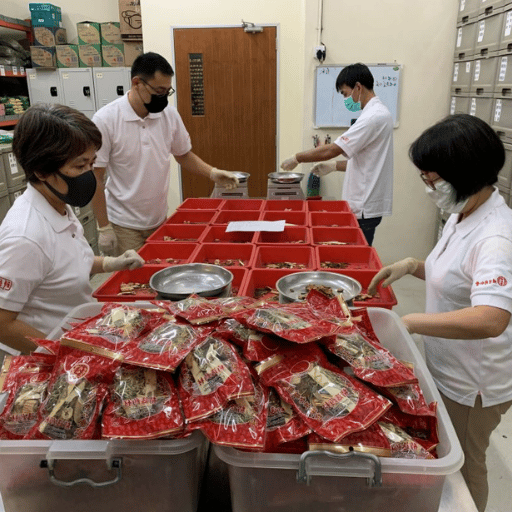
Beijing Tong Ren Tang was established in 1669—on the eighth year of Emperor Kangxi—and had served the royal families of the Qing Dynasty for 188 years (over eight emperors). its corporate motto—”No compromise on cost and labour despite the complexity of processing herbal medicines. No compromise on quality and standard despite the scarcity of medicine ingredients”—has persisted as the business guideline for more than 350 years. Presently, Tong Ren Tang Gulf owns and operates licensed TCM clinics in Dubai, where our Registered TCM Practitioners provide auricular acupressure and Chinese herbal medicine for supervised weight management regime to patients when clinically indicated.
Next step. Book a consultation with our Dubai TCM team to find out whether ear seeds fit into your specific weight-management plan, or whether a herbal + acupuncture combination would be a better starting point for your constitution.
→ TCM obesity treatment in Dubai · Book a Tong Ren Tang Dubai consultation
References & Sources
- Zhang et al. (2019). Auricular acupressure for overweight and obese individuals: A systematic review and meta-analysis — PubMed Central / NCBI
- Liu et al. (2024). Effects of auricular stimulation on weight- and obesity-related parameters: A systematic review and meta-analysis — PubMed Central / NCBI
- Hsieh et al. (2017). The Effect of Auricular Acupoint Stimulation in Overweight and Obese Adults — PubMed Central / NCBI
- Yeh et al. (2010). The effects of auricular acupressure on weight loss and serum lipid levels in overweight adolescents — PubMed / U.S. National Library of Medicine
- Nielson et al. (2020). Risks and safety of extended auricular therapy: A review of reviews and case reports of adverse events — Pain Medicine / Oxford Academic
- Matos et al. (2021). Understanding Traditional Chinese Medicine Therapeutics: An Overview — PubMed Central / NCBI