Get in Touch with Tongren Tang Gulf


Quick Specs: Realistic Acupuncture Weight Loss
| Typical weekly loss | 0.5–1 kg (1–2 lbs) |
| Common program length | 6–12 weeks, 1–3 sessions per week |
| Total weight change (realistic) | 4–10 kg (9–22 lbs) when paired with diet changes |
| Primary measurable change | Reduced craving frequency, waist circumference, BMI |
| Methods in use | Body acupuncture, auricular (ear) acupuncture, electroacupuncture |
| Evidence level | Modest — effective as an adjunct, not a replacement for diet and exercise |
What Acupuncture Weight Loss Before and After Actually Looks Like — The Real Data

Acupuncture weight loss before and after images are we tend to see are really dramatic on social media sites. The evidence does not support such incredible views, and the story for what it is far more credible and realistic, in this author’s opinion. It is here for you to see, 5 studies found in peer reviewed publications and in addition a personal account over 12 weeks.
They are listed below with references.
| Source | Population / Design | Duration | Reported Change |
|---|---|---|---|
| Abou Ismail et al. 2015 (PMC4877795) | 80 obese patients, 3-arm RCT (body acupuncture + diet, diet-only, control) | Not fixed | Acupuncture + diet produced greater weight loss and lower inflammatory mediators than diet alone |
| Hsu et al. 2009 (Europe PMC) | Obese women, auricular vs sham | 12 weeks | Decrease in leptin, increase in ghrelin (counterintuitive direction), body weight reduction |
| Yeo et al. 2014 (BMJ Open Gastroenterology) | 10 adults, auricular pilot study | 1 week | Statistically significant body-weight change after just 1 week of auricular stimulation |
| Kim et al. 2012 (Acupuncture in Medicine) | Randomized sham-controlled trial | Multi-week | Acupuncture reduced insulin and leptin, decreased BMI versus sham |
| Auricular stimulation meta-analysis (PMC11333859) | Pooled RCT data | Varied | BMI and body-weight reduction achievable, effect size described as modest rather than clinically dramatic |
| Shape magazine testimonial (Allison, 25) | Single post-partum case, weekly body acupuncture + ear magnet | 12 weeks | Around 1–2 lbs per week, so roughly 12–24 lbs total |
How much weight can I actually lose with acupuncture?
Plop the above six data points in a line and a spectrum appears. For patients who do 6-12 weeks of weekly sessions and make concurrent changes in their dietary intake, 4-10 kg (9-22 lbs) is a reasonable real world expectation. More positive outcomes are seen in longer programs and those starting out with a higher BMI.
Less positive outcomes are what you get when patients reserve a few sessions and neglect the dietary portion of the program and just sit back and expect the needles to do the work.
Studies that tracked inflammatory mediators, such as the 2015 Egyptian trial published in the Journal of Complementary and Alternative Medicine (PMC4877795)) uncovered that body acupuncture coupled with diet restriction outperformed diet on weight loss AND reduction of inflammatory parameters. That second bit is important. An identical change in body composition appears entirely different on a scan when the systemic inflammation that fueled it has dried up;
At Tong Ren Tang’s Dubai clinic, the most common inquiries about our full obesity treatment program tend to follow after potential clients browse numbers like these. Our response is the same as the research: the program serves as a support system, not a standalone fat-loss device. For a mechanism-first walkthrough, see our article on how weight-loss acupuncture works.
For readers who want a deeper walk through the clinical research, the related post does acupuncture work for weight loss elaborates upon the evidence base in greater detail.
The 12-Week Timeline — What Happens Week by Week
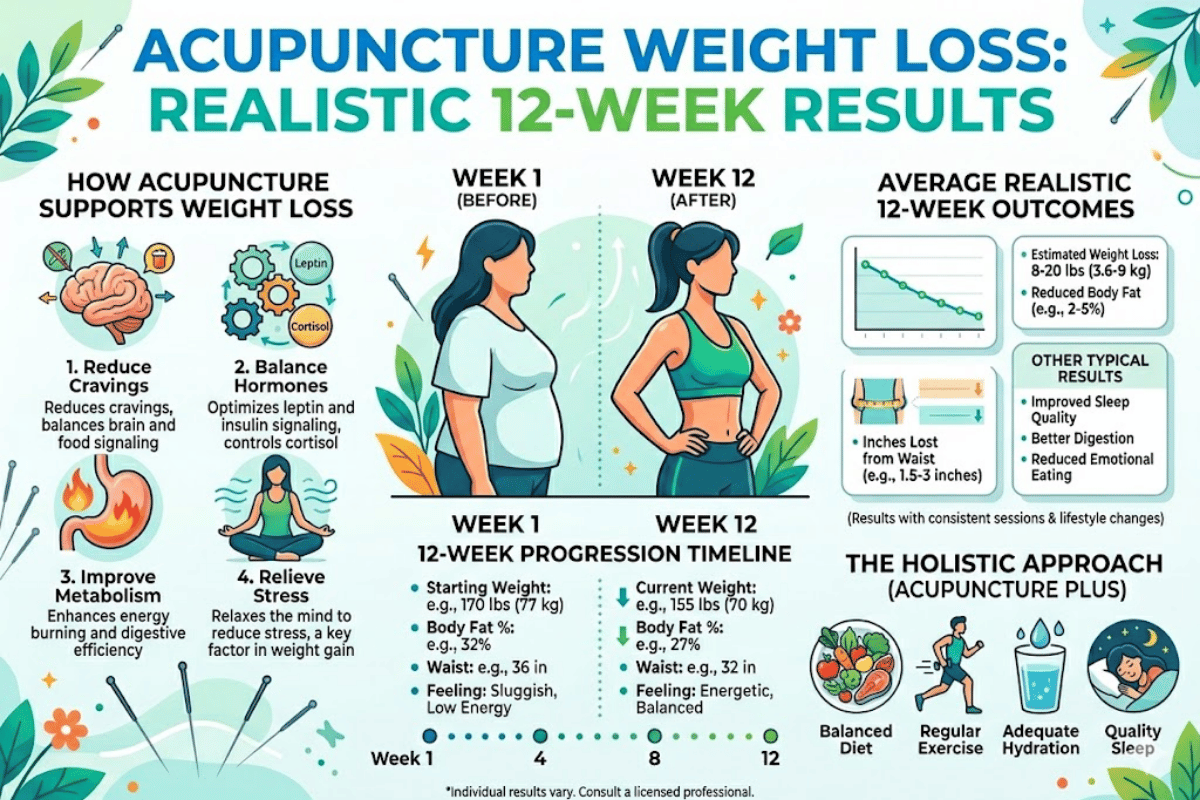
Official guidance on clinical schedule for acupuncture weight loss does not exist. All that do is a grouping of reports that concur with the general outline of the curve. We have distilled that outline into a week-by-week table our clinicians in Dubai use as a handout to educate patients.
| Phase | What patients feel | What the scale tends to show |
|---|---|---|
| Weeks 1–4 (Calibration phase) |
Early craving reduction, better sleep, less emotional eating, some report less bloat | 0.5–1 kg per week; a portion is water weight — readers who try to lose weight on the scale alone will over-read it |
| Weeks 5–8 (Stabilization phase) |
Craving control feels more automatic; waist circumference starts to change before the scale moves again | 0.3–0.8 kg per week; scale may stall for a week — this is normal |
| Weeks 9–12 (Consolidation phase) |
Habits feel built in; portion sizes dropped without conscious effort | 0.3–0.6 kg per week; cumulative 4–9 kg over the full 12 weeks |
| Beyond week 12 (Maintenance phase) |
Session frequency drops to bi-weekly or monthly; focus shifts to relapse prevention | Slower fat loss; priority moves to waist-to-hip ratio and body composition rather than scale weight |
How long does acupuncture take to work for weight loss?
Most patients who move forward will notice the change internally in most cases within the 2-3 week mark-I find its more around the sleeping patterns and appetite instead of the scales-the scales tend to be evident anywhere from the 4th -8th week mark. After 6 weeks of weekly sessions and there has been no change, it’s time to look at the program, not to the needles- it has been my experience that its usually the diet aspect of the program that is lacking or the number of sessions is too low, acupuncture could be achieveing its part while the program isn’t. In our clinic experience in Dubai, its those patients that happen to move past week 8 that get the “before and after” they came in for.
If your weight gain is linked to other conditions, check out our pages on PCOS-linked weight gain and metabolic syndrome and insulin resistance to understand why the timelines are longer and you’ll be doing a different session schedule.
How Many Sessions You Actually Need (And Why Most People Stop Too Early)

A standard regimen listed in the published guidance is the one listed by Healthline for its MD reviewer: 3 treatments a week for 6 to 8 weeks, as the program designed to produce about 10 to 15 pounds of weight loss (which comes out to 12-24 treatments). Many of the figures in the following table are our estimate of the average number of treatments for each goal based on the guidance, the Egyptian trial protocol, and the number of treatments our acupuncturists in Dubai have been booking.
| Weight-loss goal | Typical program length | Common session count |
|---|---|---|
| 5–10 lbs (kickstart) | 4–6 weeks | 6–12 sessions, 1–2 per week |
| 10–15 lbs | 6–8 weeks | 12–24 sessions, 2–3 per week |
| 15–25 lbs | 10–12 weeks + maintenance | 20–36 sessions, 2 per week tapering to 1 |
| Maintenance after loss | Ongoing | 1 session every 2–4 weeks |
One common remark on forums such as Reddit’s acupuncture group is that two months of treatment did not change the needle. You can understand why from previous research: a two-month course of treatment without any diet modification is just about always an under-dose. A long-running r/acupuncture discussion listplated by a practitioner where at the end an expert notes that significant weight loss this short a interval will typically require dietary adjustment with treatment planning—your acupuncturist should have set this expectation in session onetime, not sixteen.
For patients seeking both, a Chinese herbal medicine duo, we offer our “paired Chinese herbal medicine support” article on how we layer formulas with acupuncture therapy in complex cases.
Ear Acupuncture (Auricular) Before and After — What’s Different
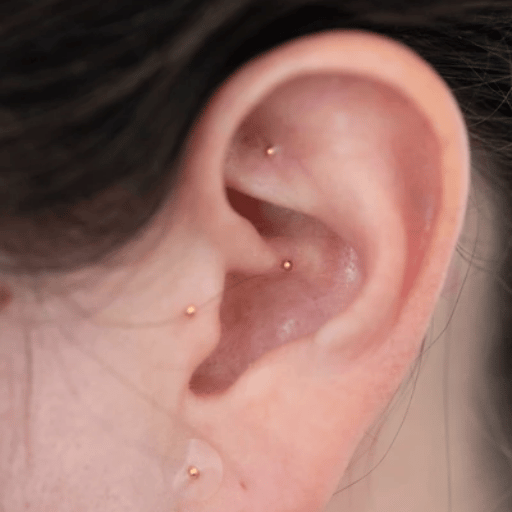
Ear acupuncture, also called auricular acupuncture therapy, is the best-known of the ear-point techniques. It uses fewer target points on the pinna than body acupuncture does on the body. Its traditional roots are in appetite and addiction treatment work where it was found useful.
Its evidence base is different from that of body acupuncture and it has a rather different results profile.
✔ Advantages
- Changes in body weight within seven days of auricular stimulation as reported in the BMJ Open Gastroenterology pilot
- Fixed points so a small set of Ear points. Shorter sessions.
- Can be administered along with take home ear seeds or magnets for round the clock craving assistance
- Reasonable option for patients uncomfortable with body needling
⚠ Limitations
- The effect size observed by the 2024 auricular stimulation meta-analysis (PMC11333859) is described as modest, and how clinically remarkable that is remains debated.
- Hormone outcomes across studies are inconsistent, including actually the direction of change of ghrelin.
- Best as a craving-control whatever, not a metabolic reset alone
- Needs a regular weekly session over a period of six to 12 weeks to reach the same level of effectiveness as body acupuncture
Can ear acupuncture alone produce visible before-and-after results?
In our Dubai clinic practice, ear acupuncture alone usually results in a less dramatic before-and-after than body acupuncture alone, but it’s not the entire program. The patients who use strong, ear-only results are typically using the auricular sessions as a starting point, the anchor to a 12-week dietary change, with the needles as the physical craving brake that makes the change stay. Readers interested in an at-home version, should check out our article on ear seeds as an at-home alternative, which discusses how to use magnets or seeds in between clinic sessions.
You can suppress desires for certain foods by stimulating areas on the ear. A treatment, similar to that used by acupuncture practitioners for addicted smokers and drug users, can be used.
Why Results Vary — The Biology Behind Cravings, Cortisol, and Hormones

A common hypothesis is that acupuncture ‘might be able to reset appetite hormones in one fell swoop’. Evidence published in peer-reviewed journals shows a more complicated picture. We believe the more complicated version is the one our readers need, since it accounts for why two patients in similar treatments (number of sessions, a similar greater-than-average tendency to overeat when under stress) may finish with very different before-and-after results.
There appear to be multiple hormonal and nervous system effects rather than just one signature mechanism. Two test documents, one from 2012 from Acupuncture in Medicine. Kim et al. reported that acupuncture decreased insulin and leptin levels and induced weight loss with a lower BMI than the sham group.
The other stated that this decreased leptin but increased ghrelin—all contrary to most consumer articles; both passed peer review and both could be true in different populations.
What the studies have converged upon is the direction of story, not the old numbers:
- Regulates appetites. Merely inserting the appropriate puncture sites seems to cut the need for a certain extent of complaining. And maybe it does, involving ghrelin, leptin or a vagus-nerve mediated parasympathetic shift.
- Stress axis. Those who felt less stressed during treatment ate less. Lower cortisol is an intuitive possible mechanism, and this is the pathway through which emotional eaters often responded faster to acupuncture than pure portion-control eaters.
- Insulin sensitivity.In the Kim 2012 data set insulin was decreased as BMI went down. Why is this important you wonder?Insulin is a big player in fat storage and may show an early, disproportionate response when a patient has borderline insulin resistance.
- Re-balancing nervous system. Acupuncture seems to rebalance autonomic nervous system towards parasympathetic, which enhances digestion and sleep, both of which trigger hormone fluctuations leading to easier weight reduction.
📐 Clinical Note
If your labs come back with high fasting insulin or HOMA-IR than what a metabolically healthy dieter would have, you will probably see a shorter-than-predicted before-and-after window. Kim et al. 2012 data indicated that insulin-sensitive responders’ responded faster to the acupuncture than to the diet on its own. Inquire of your acupuncturist whether a fasting insulin needs to be incorporated into your baseline investigations.
For acupoint-selection background, our article on key acupuncture points for appetite lists the most popular points for cravings and metabolic regulation.
Who Sees the Best Results (and Who Doesn’t)
Honest truth: acupuncture does not work the same on every body. Read on for a profile-by-profile breakdown of who the peer-reviewed literature says will see the greatest benefit.
| Patient profile | Realistic 12-week trajectory |
|---|---|
| Emotional eater with chronic stress | Strong early response on cravings; 5–9 kg achievable if diet follows |
| Obese women with PCOS or hormonal weight gain | Slower scale change; priority shifts to waist circumference and insulin; often needs 16-week program |
| Metabolic syndrome patient | Modest weight loss plus measurable lab improvements in fasting blood glucose and lipids |
| Metabolically healthy person looking for a quick fix | Poor fit; the acupuncture could barely outperform placebo without a dietary change |
Healthline’s expert-reviewed overview acknowledges that outcome data in research subjects is often “heavily influenced by each subject’s personal beliefs, expectations and relationship with the practitioner.” That’s unusual transparency in an article targeted at consumers, and it bears mentioning: patients who come in ambivalent but intrigued do better than patients who come in either believing or disbelieving. If you already trust your acupuncturist, that’s part of the treatment.
3 Real Mistakes That Flatten Your Before-and-After
Three primary reasons for acupuncture failure emerge from published studies and second-opinion patients alike:
⚠ Mistake 1 — Treating acupuncture as a replacement for diet and exercise
Indeed, every trial reporting clinically significant weight loss administered calorie reduction in parallel. Take the one for the 2015 Egyptian trial, above. This was comparing L-4 body acupuncture versus weight loss but not versus no intervention. Expect craving and sleep improvements more than number on the scales if you eat as often and only add sessions.
⚠ Mistake 2 — Stopping at 6–8 weeks because “nothing happened”
Many online discussion forums have people than quit around week 8, which is interesting because clinical practitioners find that around the 8-week mark, results in body composition start to manifest. If you or your weight-loss participant of choice is getting ready to pull the plug on a 12-week course, you may be losing not only your money but your future success story.
⚠ Mistake 3 — Ignoring the emotional-eating piece
One Shape subscriber using an ear magnet noticed, It really suppressed my appetite most of the time, though I noticed that it didn’t work when you eat out of boredom. Physical hunger may have been suppressed but emotional hunger, or boredom-eating may not have been. A behaviour component to treatments like these is important if the bulk of your eating is environmental or emotional.
Is Acupuncture for Weight Loss Right for You? Setting Realistic Expectations

Use the below task to to rank yourself into one of three categories. This is identical to the assessment we perform at a new obesity-treatment patients first appointment in our Dubai clinic.
- ✔
Good fit: You have 10–25 lbs to lose, your eating is driven by stress or cravings, and you are ready to pair sessions with a sustainable dietary plan for 12 weeks. - ✔
Pair with other tools: You have PCOS, metabolic syndrome, or are on a GLP-1 — acupuncture therapy works as an adjunct that helps manage side effects, cravings, and sleep, not as a replacement. - ⚠
Poor fit: You are looking for a passive fix in under 4 weeks, you are not willing to change your diet, or your weight is within a normal BMI range and you want a cosmetic change.
If you are either group one or two, you can head straight to your local licensed acupuncturist for a written 12-week program to start before you get any needles.
Frequently Asked Questions
Q: How successful is acupuncture for weight loss?
View Answer
Published evidence describes the effect as modest but real, especially when sessions are paired with dietary change. Programs running 6-12 weeks with 1-3 sessions per week typically produce 4-10 kg of weight loss in patients who complete them. Acupuncture on its own, without any adjustment to food intake, rarely produces dramatic before-and-after photos.
Q: Is weight loss acupuncture painful?
View Answer
The needles used are hair-thin sterile needles, and most recipients describe insertion as a tap or mild pinch rather than pain. Electroacupuncture can produce a gentle buzzing sensation. Soreness for a day after abdominal needling is not uncommon but quickly diminished.
Q: Does insurance cover acupuncture for weight loss?
View Answer
Coverage will depend greatly on your country and your plan. In the UAE, private insurers view acupuncture sessions as complementary and will require pre-authorization. Find out what pre-authorization is needed before you begin the 12-week program and make sure it is included in your plan.
Q: Where do acupuncture needles go for weight loss?
View Answer
A typical set of points for weight-loss sit on the stomach pathway by the stomach (located in your tummy area), lower spleen pathway on your lower leg and on the ear (auricular) points related to appetite/weight issues. Variation depends on whether your acupuncturist focuses on cravings, digestion, or stress-related gain. A consultation tends to give you an idea of the set of points for your unique presentation.
Q: Can acupuncture help you lose belly fat?
View Answer
Some research found decreased waist circumference and visceral fat (fat inside the abdomen) after acupuncture programs in general practitioners and endocrinology clinics, particularly in patients with insulin resistance or metabolic syndrome. The change seen in the stomach area is not spot reduction – it usually reflects a general change in body composition plus the hormonal effect that goes with it.
Q: How often should you do acupuncture for weight loss?
View Answer
Most programs begin with 2-3 visits per week in the first month, and then drop gradually to once weekly during the stabilization phase, then once every 2-4 weeks in the maintenance phase. The most common cause of under-performance is going less than once a week during the first phase.
About This Analysis
This practical-real expectations guide combines five individual research studies on acupuncture and weight loss and a common 12-week personal testimonial, compared with the weekly visits at Tong Ren Tang’s Dubai clinic. The information is intended to underpin honest expectations, and be a check list every patient can measure against in their own 12 weeks.
References & Sources
- Effect of Acupuncture on Body Weight Reduction and Inflammatory Mediators in Egyptian Obese Patients (2015) — PubMed Central
- The Effects of Auricular Acupuncture on Weight Reduction and Feeding-Related Cytokines: A Pilot Study — BMJ Open Gastroenterology / PubMed Central
- Effects of Auricular Stimulation on Weight- and Obesity-Related Parameters: Meta-Analysis (2024)– PubMed Central
- Influence of Acupuncture on Leptin, Ghrelin, Insulin and Adiponectin Levels in Obese Women– Acupuncture in Medicine (SAGE)
- Acupuncture for Weight Loss: Does It Work?– Healthline, medical review
- I Tried It: Acupuncture for Weight Loss– Shape magazine testimonial