Get in Touch with Tongren Tang Gulf



Published April 2026 · Reviewed by the clinical team at Tong Ren Tang Dubai
How many acupuncture sessions for back pain you will actually need depends on three things: how long the pain has been there, what pattern is driving it, and how consistently you attend the first few weeks. Published guidelines and trial data converge on a narrow range – and this guide stratifies that range so you can plan with confidence instead of guessing.
Quick Specs: Session Count by Pain Stage
| Pain Stage | Typical Sessions | Frequency |
|---|---|---|
| Acute (under 6 weeks) | 2–3 sessions | 2×/week |
| Subacute (6–12 weeks) | 5–10 sessions | 1–2×/week |
| Chronic (over 12 weeks) | 6–12 sessions + maintenance | 1×/week, tapering to biweekly |
Source: Hong Kong acupuncture clinical practice guideline (Haiyong C., 2021), Harvard Health 2025, and Medicare acupuncture coverage terms.
How Many Acupuncture Sessions for Back Pain? The Short Answer

Most patients need between 6 and 12 acupuncture sessions to see meaningful, durable pain relief from back pain, with the benefits of acupuncture building across successive visits. How many sessions you actually need depends on how long your pain has lasted: acute back pain (under 6 weeks) often resolves in 2-3 sessions; subacute back pain (6-12 weeks) typically requires 5-10 sessions; chronic back pain (more than 12 weeks) usually calls for 6-12 sessions with ongoing maintenance.
That range is not a marketing estimate. It tracks published guidance from three independent sources. A clinical practice guideline developed by the Hong Kong taskforce on standardized acupuncture practice recommended courses of 3 to 6 sessions as an initial block. Harvard Health cites 6 to 12 sessions spread over roughly three months as a usual course. And Medicare, which since 2020 covers acupuncture for chronic low back pain, authorizes up to 12 visits plus 8 additional sessions when the first 12 produce measurable improvement.
Where guidelines converge, practice diverges. The session count that fits you is shaped by your pain’s duration, its underlying cause, your age and general health, and whether you can attend twice weekly during the first month. The rest of this guide walks through each of those levers.
Why Your Pain Duration Sets the Baseline

Duration is the single strongest predictor of treatment length, and it is how every major guideline and acupuncturist stratifies care. Acute, subacute, and chronic are not marketing categories; they are clinical classifications with distinct tissue states, pain-signalling pathways, and expected response windows.
| Classification | Duration | Typical Course | Evidence |
|---|---|---|---|
| Acute | Under 6 weeks | 2–3 sessions, 2×/week | ACP 2017 (low-quality evidence, still first-line nondrug option) |
| Subacute | 6–12 weeks | 5–10 sessions, 1–2×/week | Synthesized from Hong Kong guideline + clinic ceiling data |
| Chronic | Over 12 weeks | 6–12 sessions + maintenance | ACP 2017 moderate-quality evidence; Harvard Health 2025 course guidance |
How quickly does acupuncture work for back pain?
Most patients notice something after the first or second session. That “something” is rarely 90 percent relief, and treating it as such is a common misstep. The more typical pattern: a 15-30 percent drop in pain intensity, a few hours to a day of looser muscle tone, then partial return of symptoms before the next visit. Cumulative relief builds between sessions three and five for acute cases, and between sessions four and eight for chronic cases. Patients often feel relief in a sustained way only when the sessions accumulate across a full treatment course. A 2018 individual-patient-data meta-analysis of 20 trials covering 6,376 participants, summarized by NCCIH, found that when a course was completed, beneficial effects persisted for at least a year afterward – rare durability for a nondrug intervention.
One counterintuitive point worth naming: chronic does not mean more pain per session. It means the tissue needs more repetitions to rewire. Acute pain often resolves faster because the underlying signal is still clean and correctable; chronic pain involves central sensitization that unwinds only with sustained exposure. This is why skipping to once-weekly frequency early in a chronic course often stalls progress.
What a Typical Acupuncture Course Looks Like, Week by Week

A complete acupuncture treatment course for back pain follows a recognisable arc. Understanding that arc in advance helps patients plan childcare, time off work, and realistic expectations. Below, we set out a composite schedule synthesized from Hong Kong clinical guideline protocols, Harvard Health practice descriptions, and standard Tong Ren Tang intake.
| Week | Session Focus | Duration | What to Expect |
|---|---|---|---|
| Week 1, Session 1 | Diagnostic intake + first needling | 60–90 min | History, pulse and tongue reading, physical exam, 4–10 needles retained 15–30 min |
| Weeks 1–2, Sessions 2–4 | Building phase | 45–60 min each | 2× weekly; endorphin response and local circulation build cumulatively |
| Weeks 3–5, Sessions 5–8 | Consolidation | 45–60 min each | 1–2× weekly; tangible gains in function, sleep, and morning stiffness |
| Week 6+ | Maintenance or discharge | 45 min each | Biweekly or monthly; decision made at 8–12 sessions based on response |
Harvard Health describes a typical session as inserting four to ten needles and retaining them for 10 to 30 minutes. In clinical practice at our UAE location, first visits routinely run 60 to 90 minutes because the diagnostic intake — pulse, tongue, palpation of back pain trigger points, lifestyle and stress history — determines whether you are treated for a Cold-Damp pattern, a Liver Qi Stagnation pattern, or something else entirely. That diagnostic layer is why two patients with identical MRI findings can receive meaningfully different needle prescriptions.
“A 30 percent reduction in pain intensity by session four is our clinical benchmark for continuing a course. Less than that, we re-diagnose rather than escalate needle count.”
How can you tell if your acupuncture treatment is working?
Four progress markers reliably predict whether the course is converging:
- Session-to-session pain intensity drops — track on a 0–10 scale before each visit. A trend line downward across sessions three, four, and five is the signal.
- Duration of relief lengthens — early sessions may hold relief for a day; by session six, the plateau should extend to several days or longer.
- Sleep quality improves — for back pain driven by nervous system dysregulation, easier sleep onset is an early, reliable indicator.
- Shorter morning stiffness — the time between waking and feeling mobile should compress week over week.
When none of these markers move by session four, the diagnosis is more likely off than the needle count is too low.
Key Factors That Influence Your Session Count

Pain duration sets the baseline, but five factors can shift the actual number of acupuncture treatments you need up or down. Skilled acupuncturists weigh all five during intake rather than applying a one-size protocol.
| Factor | Low Impact (+0–1 sessions) | High Impact (+3–5 sessions) |
|---|---|---|
| Cause of pain | Muscle spasm, posture strain | Disc degeneration, stenosis, radiculopathy |
| Severity | Intermittent, 3–5/10 intensity | Constant, 7–9/10, radiating |
| Chronicity | Recent onset under 3 months | Longstanding 5+ years, recurring |
| Lifestyle | Active, ergonomic workspace | Manual labour or desk-bound 10+ hours/day |
| General health | Sleep 7+ hrs, managed stress | Insomnia, chronic stress, comorbid conditions |
📐 UAE Context Note
Desk-bound office culture, 60–90 minute commutes through Dubai and Sharjah traffic, and year-round air conditioning create a combination that traditional Chinese medicine reads as Cold-Damp pattern. Patients in this profile often need the higher end of the session range even when duration and severity appear modest. Understanding how TCM treats Dampness in the body helps frame why maintenance visits during the cooler months matter here.
How often should you have acupuncture for back pain?
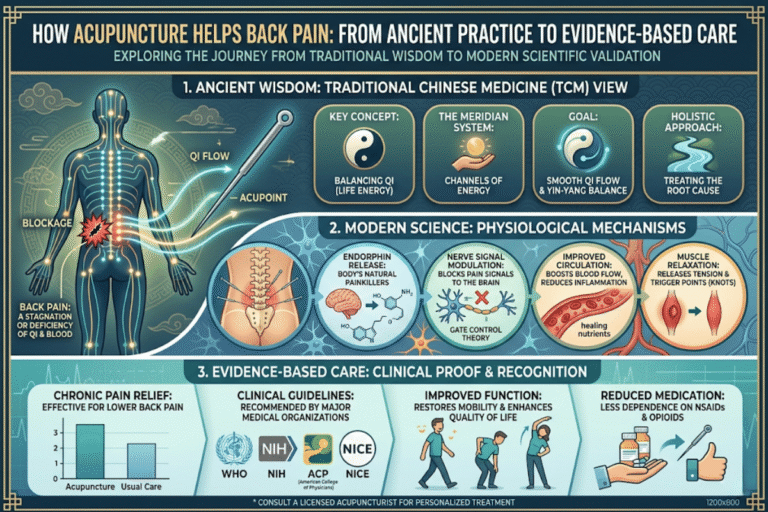
Two sessions per week for the first two to three weeks is the clinically supported starting frequency for acute or newly subacute cases. The rationale is mechanistic, not arbitrary. Acupuncture prompts release of endorphins, the body’s own pain-suppressing chemicals, and that release builds cumulatively. When sessions are spaced more than four days apart in the early phase, endorphin levels may return to baseline between visits, forcing each session to restart rather than extend the previous one. After the first two to three weeks, frequency usually steps down to once weekly, then biweekly as the pain stabilises.
Consider three realistic scenarios:
Scenario A — Office worker, subacute lower back pain after a weekend move. A 42-year-old knowledge worker with 8 weeks of lumbar ache and stiffness after lifting. Intake reveals Liver Qi Stagnation pattern layered on muscular strain. Protocol: twice weekly for three weeks (six sessions), then weekly for two weeks (two sessions). Total: 8 sessions over 5 weeks, followed by a maintenance visit 6 weeks later.
Scenario B — Construction foreman, chronic recurrent pain with radiculopathy. A 55-year-old with 7 years of intermittent pain that now radiates to the left calf. Intake reveals Kidney Yang deficiency and Blood Stasis. Protocol: twice weekly for four weeks (eight sessions), then weekly for four weeks (four sessions), then biweekly maintenance. Total: 12 initial sessions plus ongoing monthly maintenance.
Scenario C — Post-surgical recovery, acute postoperative back pain. An active 38-year-old eight weeks after microdiscectomy, cleared by the surgeon for complementary care. Protocol: twice weekly for two weeks (four sessions) focused on surgical incision periphery and contralateral points to rebalance muscle compensation. Total: 4–6 sessions.
The TCM Perspective: Why Needle Count Varies by Pattern

Every Top-ranking Western article answering “how many acupuncture sessions for back pain” treats duration as the primary variable. That framing is useful but incomplete. In classical traditional Chinese medicine, the needle count follows the pattern, not just the timeline. Two patients with identical MRI findings and identical pain duration can receive meaningfully different prescriptions because their underlying patterns diverge.
| Classical Pattern | Typical Presentation | Typical Sessions |
|---|---|---|
| Cold-Damp Bi | Heavy, aching pain worse in cold or rainy weather; stiffness improves with warmth | 4–6 sessions, 2×/week |
| Liver Qi Stagnation | Stress-triggered pain, emotional volatility, shoulder and side-of-back tension | 6–8 sessions, 1–2×/week |
| Blood Stasis | Sharp, fixed pain worse at night; often post-trauma or longstanding | 8–12 sessions |
| Kidney Yang Deficiency | Dull, chronic low back ache with cold sensation, fatigue, weak knees | 10–15+ sessions, 1×/week tapered |
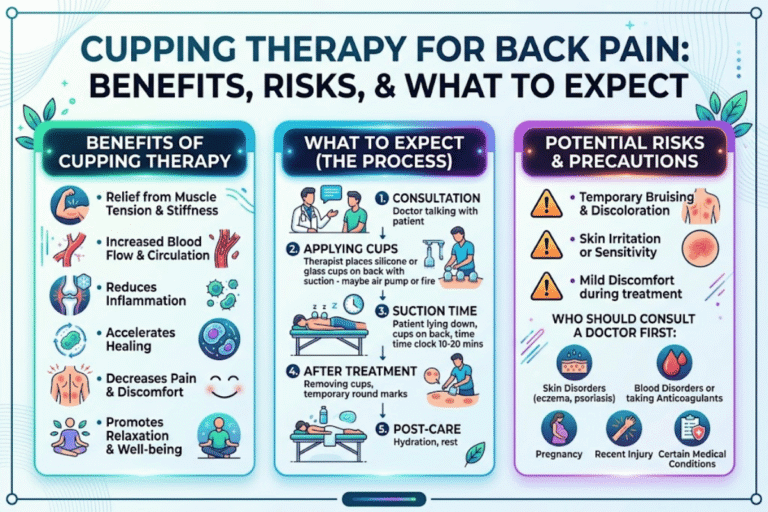
These four patterns are textbook categories in classical Chinese medicine — drawn from the same diagnostic system NCCIH describes in its Traditional Chinese Medicine overview. Pattern differentiation does not replace biomedical diagnosis; it layers on top of it. A patient with an MRI-confirmed L5-S1 disc protrusion still has an MRI-confirmed disc protrusion. But the acupuncture protocol that helps that specific person move again depends on whether their pattern reads as Kidney Yang deficiency (needle retention longer, supportive points emphasized) or as Blood Stasis (stronger stimulation, cupping therapy as an adjunct, possibly moxibustion as a supporting modality).
“The needle follows the pattern, not the protocol.”
The Pattern-Based Session Protocol — our internal framing at Tong Ren Tang — means the intake exam comes before the session count. If a practitioner gives you a fixed number of visits without first reading your tongue, taking your pulse, and mapping the pain to a pattern, that session count is a guess, not a plan.
When to Stop: Signs of Response, Plateau, and Maintenance

The decision to continue, pause, or shift the acupuncture treatment plan happens around session 8 for most back pain courses. Three outcomes branch from that decision point.
Discharge Decision Framework at Session 8
- Full responder (60–100% pain reduction): Taper to biweekly for two visits, then discharge with a return-as-needed plan. Maintenance once a month is common during cold months.
- Partial responder (30–59% pain reduction): Continue weekly for another 4 sessions (total 12). If response plateaus, reassess diagnosis and consider combining with cupping for back pain or Chinese herbal maintenance therapy.
- Non-responder (under 30% pain reduction): The Hong Kong clinical practice guideline explicitly advises re-evaluation “when there is no obvious improvement” by this point. Possible causes: pattern misdiagnosis, structural lesion requiring imaging, or a condition that acupuncture is not the right tool for. Refer back to the referring physician.
Maintenance visits exist because back pain rooted in structural wear or recurring lifestyle triggers rarely resolves permanently, and chronic conditions respond to a treatment schedule that continues beyond the initial course. A 2017 meta-analysis of 20 trials covering 6,376 participants, summarized by NCCIH, found that acupuncture effects persist for at least a year after the treatment course ends. That durability is rare — but “persist” is not “never return.” Monthly maintenance during cold or humid months, or during predictable flare triggers (peak work periods, long flights, renovation months), extends the yield of the initial course.
What not to do: stop after three sessions because you feel 80 percent better. That is when patients most often relapse within weeks, because the underlying pattern has not yet been held in a corrected state long enough for the tissue and nervous system to adapt.
Evidence Check: What Recent Research Shows About Session Count

The evidence supporting acupuncture for back pain is strong enough to be cited as first-line nondrug care by some guideline bodies — and strong enough to be withheld by others. Both positions are defensible, and readers deserve the real picture rather than a marketing version.
| Source | Year | Population | Finding |
|---|---|---|---|
| Vickers et al., Journal of Pain (via NCCIH) | 2018 | 20 trials, 6,376 participants | Effects of a completed course persist at least 1 year |
| American College of Physicians guideline | 2017 | Systematic review | Acupuncture recommended as first-line nondrug for chronic low back pain (moderate quality) |
| NICE NG59 (UK) | 2016 | UK guideline review | Removed acupuncture from the recommendations for low back pain |
| Hong Kong clinical practice guideline (Haiyong) | 2021 | Consensus + systematic review | 3–6 session initial course; re-evaluate if no improvement |
| Advances in Therapy (via Harvard) | 2021 | Low back pain trial data | Benefits documented up to 2 years after treatment |
The tension between the US ACP “recommend” position and the UK NICE “do not recommend” position is not a sign that acupuncture is fake or miraculous — it is a sign that reasonable experts read the same underlying trial data and weight sham-acupuncture comparisons differently. Several randomized trials comparing acupuncture to usual care, sham acupuncture, and simulated acupuncture have shown acute and chronic back pain outcomes improving more with genuine needling, with 12 sessions typical in the treatment protocol tested. For patients, the practical reading is this: the effectiveness of acupuncture for back pain is real but moderate, the durability is unusually long for a nondrug intervention, and the session count that works for you is more individualised than any guideline summary can capture.
Safety Considerations and When to Seek Urgent Care

Acupuncture has a low complication rate when delivered by a licensed practitioner using sterile single-use needles, which the FDA regulates as medical devices. Minor side effects, as Harvard Health documents, include pain, bruising, or light bleeding at the insertion point. Patients with myofascial pain involving trigger-point sensitivity may notice brief local soreness at a higher rate than those receiving acupuncture for referred nerve pain. Skin infections occur rarely. NCCIH cautions that serious adverse effects have been reported only when acupuncture is improperly delivered: infections, punctured organs, or central nervous system injury, all of which trace back to nonsterile needles or untrained delivery.
⚠️ Red Flags: Do Not Rely on Acupuncture Alone
Consider immediate medical assessment, either prior to or simultaneous with each acupuncture plan if back pain is accompanied by:
- Numbness in the groin or saddle area, or loss of bladder or bowels control
- Sudden severe weakness or numbness in one or both legs
- Thunderclap onset (worst pain of your life, within seconds)
- Unexplained weight loss, fever, or history of cancer
- Recent significant trauma (fall from height, motor vehicle collision)
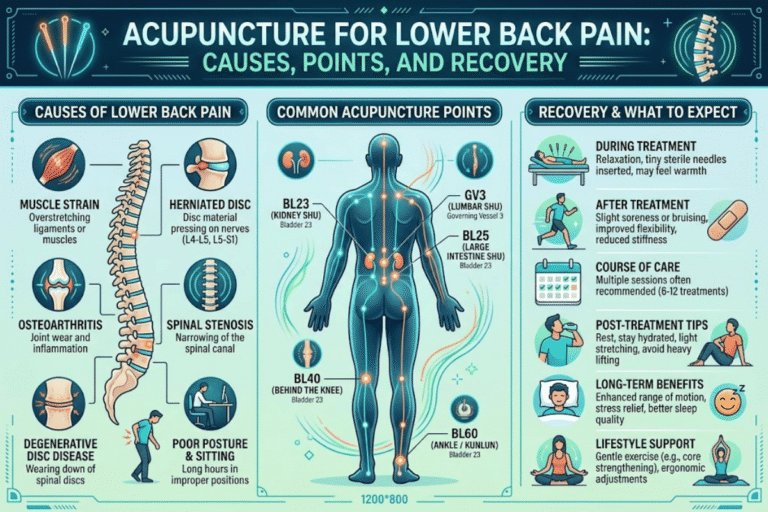
Pregnant patients may need a practitioner familiar with classical forbidden-during-pregnancy points (e.g. SP6, LI4, the BL31-34 sacral points) while patients with bleeding disorders, pacemakers, or electrical implants should highlight those conditions at intake, as electroacupuncture may need modification or omission.
Ready to Build a Session Plan That Fits Your Back Pain?
The session range in this guide is evidence-based, but your actual course depends on diagnostic findings that only an in-person intake can resolve. At Tong Ren Tang Dubai, every back pain consultation begins with a full pattern differentiation before any needle is prescribed.
Book a Back Pain Assessment at Tong Ren Tang Dubai →
Prefer to scope the timeline first? Try our treatment timeline estimator for a protocol-matched projection based on your condition.
Frequently Asked Questions
Q: How long should I wait between acupuncture sessions?
View Answer
In the first two to three weeks of a back pain course, sessions should be three to four days apart (twice a week) so that endorphin and anti-inflammatory effects accumulate rather than reset. After that initial phase, once-weekly spacing is usually sufficient, with biweekly or monthly maintenance afterward.
Q: What are the 4 golden rules of acupuncture?
View Answer
Practitioners frame them slightly differently, but the most widely taught four are: diagnose the pattern before choosing the points; select the fewest points that will do the work; retain needles long enough for the expected effect to take hold (typically 15 to 30 minutes); and adjust the prescription between sessions based on how the patient actually responded, not on the previous session’s notes.
Q: Can acupuncture replace medication or surgery for back pain?
View Answer
For most nonspecific mechanical back pain, acupuncture can function as the primary treatment — the American College of Physicians (2017) listed it as a first-line nondrug option. It does not replace surgery for confirmed structural emergencies (cauda equina syndrome, severe progressive neurological deficit), and it is usually integrated with, rather than substituted for, prescribed medication after discussion with the managing physician.
Q: Does acupuncture hurt?
View Answer
Acupuncture needles are approximately the thickness of a human hair — meaningfully thinner than hypodermic needles used for injections. Patients usually report a brief dull ache, a heaviness, or a spreading warmth at the insertion point (the classical “de qi” sensation), which most experience as tolerable and transient. Sharp pain is uncommon and should be reported to the practitioner so the needle can be adjusted.
Q: Is acupuncture safe during pregnancy for back pain?
View Answer
Pregnant patients can receive acupuncture safely during pregnancy when care is delivered by a practitioner trained to avoid specific forbidden-during-pregnancy points (including SP6, LI4, and the BL31–34 sacral points, which can stimulate uterine activity). Many obstetric practices now refer patients for acupuncture for pregnancy-related lower back and pelvic pain. Always confirm your pregnancy status at intake and share obstetric care details.
Q: What happens if I stop halfway through my acupuncture course?
View Answer
Partial relief often holds for a few weeks before the underlying pattern reasserts itself, particularly for chronic cases. If budget or schedule interrupts a course, the better option is to pause and resume rather than restart from zero — most patterns respond to the same protocol when picked back up within a month or two, though a single re-diagnostic visit is wise after a longer gap.
About This Guide
This guide on how many acupuncture sessions for back pain draws together clinical guideline data from the American College of Physicians (2017), the Hong Kong acupuncture practice taskforce (2021), NICE NG59 (2016), and NCCIH (updated 2022), alongside practice patterns observed by the Tong Ren Tang Dubai clinical team. Tong Ren Tang has operated continuously since 1669 — 350+ years of Chinese medicine practice, including 188 years as the royal physician supplier to the Qing imperial court. Session counts in this guide are reference ranges; your individual plan follows pattern diagnosis at intake.
References & Sources
- Acupuncture: Effectiveness and Safety — National Center for Complementary and Integrative Health (NCCIH), National Institutes of Health
- Acupuncture for Pain Relief: How It Works and What to Expect — Harvard Health Publishing (2025)
- Acupuncture for Low Back Pain: A Clinical Practice Guideline from the Hong Kong Taskforce of Standardized Acupuncture Practice — Haiyong C. et al. (2021), PMC10164622
- What Is the Appropriate Acupuncture Treatment Schedule for Chronic Pain? Review and Analysis of Randomized Controlled Trials — PMC6604345
- Acupuncture Coverage — U.S. Centers for Medicare & Medicaid Services
- Low Back Pain and Sciatica in Over 16s: Assessment and Management (NG59) — National Institute for Health and Care Excellence, UK
- Traditional Chinese Medicine: What You Need to Know — NCCIH, National Institutes of Health
- Acupuncture and Endorphins — Han JS, Neuroscience Letters (2004)
Related Articles
- Back Pain Treatment at Tong Ren Tang — full diagnostic and treatment pathway for back pain
- Cupping Therapy for Back Pain — a common adjunct to acupuncture for Blood Stasis pattern
- Moxibustion as a Supporting Modality — heat-based supplement for Cold-Damp and Kidney Yang deficient patterns
- Chinese Herbal Remedies in Dubai — orally administered support for maintenance phase
- How Does TCM Treat Dampness in the Body? — deep dive into the Cold-Damp pattern relevant to UAE lifestyles